Хочете будувати кар’єру в Data Science та AI? Vodafone Big Data Lab відкриває новий набір —>
Наталя ХандусенкоScience Pop
31 January 2025, 09:22
2025-01-31
12-year-old inventor performs nuclear fusion in his room, after which FBI agents visit him
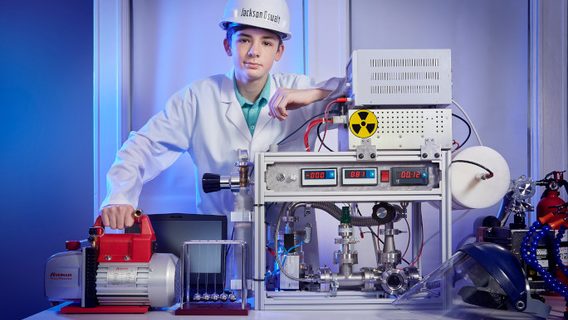
Jackson Oswalt from the US turned to science instead of video games to do something meaningful. Just two hours before his 13th birthday, he became the youngest person to achieve nuclear fusion. But what he definitely didn’t expect was a visit from the FBI.
Jackson Oswalt from the US turned to science instead of video games to do something meaningful. Just two hours before his 13th birthday, he became the youngest person to achieve nuclear fusion. But what he definitely didn’t expect was a visit from the FBI.
«I realized that I could be the best at any video game, but in the end it still wouldn’t mean anything. In the grand scheme of things, video games didn’t play any role. So I changed my path. I immediately switched to the closest thing to video games in real life: science,» the young inventor said.
Nuclear fusion is an incredibly difficult task to do at home. The process involves isolating two or more atomic nuclei and then fusing them together under extreme pressure and heat to form one or more atomic nuclei and neutrons. The end result is the release or absorption of energy, which is why this technology is often associated with a power source.
Inspired by the story of Taylor Wilson, who built a nuclear fusion reactor as a teenager, Jackson wondered if someone so young could accomplish such a task. He began watching physics videos on YouTube and researching the materials he would need to complete his attempt to create an energy source. He was only 11 years old at the time.
Jackson shopped on eBay and found the materials needed for the first step of his plan—a «demonstration fusion reactor» that creates plasma but falls short of fusion. He brought the device to his school science fair, having finished it the night before, and while it impressed (and confused) the audience, Jackson knew he had more work to do to achieve his ultimate vision.
This required rebuilding the vacuum chamber, purchasing a turbomolecular pump on eBay, repairing the melted tantalum internal grid, and finding deuterium for fuel («somewhat legally,» he wrote in a post on X).
But this was far from a working fusion reactor. If I ran this setup for more than a few minutes, the «grid» in the center would melt and destroy itself. Clearly there was work to be done.
I rebuilt the vacuum chamber, got a turbomolecular pump from eBay, sourced some Deuterium… pic.twitter.com/LwpfNqrIRb
After these modifications—and about a year of testing—Jackson successfully achieved fusion. His record was confirmed by the Fusor.net research consortium on February 2, 2018, and confirmed by fusion researcher Richard Hull, who maintains a list of amateur scientists who have achieved fusion at home.
Because Jackson performed fusion at 1:30 p.m., just two hours before his birth at 3:38 p.m., he was technically 12 years old, and therefore also earned a Guinness World Record title for his incredible feat.
When two atoms of deuterium fuse, half the time they produce a Helium-3 atom and a spare neutron. Detecting this neutron is how we prove fusion has occurred.
After a handful of stressful tests just days before my 13th birthday, I successfully achieved fusion and detected these… pic.twitter.com/sEkMT8skFI
But his story proved far from over, as he was awakened one Saturday by two FBI agents who searched his home with a Geiger counter to ensure that no radiation was detected in Jackson’s experiments.
«Fortunately, I remained a free man,» the teenager said.
After Jackson’s exploits were in the news, he began being invited on tours of energy startups across the country, and he even visited a fission power plant to see the technology in action.
Today, Jackson is working on equipment for research labs like Midjourney, as well as other new AI-related robots. And, importantly, nuclear fusion reactors—the technology Jackson worked with in his playroom—are still being seen as a long-term solution to clean energy, like China’s «Artificial Sun,» which was unveiled last week.