Промо на dev.uaMoney
6 September 2025, 10:00
2025-09-06
5 myths about switching to electronic document management that prevent you from saving time and money
Document workflow automation sounds convincing, but most companies stop halfway. Doubts arise: «It’s difficult,» «We work like this anyway,» «It’s all too expensive.» Such explanations seem to make sense, but in practice they are the ones that hinder development.
Document workflow automation sounds convincing, but most companies stop halfway. Doubts arise: «It’s difficult,» «We work like this anyway,» «It’s all too expensive.» Such explanations seem to make sense, but in practice they are the ones that hinder development.
As a result, businesses spend years wasting time and money on routine. Employees agree on contracts by mail, search for files in old folders, rewrite already prepared documents. Strategic tasks are pushed to the background.
In addition, companies make another serious mistake — they perceive electronic document management as a tool for a separate department (for example, accounting) or a narrow group of employees. In this approach, the benefits of digitalization remain limited. After all, documents pass through almost everyone in the company: managers, lawyers, leaders, task performers. If the system is available only to part of the team, the rest continue to work as before — via mail, instant messengers or flash drives. And this is where delays, duplication and risks arise.
Efficiency comes when document management is integrated into the daily work of all employees. A manager can immediately create a draft contract from an email, a lawyer can agree on changes without exchanging dozens of files, a supervisor can sign a document online, and a contractor can see the current version with one click. This creates a shared digital environment where processes move faster, and control and transparency become the norm.
The facts speak for themselves.
Employees waste up to 1.8 hours every day searching for the right documents [1].
83% of office workers are forced to create duplicate files because they cannot find existing ones [2].
Companies lose an average of 3% of revenue to paper processes and another 9% to contract chaos.
And according to Adobe [3], almost half of employees find it difficult to quickly find the document they need.
It’s not just about money. Every mistake in handling paperwork or unsecured files increases the risk of data breaches. In the healthcare industry, there were over 700 incidents affecting 133 million patient records in 2023 [4]. In the US alone, the number of data breaches exceeded 1,800 in one year.
According to the Ponemon Institute [5], the average cost of a data breach to a business was $2.51 million in 2017, and this figure has only increased since then.
It is important to note that document leakage or loss means not only direct financial losses, but also loss of trust of partners and clients. And here you need to understand: if you have not yet switched to electronic document management, it is not just inconvenient. It is dangerous. Competitors who have already implemented modern systems are at least ten years ahead of you.
At the same time, successful companies show a different picture. Barclays Bank reduced the review of credit applications from two weeks to a few days. Kaiser Permanente gave doctors back two hours a day by automating medical records. Marchesini Group saved hundreds of thousands of euros by optimizing business processes.
The experience of users of platforms like Font [6] shows how quickly you can feel the difference. Document approval, which used to take two to three days, is now completed in three to four hours. This is not a cosmetic change, but a different pace of work. Instead of a drawn-out process, the solution is ready the same day.
Yes, at the beginning, owners or employees have doubts. But after a few weeks of work, they disappear. People see that the endless paper cycle is a thing of the past, and instead a simple and secure tool appears. Therefore, the question should sound different. Not «is automation needed», but «how much more time is the company willing to spend on something that could have been done faster and more securely a long time ago.»
So, automation is not a fad, but a measurable efficiency and security. Below, we look at five myths that still prevent businesses from taking this step.
Myth 1. «Switching to a new system will paralyze the company’s work»
It is commonly believed that the implementation of electronic document management stops work: processes will break down, documents will disappear, and employees will be left without tools.
In reality, everything happens differently. The transition takes place in stages. First, the structure and document templates are set up, then the approval routes and integration with other systems are set up. The data is saved, there is no risk of loss.
It’s faster than it seems in terms of time. For small teams, the setup takes a few hours, for larger teams it takes a few days. At the same time, the business continues to operate as usual.
The example of the Font platform shows that fears are exaggerated:
A city utility company responsible for heat supply faced a typical problem: employees worked in different parts of the city, and internal documents took several days to approve. To solve this issue, the company turned to Font.
The setup took a few hours. The manager created an organizational structure, added templates, and invited colleagues to the system. Documents began to be approved online, including through a mobile application. The result was tangible: approvals were reduced from several days to one working day, and each week the team saves about 10 hours of time that previously went to paper routine.
Myth 2. «Electronic document management is too expensive»
It may seem like a new system is an additional expense. However, the biggest losses, on the contrary, occur in paper-based or chaotic document flow: printing, archives, employee time, errors, and the risk of data leakage.
Modern SaaS solutions do not require servers or expensive licenses. Payment is monthly, and the effect is felt immediately. Approval is reduced from several days to hours, risks are reduced. Typically, companies start with a free plan, and then scale to meet their needs.
Companies that have switched to modern document management have seen approvals take hours instead of days, the risk of errors is reduced, and data security is no longer a concern—savings that far outweigh the cost of the subscription.
Myth 3. «It’s dangerous to store data in the cloud»
There is a common belief that if documents are stored in the cloud, they can easily be stolen. But the truth is that the risks are greater in mail or local archives. There, data is copied, duplicated, and easily lost.
In modern systems, security is much higher. For example, in Font, data is encrypted using the AES-256 standard, stored in data centers in Germany, and constantly duplicated on several servers. There is two-factor authentication, and the administrator can block access to a specific user or an entire group at any time.
Real stories confirm this. One entrepreneur had his laptop stolen, but his documents remained untouched because they were not stored locally. Another had his equipment taken away during a search, but access was disabled within minutes, and not a single file fell into the wrong hands.
For the most demanding clients, Shrift has developed and patented in the European Union end-to-end data encryption technology. When activated, even Shrift administrators or the data center where the servers are located will not be able to access the information in decrypted form.
Therefore, we can conclude that the cloud is not a weak point, but a way to protect documents from accidental or intentional loss.
Myth 4. «Employees won’t want to retrain»
Change is scary. People think that a new system is an additional stress and a long learning curve. In fact, modern solutions are designed to be easy to understand without special courses. There are short interactive tours, test environments, reference materials and support that you can contact at any time.
Adaptation usually takes no more than a week. For some teams, it takes three or four days, for larger teams, it takes a little longer, but without stopping work.
And most importantly, resistance quickly passes. Once employees see that a document is approved in hours instead of days, and finding the right files doesn’t take up half their working time, they begin to perceive the new system not as a burden, but as a relief.
Myth 5. «Clients and partners won’t want to work in our system»
There are concerns that external contractors will not want to register in yet another system. However, Shrift takes this into account from the start. You can simply send a link to the document to a partner: he opens it in a browser, signs or comments without any registration.
Such «guest accesses» are safe and convenient. Information is updated instantly, both parties see changes immediately. This saves time and removes the main barrier — the partner’s reluctance to connect to someone else’s system.
Companies that use this approach note the simplicity. For a client or supplier, it looks like a regular document in a browser, only with the ability to sign it online. No archives in the mail, extra copies or lost documents.
Time is no longer on the side of business.
Previously, the transition to electronic document management seemed like a matter of the future. Today it is a matter of survival. According to McKinsey, employees spend a fifth of their working day searching for information. Add to this tons of paper, cartridges and endless email chains, and it becomes clear why companies are losing money without even noticing it.
Digital systems eliminate this shadow part of the costs. A document is approved in hours instead of days. Access to data can be blocked in a minute. And the file you need is in the search faster than you can remember where it was last stored.
What does the business get?
less routine and time loss;
protection and control over information;
a clear picture of processes;
the opportunity to grow without chaos.
This is why Shrift was created. The platform appeared in Ukraine as a response to the business demand for speed, security, and convenience in working with documents. It was conceived as a tool that combines the simplicity of «light» services and the power of solutions that can scale with the company. As a result, Shrift has taken its niche — between minimalist solutions like «Vchazno» and cumbersome EDS systems, which are mostly created for the needs of state institutions and require long-term implementation.
Practice confirms this.
The utility company independently set up the system in a few hours and saves up to 10 working hours each week.
The trading company reduced the contract processing cycle by 60%, which allowed it to close deals much faster.
Employees received a tool where documents, tasks, and communications are combined in one space.
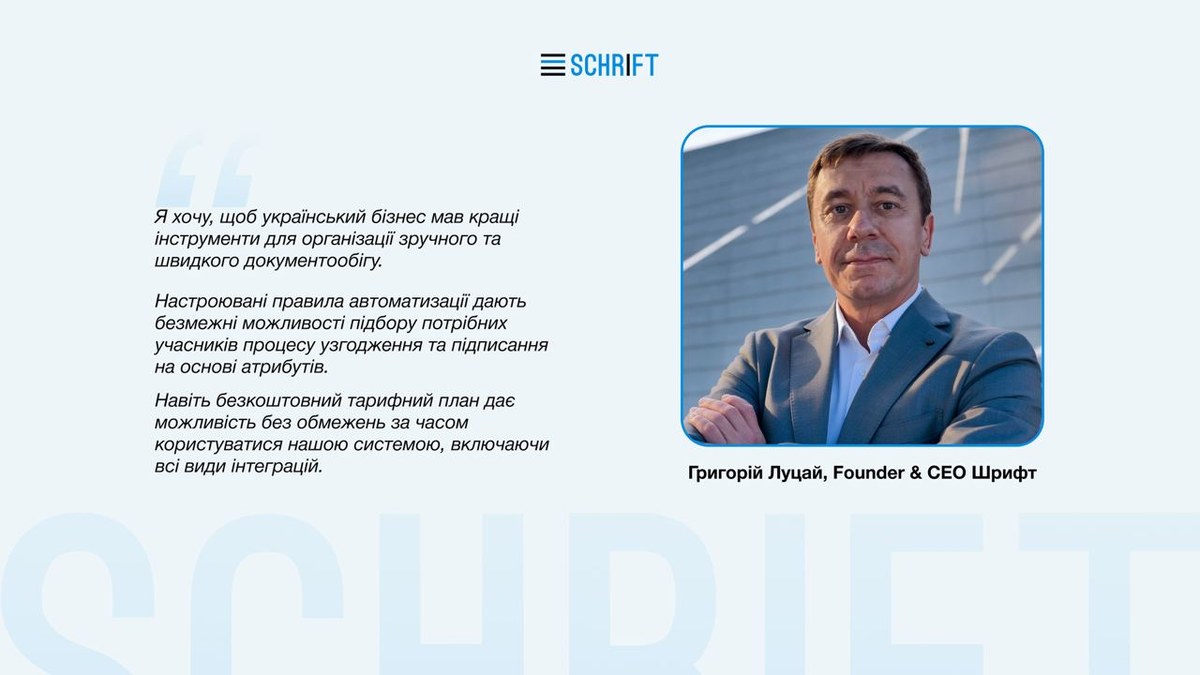
It is also worth mentioning automation rules. They set the route for documents to flow within the company and eliminate unnecessary actions. Automation rules, based on additional document attributes, determine which specialists need to be included in the approval process. You can use the direction of activity, type of document, region of location of the counterparty, amount of the document, and any other attributes. Instead of sending files by mail or reminding each other, the process is automatic: approval by the security manager and lawyer, verification by the accountant, approval by finance, signature of the counterparty and manager.
This helps to avoid delays and disruptions. Employees can see at what stage a document is and who is responsible for the next stage. This saves hours of work, and the system becomes not just a file repository, but a working tool that actually supports the daily pace of business.
Keep in mind that every day without «digitalization» is a loss and expense. Those who switch now win. And Font proves that it can be done without chaos and months of waiting. The system starts quickly, works stably and grows with the business.