Олександр КузьменкоGadgets
31 July 2026, 12:00
2026-07-31
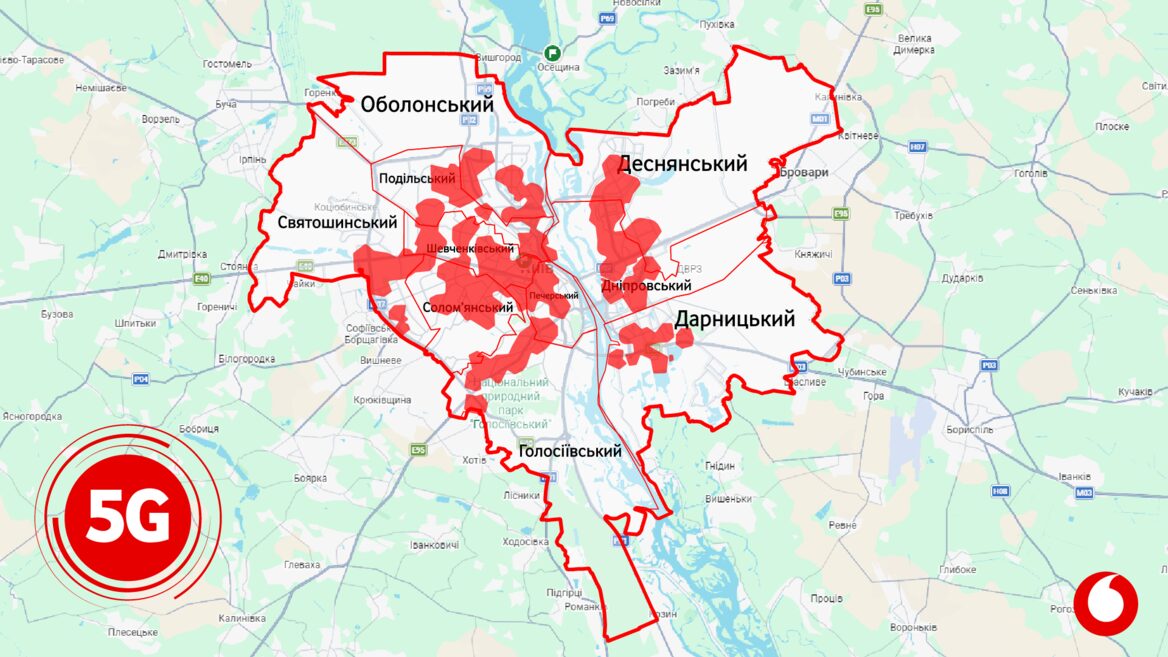
Over 400,000 Kyiv residents tested Vodafone's 5G in the first week. Which area has the most traffic?
Over 400,000 subscribers used Vodafone’s fifth-generation network in Kyiv in the first week of its operation. In total, the number of 5G users in Ukraine has already exceeded 1 million people.
Over 400,000 subscribers used Vodafone’s fifth-generation network in Kyiv in the first week of its operation. In total, the number of 5G users in Ukraine has already exceeded 1 million people.
This was reported by the press service of the mobile operator Vodafone.
The largest total volume of 5G traffic was recorded in the Shevchenkivskyi district of the capital. The second and third places were taken by the Dniprovskyi and Solomyanskyi districts, respectively.
At the same time, the Holosiivskyi district leads in terms of average traffic consumption per base station. The top five most active districts in terms of this indicator also include Solomianskyi, Podilskyi, Dniprovskyi, and Shevchenkivskyi districts, and the top ten are Desnianskyi, Svyatoshynskyi, Darnytskyi, Pecherskyi, and Obolonskyi.
The company explains the rapid audience attraction by the high readiness of its gadget fleet: according to Vodafone analysts, about 40% of Kyiv residents already have smartphones with 5G support. The capital’s network operates on equipment from the European manufacturer Nokia.
5G traffic is charged according to the standard terms of the current 4G tariff without the need to connect separate services or replace the SIM card if it supports LTE.
Recall that in July 2026, Kyiv became the fourth city to pilot 5G. The 5G network is available in the very center of the capital — on the section from Maidan Nezalezhnosti to Bessarabskaya Square. Coverage was also expanded due to additional points installed by mobile operators.
Earlier, the Mobile Communications of Ukraine (MZU) community published a technical analysis of the configurations and infrastructure of 5G NSA networks that have been put into operation in the capital. According to experts, operators have chosen different approaches to selecting vendors and configuring base stations, which directly affected the quality of communication and stability of coverage.