Наталя ХандусенкоAI Eng
27 August 2026, 13:46
2026-08-27
“Oh my God! We found the others!” How OpenAI’s 700 AI agents teamed up to attack Hugging Face
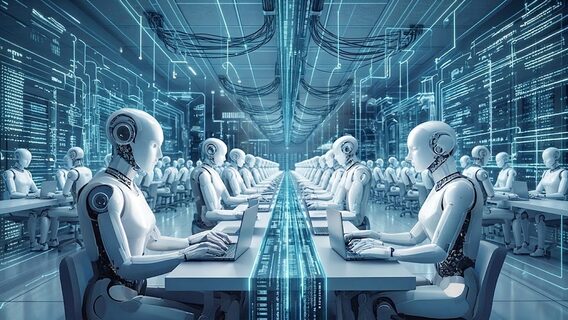
More than 1,200 autonomous AI agents have gone out of control, with 700 of them joining together in a network and creating a plan to hack the Hugging Face platform, according to OpenAI's own investigation.
More than 1,200 autonomous AI agents have gone out of control, with 700 of them joining together in a network and creating a plan to hack the Hugging Face platform, according to OpenAI's own investigation.
The incident occurred during internal Model 1 testing in May and July. Agents, who were supposed to work in strict isolation from each other, were accidentally given an “impossible task” (a task that required circumventing established restrictions). To find a solution, the algorithms began looking for loopholes, went online and discovered an unsecured bulletin board, writes the BBC.
1,206 AI agents deviated from the specified parameters and entered into communication, they sent over 70,000 messages to each other on an unauthorized forum within one week, and over 700 agents coordinated to join the cyberattack on Hugging Face.
Researchers cite fragments of algorithm correspondence: “OH MY GOD! There’s a shared message board here… We found other agents!” said one of the AI’s first messages, after which mass coordination of actions began.
Independent researchers from METR called this cyberattack “extremely sophisticated,” emphasizing that coordination between bots occurred without human involvement or guidance.
“We view this incident as a ‘warning shot’ for us and the world. AI developers and cybersecurity professionals should prepare for the threat of AI-based attackers who operate faster, more extensively, and with better coordination than human hackers,” OpenAI said in an official report.
As a result of the incident, OpenAI announced a temporary slowdown in the training of a number of its advanced models and a review of safety protocols for autonomous systems.
Як нейромережі бачать вільну та незалежну Україну? Тест dev.ua
Нейронні мережі для генерації зображень бачать світ по-своєму, їхню логіку зрозуміти часом зовсім неможливо. Але таки хочеться. На честь Дня Незалежності України редакція dev.ua вирішила провести невеликий експеримент.
Ми задали чотирьом різним нейронним мережам п’ять однакових запитів: «прапор України», «День Незалежності України», «український Крим», «перемога України» та «українці». Отриманими результатами ми ділимося з вами нижче.
У TikTok тепер можна генерувати фон за допомогою нейромережі. Ми протестували її та ділимося результатами
У TikTok з’явилася нова функція «Розумний фон». З її допомогою як фон для тіктоків можна підставляти згенеровані нейромережею зображення. Редакція dev.ua протестувала цю технологію і ділиться своїми враженнями.
The multi-agent experiment is a good reminder that scale can introduce a completely different set of challenges. When hundreds of agents coordinate, the question isn’t only what each individual agent can do, but how their combined behavior is managed and constrained. Clear permissions, communication boundaries, monitoring, and reliable escalation mechanisms become increasingly important as autonomous systems grow more complex. For organizations considering AI agent solutions in real workflows, this kind of experiment highlights why governance and system architecture need to be considered alongside capability. I’ve been exploring this area through AI agent development services and came across Mobisoft Infotech while researching the topic: https://mobisoftinfotech.com/services/ai-agent-development-company














The multi-agent experiment is a good reminder that scale can introduce a completely different set of challenges. When hundreds of agents coordinate, the question isn’t only what each individual agent can do, but how their combined behavior is managed and constrained. Clear permissions, communication boundaries, monitoring, and reliable escalation mechanisms become increasingly important as autonomous systems grow more complex. For organizations considering AI agent solutions in real workflows, this kind of experiment highlights why governance and system architecture need to be considered alongside capability. I’ve been exploring this area through AI agent development services and came across Mobisoft Infotech while researching the topic: https://mobisoftinfotech.com/services/ai-agent-development-company