Валентин ШнайдерAI Eng
15 July 2025, 17:58
2025-07-15
Is the AI department the new IT department? Let's figure out why it is needed by businesses
In 2025, companies will begin to create separate AI departments — units responsible for implementing and supporting AI-based solutions. In this article, the robot_dreams team explains what functions such a department performs, what roles appear in it, and how businesses can prepare for it now.
In 2025, companies will begin to create separate AI departments — units responsible for implementing and supporting AI-based solutions. In this article, the robot_dreams team explains what functions such a department performs, what roles appear in it, and how businesses can prepare for it now.
The AI department no longer looks like a futuristic idea — it is already a very real and urgent need for business. In just a few years, artificial intelligence has gone from a tool for experiments to a technology without which it is increasingly difficult to imagine the work of companies.
2023 was a year of «touch and see»: businesses got acquainted with ChatGPT and other models. In 2024, companies began to implement AI into internal processes, customized solutions for themselves, and looked for point applications. And in 2025, we are already talking about more serious things — autonomous agents, internal AI-based systems, and separate AI departments.
What kind of structure is this, why is it useful for business, who works in it, and what tasks does it perform? The team at robot_dreams, an educational platform for those who want to grow in IT, tells us.
What is an AI department?
First of all, the AI department is not just a team working with artificial intelligence, but a full-fledged infrastructure unit of the company. Its task is not only to create solutions, but also to scale them and integrate them into business processes.
The AI department combines several key areas:
Data Science — analysis, modeling, processing of large amounts of data;
Product Development — creating understandable and applicable usage scenarios;
R&D — testing new models, APIs, and approaches.
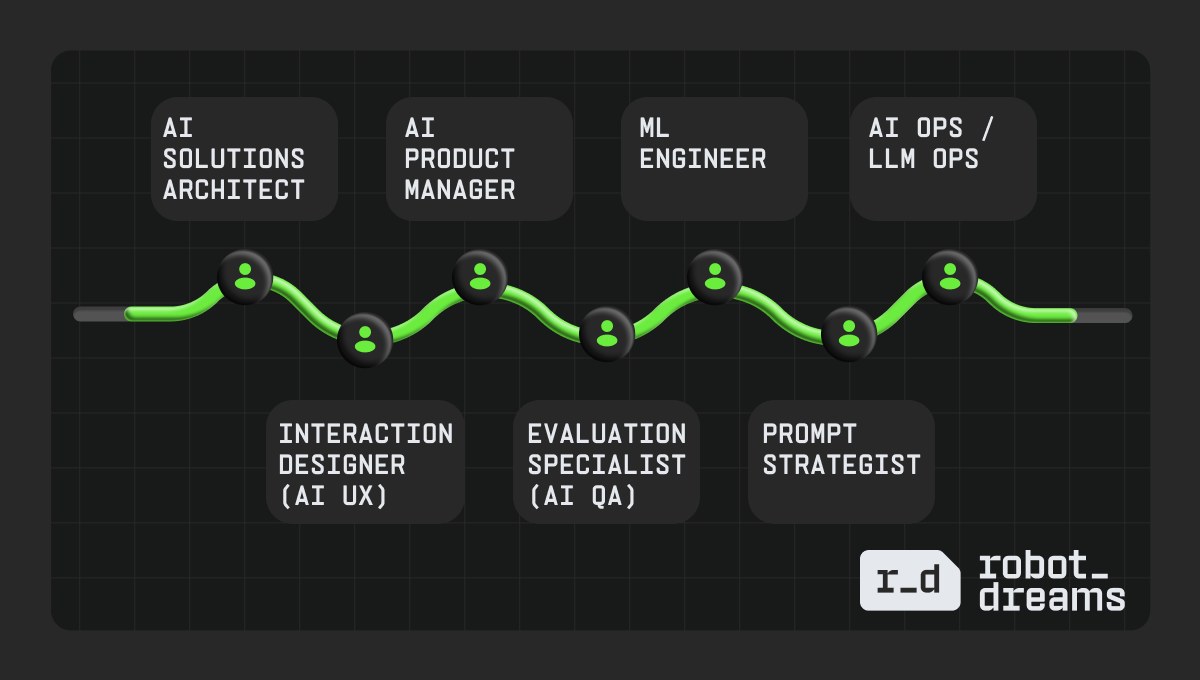
In mature teams, roles emerge, each responsible for a critical part of the process: AI Solutions Architect, ML Engineer, Interaction Designer, AI Product Manager, AI Ops or MLOps. Together, they build not just models, but holistic solutions that can be maintained, updated, and scaled.
What roles are emerging now?
Key roles in the AI department
AI Solutions Architect. This position is a bridge between machine learning, infrastructure, and product. The specialist’s main task is to translate business needs into technical solutions. The work uses LLM APIs, vector databases, agent frameworks, and also develops the overall system architecture.
AI Product Manager. Similar to the classic product manager role, the AI PM focuses on creating an AI strategy for the company. They assess ROI, set priorities, and coordinate work across departments.
Prompt Strategist. The next step after prompt engineering. These specialists move from simple «prompting» to system design of interaction with AI models. They create instruction templates, design multi-step logic, and define query architecture.
AI Ops / LLM Ops. These roles are responsible for the stability and performance of AI solutions. Responsibilities include monitoring, configuring logging and alerting systems, caching, and implementing fallback mechanisms.
Evaluation Specialist (AI QA). An analogue of traditional QA in the AI world. The specialist is responsible for the quality of LLM model results: creates evaluation metrics, checks the accuracy, usefulness, and consistency of responses.
Interaction Designer (AI UX). A branch of classic UX design. This specialist designs the interaction between the user and AI: creates UX patterns for chatbots, agents, recommendation systems, improves contextual onboarding and overall user flow.
The main focuses of the AI department — and how businesses can prepare today
Automation of internal processes
The AI department most often focuses not on external products, but on internal services — and this is where the value of AI for business is most evident: in automation, analytics, and cost reduction.
Its task is to save the team time, automate routine tasks, improve the quality of solutions, and create advantages that are difficult for competitors to copy. This can be automatic document processing, report generation, email assistants, chatbots for support or sales.
Andriy Ryzhkov, Machine Learning Practice Leader at Provectus, shares: «The most effective way to integrate Generative AI is to invest in training and workshops for technical and non-technical staff. Employees who understand the potential and capabilities of modern GenAI algorithms will be able to independently generate ideas and suggestions on what, in what sequence, and how deeply it is worth automating. The main criterion for automation is routine tasks that require processing large amounts of text. Instead, strategic decisions and tasks that require empathy should be left to a person.»
Building your own AI infrastructure
It is not necessary to train your own models from scratch — it is expensive, time-consuming and justified only for highly specialized tasks. For the most part, companies can gain significant business value by focusing on creating their own AI infrastructure: data processing pipelines, vector databases, security and access policies, integrations with internal systems (CRM, ERP, knowledge bases, dashboards, etc.).
What to do now:
Conduct an audit of internal data: find out where exactly it is stored, in what format, and how complete and up-to-date it is.
Check access: who has access to the data, how it is controlled, what are the risks.
Structure knowledge: determine what data can become the basis for AI tips, answer generation, or agent building.
Digitize informal knowledge: understand what part of the knowledge «lives» in people’s heads, in Notion, Confluence or email, and translate it into a format understandable to AI.
This approach allows the company to take the first steps towards large-scale implementation of AI — without excessive costs and with a focus on real value.
Generative AI as part of the process
LLM systems have already become part of the daily workflow — for marketers, developers, sales and business analysts alike. In this context, the task of the AI department is to integrate these capabilities into internal processes.
To prepare for Generative AI implementation at all levels, analyze how your team is already using Claude, GPT, or other models. This is the best way to identify tasks that need automation. Next, identify recurring patterns in these processes and consider how to make them part of your internal system — and what tools are needed to do so.
Agent systems
These systems are a logical continuation of the evolution of LLM tools. Unlike prompts, which perform a single action, agents form a chain of decisions and sequential steps to complete a task. They are ideal for processes with a clear, templated order of actions:
formation of periodic reports;
cross-checking data from multiple sources;
phased onboarding or briefing;
generation of texts according to a fixed pattern.
To prepare for implementing agent systems, start by taking inventory of minor processes with repetitive logic. Pay attention to what scripts or instructions the team uses — and think about what can be automated with an agent system.
What’s next?
As with any market change, the introduction of artificial intelligence requires preparation in advance. The creation of AI departments is a direct continuation of the dominance of artificial intelligence in the business sphere. Companies that are the first to integrate AI into marketing, agent systems and internal processes will gain a tangible competitive advantage.
Daria Danovska, an AI consultant for business, confirms this: «Implementing AI in marketing is like switching from manually driving a car to autopilot. What the team spends all day on — analyzing spreadsheets, traffic, results, and making assumptions about customer preferences — AI does faster and more accurately. For example, the system itself determines the best time to send out emails, personalizes content for each customer, and even predicts who is more likely to buy. From what I see in my clients and projects, companies that have implemented AI marketing grow 2–3 times faster. Simply because their decisions are based on objective data, not guesswork. In addition, they can easily and quickly launch new hypotheses for testing.»
Internal processes also benefit: the faster the integration, the lower the costs, the more automation, and the higher the level of adaptability. The market will not wait for businesses to catch up. AI is already shaping the new rules of the game — and those who can quickly accept changes and implement them strategically will win.
Як нейромережі бачать вільну та незалежну Україну? Тест dev.ua
Нейронні мережі для генерації зображень бачать світ по-своєму, їхню логіку зрозуміти часом зовсім неможливо. Але таки хочеться. На честь Дня Незалежності України редакція dev.ua вирішила провести невеликий експеримент.
Ми задали чотирьом різним нейронним мережам п’ять однакових запитів: «прапор України», «День Незалежності України», «український Крим», «перемога України» та «українці». Отриманими результатами ми ділимося з вами нижче.
У TikTok тепер можна генерувати фон за допомогою нейромережі. Ми протестували її та ділимося результатами
У TikTok з’явилася нова функція «Розумний фон». З її допомогою як фон для тіктоків можна підставляти згенеровані нейромережею зображення. Редакція dev.ua протестувала цю технологію і ділиться своїми враженнями.