Хочете будувати кар’єру в Data Science та AI? Vodafone Big Data Lab відкриває новий набір —>
Ігор Вишневський Weapon
2 March 2026, 13:10
2026-03-02
“Your AI eyes that grab drones by the tail before they become a problem.” IT-worker developed the I-SEE drone detection system
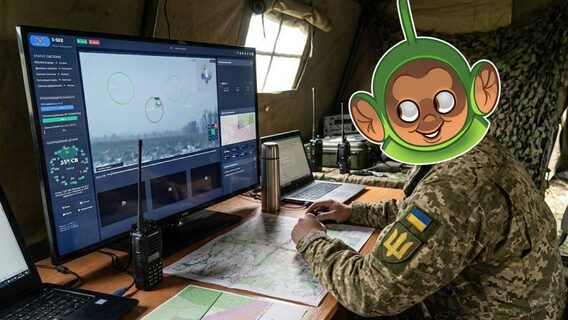
A Ukrainian IT professional developed I-SEE software for detecting enemy drones, namely an AI system for early detection, classification, and tracking of UAVs in real time.
A Ukrainian IT professional developed I-SEE software for detecting enemy drones, namely an AI system for early detection, classification, and tracking of UAVs in real time.
As the developer claims, I-SEE detects threats 360° with an accuracy of over 95%, scales to any object, and is significantly cheaper than its counterparts.
«Not a 'box with antennas', but your AI eyes that grab drones by the tail before they become a problem,» the IT expert describes his product on the TG channel, where he talks about developing and updating the system and adding new features.
How the system works and what are its advantages
The developer of the I-SEE system emphasizes that EW is not a universal solution due to fiber-optic FPV and drones with repeaters, which operate without a radio signal and become noticeable only in the final attack area. Radar systems, on the other hand, are expensive and difficult to deploy.
«Many alternative solutions suffer from a high number of false positives. Reaction to birds, glare, and random objects overloads operators, reduces trust in the system, and increases the risk of missing a real threat,» the product presentation provided to dev.ua reads.
Meanwhile, the I-SEE system uses advanced computer vision and artificial intelligence to accurately detect and track drones in real time.
As noted in the presentation, AI minimizes the human factor, as it sees the «dot» before the eye; stably tracks up to 100 targets (depending on the power of the PC); detects the prioritization of the strike threat; automatically transmits alarms to Telegram or Discord with a photo and coordinates; gives tips for interception, rather than simply turning on the alarm; has an available mobile application (MVP) and a separate command center program «so that even units without I-SEE installed can see the situation and receive warnings in advance.»
In addition, the advantages of I-SEE in real combat conditions, according to the system developers, are that it does not lose the drone during short disappearances, records a minimum of false alarms, and provides time for unit maneuver or automatic targeting and destruction when integrated with a net gun or turret.
At the same time, I-SEE is not tied to a specific camera or physical location — the system can work with any video stream transmitted over the network using standard USB, RTSP, RTMP, HTTP and other connection protocols.
I-SEE operates as an edge system, completely offline, and video streams are processed locally at a frequency of 30–60 FPS, ensuring fast AI frame processing and prompt system response.
The system uses adaptive image processing to operate in fog, twilight, and bright sunlight. The data it collects is stored locally for further analysis and training of soldiers.
It is also important that I-SEE supports data exchange between multiple installations (P2P), and each system shares information about detected threats with others, forming swarm situational awareness without transmitting the coordinates of the cameras themselves.
Meanwhile, its operating range depends on the optics, zoom, and observation conditions — the quality of the camera video, the camera’s viewing angle and placement, computing resources (GPU), and the settings of thresholds and filters.
As for the relevance of AI models, as the developer notes, the models must correspond to real drone types and scenarios, and regular retraining on combat data directly increases accuracy and reduces errors. More details about the development can be found on the I-SEE website .
What are the prospects for scaling the product: the developer answers
The developer of the I-SEE system, named Viktor, agreed to answer several questions from dev.ua regarding the prospects of his product and its current application.
According to Viktor, the system is already being tested by combat brigades. «Everyone is taking on their own tasks,» the IT expert noted, avoiding additional details.
Victor developed the system himself at the request of friends who are in the Defense Forces.
Assessing the prospects and ways of further scaling, the IT specialist notes that this is a difficult question, because marketing is needed here. «But in general, I am making a core, brains that will be able to forge all tasks. That is, you need to look — it will look, you need to shoot down — it will shoot down (there are already sitcoms, we make turrets and lasers). We will need drone auto-guidance — we will also do it. So that there is one tool for wide use with a simple and understandable interface,» Viktor described his development in a comment to dev.ua.
The developer has not yet been able to say how much his product will cost the end user, that is, the Ukrainian military, but he assured that its cost will be more than affordable. «I can’t say right now, but if you compare it with foreign analogues, it will be pennies, really pennies. „Chuyka“ costs more than what I have in mind,» he assured.
As for the funds spent on developing the system, Victor estimated them at over 2.5 million UAH per year, during which the product was developed.
«A year has passed, and the total amount exceeded 2.5 million UAH (but it wasn’t just my money, because people helped),» says the IT worker.
He generally refused to talk about the product’s weaknesses and shortcomings, so as not to share this information with the enemy.
CEO Brave1 on priority developments for this year: «It is necessary that it is not profitable for the Russians to scale the number of „shaheeds“. They must understand that there is no point in wasting money and time»
Ukrainian developer invested over $100,000 in MilTech applications that the Armed Forces of Ukraine have been using for 10 years. How TacticMap and MyGun, which entered the TOP-3 of the AppStore, work
Як нейромережі бачать вільну та незалежну Україну? Тест dev.ua
Нейронні мережі для генерації зображень бачать світ по-своєму, їхню логіку зрозуміти часом зовсім неможливо. Але таки хочеться. На честь Дня Незалежності України редакція dev.ua вирішила провести невеликий експеримент.
Ми задали чотирьом різним нейронним мережам п’ять однакових запитів: «прапор України», «День Незалежності України», «український Крим», «перемога України» та «українці». Отриманими результатами ми ділимося з вами нижче.
У TikTok тепер можна генерувати фон за допомогою нейромережі. Ми протестували її та ділимося результатами
У TikTok з’явилася нова функція «Розумний фон». З її допомогою як фон для тіктоків можна підставляти згенеровані нейромережею зображення. Редакція dev.ua протестувала цю технологію і ділиться своїми враженнями.