Валентин ШнайдерAround IT
20 October 2025, 15:05
2025-10-20
American engineers have printed concrete that absorbs CO2 and reduces material costs by up to 60%
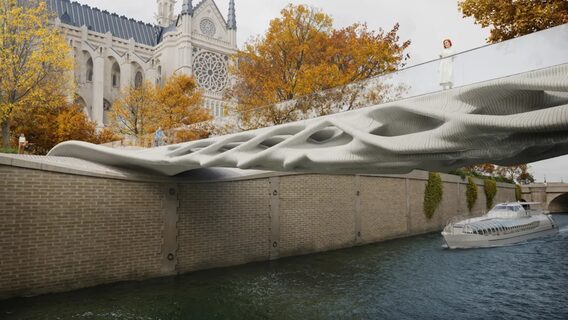
The Diamanti project from the University of Pennsylvania combines bionic geometry and modified cement mix: 3D-printed modules work as carbon dioxide «traps» while reducing the mass of structures and the need for material.
The Diamanti project from the University of Pennsylvania combines bionic geometry and modified cement mix: 3D-printed modules work as carbon dioxide «traps» while reducing the mass of structures and the need for material.
As TechSpot reports, the development is being led by the Polyhedral Structures Laboratory under the leadership of Professor Masoud Akbarzadeh. The team of engineers and materials scientists replaced part of the cement with diatomaceous earth, a silicon-containing additive from fossil algae, which increases porosity and allows CO2 to penetrate deeper and chemically bind with calcium compounds. In laboratory tests, the modified concrete absorbed more than 140% more CO2 than a regular sample under the same conditions, and the geometry based on triperiodic minimal surfaces evenly distributes the load, allowing you to save up to 60% of the material without losing strength.
The key to efficiency is robotic 3D printing, which forms curved hollow blocks without formwork. Each element has an increased air contact area and internal channels that accelerate carbonization. Calculations are performed using the polyhedral graph statics method to control the compression and tension paths in the body of the structure and reduce the need for traditional reinforcement.
The practicality of the approach is confirmed by a 2.5-meter bridge assembled from nine printed sections and shown at the Time, Space, Existence exhibition in Venice: the modules are connected by eight steel cables without glues or mortar, so the system can be disassembled and reused. Further tests at CERIB in France covered five- and ten-meter prototypes (the 10-meter one was printed in Carsey3D with Sika compounds) and confirmed the calculated figures. The next step is planned to be the first full-scale bridge in France, as well as the transfer of Diamanti principles to floor slabs and facade panels; the main limitation remains the availability of diatomaceous earth, so the team is currently looking for alternative additives with similar chemistry and porosity.
Concrete and cement account for approximately 8% of global CO2 emissions due to the calcination of limestone at temperatures up to ~2000°C and process emissions. Even partial replacement of massive elements with lighter 3D modules with more active carbonization can significantly reduce the «carbon footprint» of infrastructure: from bridges to building envelopes.
Previously, dev.ua wrote about how Ukrainian startup DrukDim aims to revolutionize the construction industry: its 3D printer for houses can build housing in just a few days. Co-founder and CEO of the company Bohdan Mezhynov told how the idea of printing houses came about, what difficulties the team faced along the way, and what they plan to do next.