Хочете будувати кар’єру в Data Science та AI? Vodafone Big Data Lab відкриває новий набір —>
Наталя ХандусенкоRobots
16 December 2025, 11:16
2025-12-16
Americans have created the smallest robots in the world, the size of a bacterium: what they can do
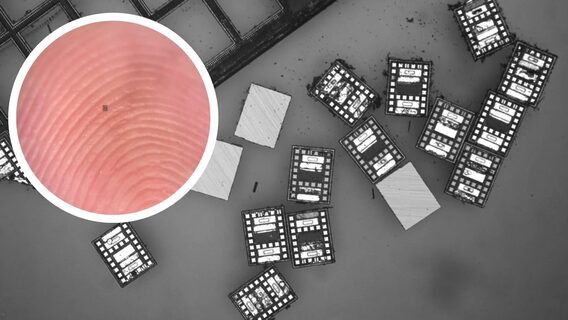
Researchers from the University of Pennsylvania have unveiled the world's smallest programmable autonomous robots, with their "brains" created by scientists from the University of Michigan. Each robot measures about 0.2×0.3×0.05 mm, making them nearly invisible to the naked eye. In fact, they are about the size of bacteria and other single-celled creatures.
Researchers from the University of Pennsylvania have unveiled the world's smallest programmable autonomous robots, with their "brains" created by scientists from the University of Michigan. Each robot measures about 0.2×0.3×0.05 mm, making them nearly invisible to the naked eye. In fact, they are about the size of bacteria and other single-celled creatures.
Despite their size, the robots are able to move along complex trajectories, respond to temperature changes, and even coordinate their movements in groups. What makes them particularly impressive is their low cost and durability, writes Interesting Engineering.
Robot microbes
For years, electronics have been steadily shrinking, but robotics has lagged behind. Autonomous movement at the micro level has proven particularly challenging, largely because water behaves very differently at the tiny scale.
“We were able to shrink autonomous robots by a factor of 10,000,” said Mark Miskin, senior author of the study from the University of Pennsylvania. “This opens up fundamentally new horizons and scope for programmable robotics.”
At the micro level, moving through water is like moving through thick syrup. Instead of using propellers or mechanical linkages, the developers have taken a more sophisticated approach: setting the environment itself in motion. The robots don't interact with the water mechanically, but generate an electric field that stimulates the movement of ions in the liquid.
These ions, in turn, push water molecules past each other, creating a thrust that propels the robot forward. This propulsion system has no moving parts, allowing the robots to swim for months and be transported using a standard micropipette. They are also able to move in coordinated groups, resembling schools of fish.
A brain that works in light
The robots' intelligence is powered by ultra-miniature computers developed at the University of Michigan. These tiny processors operate on just 75 nanowatts of power, about 100,000 times less than the power consumed by a smartwatch.
"We saw that the Penn Engineering propulsion system and our microcomputers were simply made for each other," said David Blau, senior author of the study.
To make this possible, the team had to radically rethink how programs are written and executed at the micro level.
“We had to completely rethink the command set of the computer program, compressing what would normally require many instructions to control movement into a single, dedicated command,” Blau noted.
Most of the surface of each robot is covered with solar cells that collect light for power and also serve as optical receivers.
Light pulses are used both to power the robots and to program them, with each robot having a unique identifier that allows it to receive individual instructions.
The current generation of robots is equipped with temperature sensors capable of detecting a difference of even a third of a degree Celsius.
"This is really just the first chapter," Miskin said. "We've proven that you can put a brain, a sensor and a motor into something so small that it's almost impossible to see, and still have it running and functioning for months."