Хочете будувати кар’єру в Data Science та AI? Vodafone Big Data Lab відкриває новий набір —>
Ігор Вишневський Weapon
21 January 2026, 09:00
2026-01-21
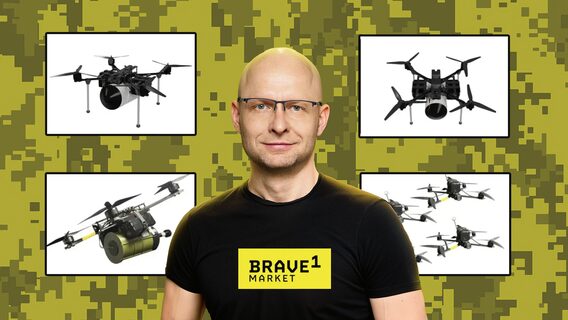
"We've made a huge leap. But there's still room to jump." A great interview with Brave1 CEO — about laser weapons, interceptor drones, a missile program and more
At the beginning of last summer, the Brave1 defense innovation cluster was headed by Andriy Hrytsenyuk, a top manager with over 20 years of experience in IT, mainly in the banking sector. Since 2023, he has already worked in the Ministry of Digital Affairs team, where he participated in the development and launch of a number of key digital products.
In an interview with dev.ua, Andriy Hrytsenyuk spoke about his attitude to personnel rotations at the Ministry of Digital and Defense, about plans for laser weapons and their implementation; about programs for interceptor drones and missile production; about how often Brave1-funded miltech startups never reach the release of the promised product and why they have to be sued, and also about the mysterious but high-profile plans of the cluster for 2026.
At the beginning of last summer, the Brave1 defense innovation cluster was headed by Andriy Hrytsenyuk, a top manager with over 20 years of experience in IT, mainly in the banking sector. Since 2023, he has already worked in the Ministry of Digital Affairs team, where he participated in the development and launch of a number of key digital products.
In an interview with dev.ua, Andriy Hrytsenyuk spoke about his attitude to personnel rotations at the Ministry of Digital and Defense, about plans for laser weapons and their implementation; about programs for interceptor drones and missile production; about how often Brave1-funded miltech startups never reach the release of the promised product and why they have to be sued, and also about the mysterious but high-profile plans of the cluster for 2026.
Content
How scientists are helping Brave1 CEO deal with military technology
— You’ve been in office for more than six months. How difficult was it to integrate into the domain, considering that you had no direct involvement with the topic of weapons?
— Since 2022, I have regretted many times that I did not have combat experience or appropriate military education. Now I have to quickly close these gaps.
But it’s worth saying that since I worked at the Ministry of Digital Affairs, I’ve been involved in many military projects. Therefore, Brave1 wasn’t exactly a «clean slate» for me.
In general, it all depends on the leadership and management model. There are different approaches to managing the area you are responsible for. My approach to working at Brave1 has always been that you can’t just manage without being a subject matter expert. You always need to have some core expertise!
In order to understand how some military things work, I am constantly forced to learn. Sometimes I ask scientists or military people to give mini-lectures for a few hours in order to immerse me in the topic and give me a kind of essential on specific issues.
For example, I asked scientists and experts to explain how lasers work. It took me about a week to understand the nuances of laser technology, thermal imaging, and air defense. Fortunately, there are many people in Ukraine with an academic, very deep understanding of the nature of these things.
— Since you yourself mentioned lasers, I have to ask about the development of laser weapons in Ukraine. For example, how realistic is it to use laser weapons against «shaheeds»?
— Lasers and their applications are a broad concept. Let’s start with things where there is already good progress. For example, lasers are very often used to illuminate targets.
There are foreign Copperhead shells. And there is an airplane, helicopter or UAV with a corresponding laser that can shine on the target. Thus, this high-precision shell is guided to the illuminated target. A UAV can also make a very precise hit on a target illuminated by a laser, and for this it does not need to have GPS or use computer vision algorithms. That is, it is promising.
Ukraine did not have its own laser designators at the beginning of the war — they used exclusively partner ones. Now they have appeared, Ukrainian developments have started working. Brave1 has been financing this since the beginning of its creation. In 2024, we also provided grants to companies so that they could create Ukrainian solutions.
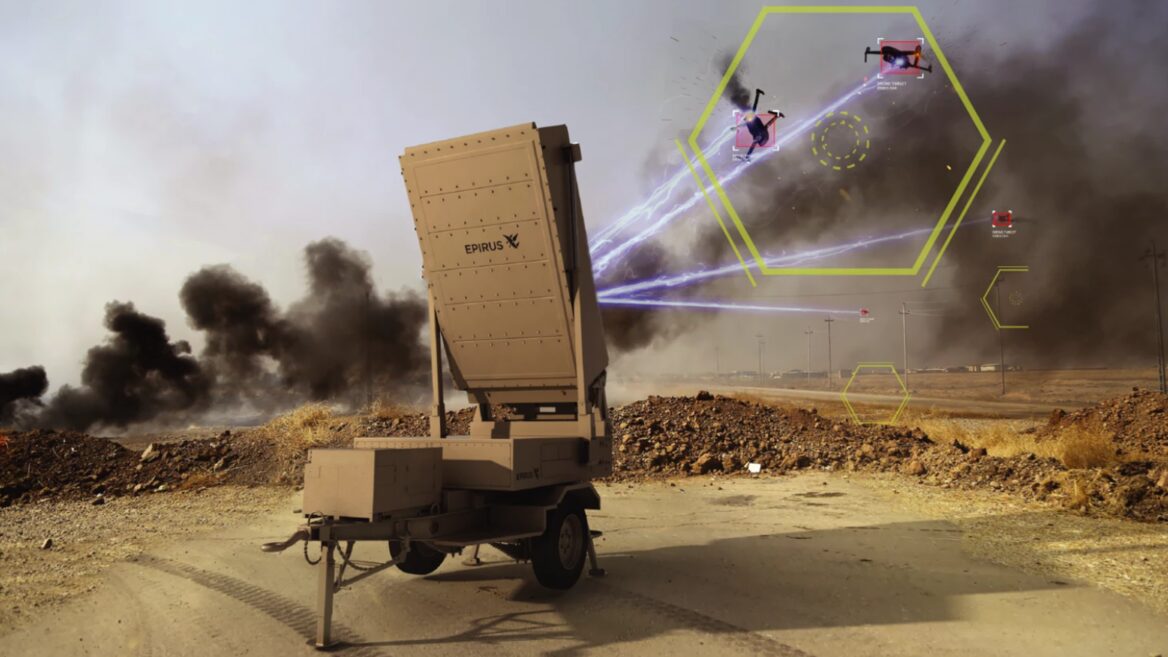
The second direction is combat lasers. They also come in different types: fiber optic, solid-state, CO2 lasers, diode, etc. I am sure that this year combat lasers will actually be used against small enemy UAVs and at short distances.
If we talk specifically about the «Shaheeds», I believe that this year the progress and readiness of developments will not yet reach a state where they can be shot down with the help of lasers.
There are longer distances, and the longer the distance, the more power is needed. But many countries are experimenting with this. We are also doing this, we have several projects.
On Fedorov’s new appointment: «Everyone will benefit from this»
— Last week, Mikhail Fedorov became the Minister of Defense. Will these major personnel changes change anything in the work of Brave1? After all, one way or another, Fedorov is considered the architect of this system.
— It was Mykhailo who proposed the idea of creating the «Army of Drones» — the prototype of Brave1, and what it grew from. But as for the work of Brave1, I don’t think there will be any changes for us in this regard.
Brave1 was founded on the initiative of the Ministry of Digital Affairs and Mykhailo Fedorov, but it was founded by eight institutions, including the Ministry of Defense, the General Staff, the National Security and Defense Council, and the Ministry of Economy. We have a supervisory board that includes both state representatives and independent members. Therefore, we will continue to closely cooperate with both the Ministry of Defense and the Ministry of Digital Affairs, but institutionally we do not expect any changes.
Andriy Hrytsenyuk and Mykhailo Fedorov, photo from Facebook Brave1
Mykhailo implemented serious and rapid reforms in all areas for which he was responsible. And I think everyone will agree with me that the Ministry of Defense is an institution that clearly needs to be reformed significantly, improve its work, and increase its efficiency.
I am sure that after Mykhailo’s appointment there will be significant progress in the work of the Ministry of Defense. Everyone will benefit from this — both the military and civilians, and Brave 1 as well. Therefore, I look forward and expect serious positive changes.
— You are looking ahead, but do you have no intention of changing your current position? As a result of these rotations, were you offered, conditionally, to move to the Ministry of Digital Affairs to a higher position or to go to the Ministry of Defense together with Fedorov?
— I have a lot of work to do here. It is important for me to continue what we are already doing with the Brave1 team. I think I am in my place now. So I am not considering moving anywhere.
— In a previous interview, you said that conventional FPV drones are a mature product that no longer requires grant support. Can you name three technologies that absolutely need grant support and are currently hyper-relevant?
— I can name more. What did I mean when I said this about FPV drones? If we see a certain industry in which we need to make a breakthrough, because this industry is «empty,» then we start to focus the entire defense industry and individual companies on the need to create products in this direction. But then, when enough projects are being developed and there are ready-made products, we see that this segment can continue to live without active focus on our part. So we remove this direction from the priority funding of Brave1 — the market will adjust itself. Then we simply support it and help companies to work fully and solve their problems faster.
If we talk about the areas from which we made such a step-out, we removed FPV drones, logistical NRCs, and kamikaze BEKs from the highest priorities.
There are many such examples. Even among the areas that we identified as priorities last summer, we are already doing a new revision, and, again, we are removing some things.
The most relevant developments, in turn, correspond to the activities that we are conducting. We recently held four major competitions. The first is anti-aircraft missiles, the second is tactical ballistics, an alternative to Himars. The third is artificial intelligence in five categories that we have identified as the most relevant as of now. And the fourth direction, a major competition in which we are currently conducting, is explosives. The fifth direction, which we announced in December, is independent production of components in Ukraine.
— Regarding explosives, manufacturers have constantly complained in previous years about the overregulation of this area. Are there any improvements in this regard?
— Deregulation is a very important area of work for Brave1 and the Ministry of Digital Affairs, together with the Ministry of Defense and other institutions. In order for effective products to appear and for this to happen quickly, the process needs to be simplified.
More than 30 legislative changes initiated by Brave1 have already been adopted.
There have also been some simplifications regarding explosives, but that’s not all. We will open up more things that are currently closed to manufacturers. We will simplify this as much as possible so that it is cheaper to work with, and more companies can do it, and the process is as efficient and fast as possible.
On lawsuits against miltech startups: «We only have 11 examples where we demand a refund»
— How often in Brave1's practice are there cases when a startup never reaches the finish line with its product?
— Let’s break this down into several components. The first is examples of when sole proprietors or small teams, people with some ideas, came to us, and now they are successful large companies. There are many such examples.
We recently conducted such an «inventory»: more than 100 companies that are now successful businesses and are very well-known both in Ukraine and abroad came to Brave1 at one time and received grant support.
And not only from a grant perspective, but also from a qualification perspective, from a product testing perspective, feedback and consulting perspective on the developments themselves, matchmaking, and getting to know other companies.
Venture capital funds have a classic statistic — usually if at least one out of 10 startups becomes successful, investors recoup their investments in the other nine.
Of course, we have better statistics. In total, Brave1 has issued over 800 grants and funded many developments. And we only have 11 examples of when we sued companies and demanded a refund.
That is, these statistics are much better than the best global statistics on working with startups. There are also cases where a company was able to develop, but the business did not take off: either because they are unable to scale production, or their product is competitively inferior to others, or someone entered a little slower, and someone was simply unlucky, someone did not manage to get investments. Of course, some companies stop working, but for us the most important thing is that products are created and people gain experience. They can then be absorbed by another manufacturer. There are many such examples in those areas where the market is already saturated. Normal organic processes of absorption for the economy have already begun, and this is good. Therefore, all the support and all these investments are not in vain.
— And are litigations with companies that received Brave1 grants but did not fulfill their conditions common practice or a last resort? Can the issue be resolved out of court — for example, will you simply get your money back?
— Litigation is the last resort. We have had a few cases where companies have simply decided to refund money, although these cases are few and far between. It may not even be related to the product itself, but more to legal and accounting issues.
For example, when a decision is made on grant funding, companies submit their planned cost estimates. And there are examples when companies indicated one thing in the estimate, but spent money on another — partly from grant funds. They return part of the amount that was incorrectly spent. Usually these are small amounts, and companies, understanding their responsibility, make returns so that there are no violations of the terms of the contract.
— Do you have your own team of lawyers? Who deals with these issues?
— The first is an internal team of lawyers. And in 2025, we also included partner banks in these processes, where accounts are opened for defense companies to receive funding. This is done so that they, with their expertise, also carry out this verification.
For example, previously, the manufacturer would immediately pay for something and then report on it. If there was a violation, he had to return the funds. To prevent such errors, which are mostly technical errors on the part of the manufacturer, banks now monitor the authorization of expenses. This is done so that there are no cases where a refund is necessary, so that it is checked in advance.
About interceptor drones and the missile program
— A hyper-relevant product is interceptor drones. Last year, Ukraine took a big step or even a leap in scaling up their production. What is the role of Brave1 in this, what has been achieved in this niche?
— The role of Brave1 and the Ministry of Digital Affairs is key here, because since 2024, when interceptor drones were just being born, we have been coordinating this program. Initially, interceptors were used against reconnaissance drones, and only then did we start using them against the «shaheeds.»
Then other specialized types of interceptor drones started to appear. So in 2024, we felt that this technology had tremendous potential.
First of all, we organized work with manufacturers to help them create the right products. The second was testing and training military crews: providing them with everything they needed for their work. This is what is connected with radars, with software for processing data from radars, for their integration with the drones themselves. Thanks to this activity of ours, there are now dozens of companies that make interceptor drones of various types.
We don’t need a universal tool — it will be expensive and not as effective as something specialized. And this is one of the technological revolutions in the world in general: at international exhibitions, interceptor drones are already everywhere. All countries have understood how effective it is. And it is much cheaper than missiles. Yes, in terms of efficiency, an interceptor drone cannot work as well as an anti-aircraft missile, but its cost is also significantly lower. And with the help of several interceptor drones, you can achieve the same results as with missile weapons.
But I believe that the potential of interceptor drones has not yet been fully realized: both in terms of autonomy and artificial intelligence. We have made a huge leap, but there is still room to jump.
— Let’s talk not only about weapons that help us defend ourselves, but also about weapons that help us attack. Can you tell us more about the funding of projects that developed Ukrainian ballistic missiles?
— I would look at it more broadly. In general, in the missile direction, there are several categories in which Brave1 provides financing. The first is ballistics. The second is cruise missiles. The third is anti-aircraft missiles. And the fourth is compact air-to-surface missiles. In all four directions, we understand how important it is for Ukraine to have effective products at an adequate price.
Therefore, we have several competitions in each of these areas. The last competition recently ended, where another eight Ukrainian companies received contracts and funding to create these developments. These are products of different classes: from small ones, less than 70 cm, to large multi-meter rockets.
The rocket direction is one of those important directions where we don’t just wait for results when the company that received funding delivers results in accordance with the terms and conditions of the agreement. No, we have weekly, biweekly joint project management of these projects together with the companies.
If we see that there is a slippage somewhere or the company is facing problems, we help solve these problems. We involve scientists from universities to help manufacturers solve the problem. We involve the military or experts in specific areas so that the manufacturer quickly receives advice or recommendations on the suppliers of the components used.
— Does your help go far beyond, conventionally, legal and organizational consulting? If something «doesn’t work out,» are you ready to bring even an outside engineer or specialist to someone’s production?
— We signed memorandums of cooperation with eight Ukrainian universities and the Dutch scientific group TNO so that we have access to experts and can receive these consultations.
For example, one of the manufacturers of anti-aircraft missiles faced the problem of missile rotation and interaction of the guidance system with the missile control system itself. It was necessary to understand from an architectural point of view how to do it better. Or to make the so-called roll so that the missile rotates during movement, and adjust the guidance system accordingly.
Or vice versa — to make this roll-rotation not happen, and thus simplify the guidance system. Of course, we understand who the greatest expert on these issues is, and who can tell us about the options for how this can be done.
Or another project — a developer of thermal homing heads began to purchase various sensors from different countries for experiments, without being a deep expert on the topic of sensors. In order to save time and money, we introduced him to one of the best matrix specialists in Ukraine. In a few days, they analyzed in detail what he planned to buy and crossed out what definitely would not suit him. After that, the developer started working much faster. Such examples are what we constantly encounter in our work.
There are also many questions related to alternative components. For example, someone uses a specific antenna and contacts us that its efficiency has decreased. We immediately provide alternative options and Ukrainian suppliers who can help with better solutions. Recently, almost in the middle of the night, one of the developers also wrote about a rather specific component. They immediately gave an option, then a few more options. That’s it, the manufacturer’s problem is solved! Otherwise, he would have waited a very long time for something to arrive from China in a month.
Brave1 is a collaboration that brings together component developers, manufacturers of finished products, the military, scientists, and experts. This is what gives it a crazy synergistic effect.
About Brave1 Market and buying weapons with eBalls
— A little about your «Amazon for War,» or Brave1 Market. It appeared, if I remember correctly, just a few months before your move to Brave1…
— When it appeared, I was still working at the Ministry of Digital Affairs, but the idea of this marketplace and its UX and functionality are something I was involved in in my previous position.
«So, he probably wouldn’t have appeared without you?»
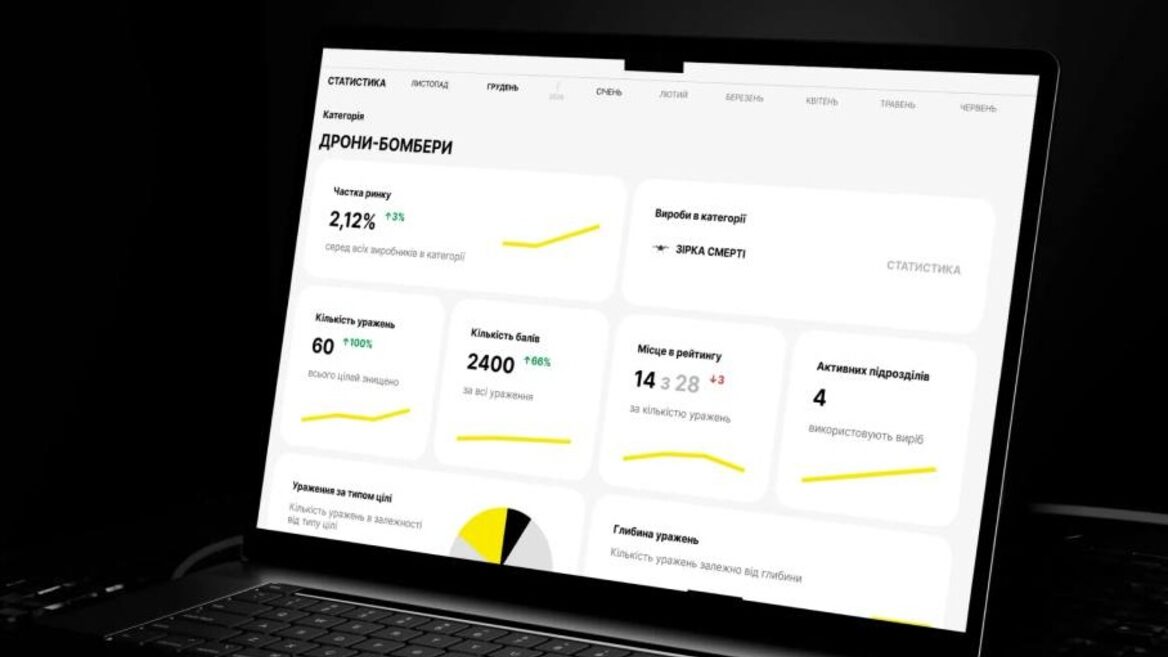
— No, he would have definitely appeared, but I also played my part in it. It was a cool idea that Mykhailo proposed, and we figured out how to implement it, and we did it as quickly as possible. When I worked at Brave1, we launched the functionality of paying for weapons with combat points, and made this marketplace like a weapons catalog, and the military could contact manufacturers here.
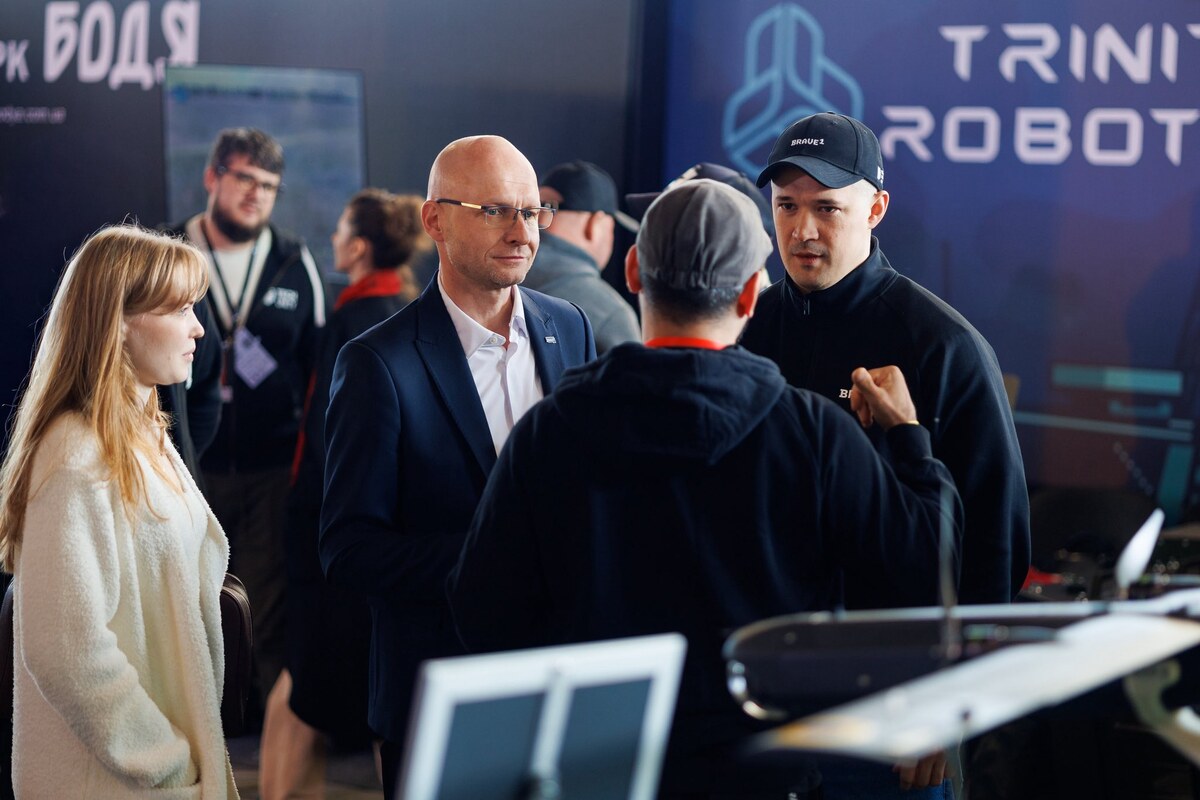
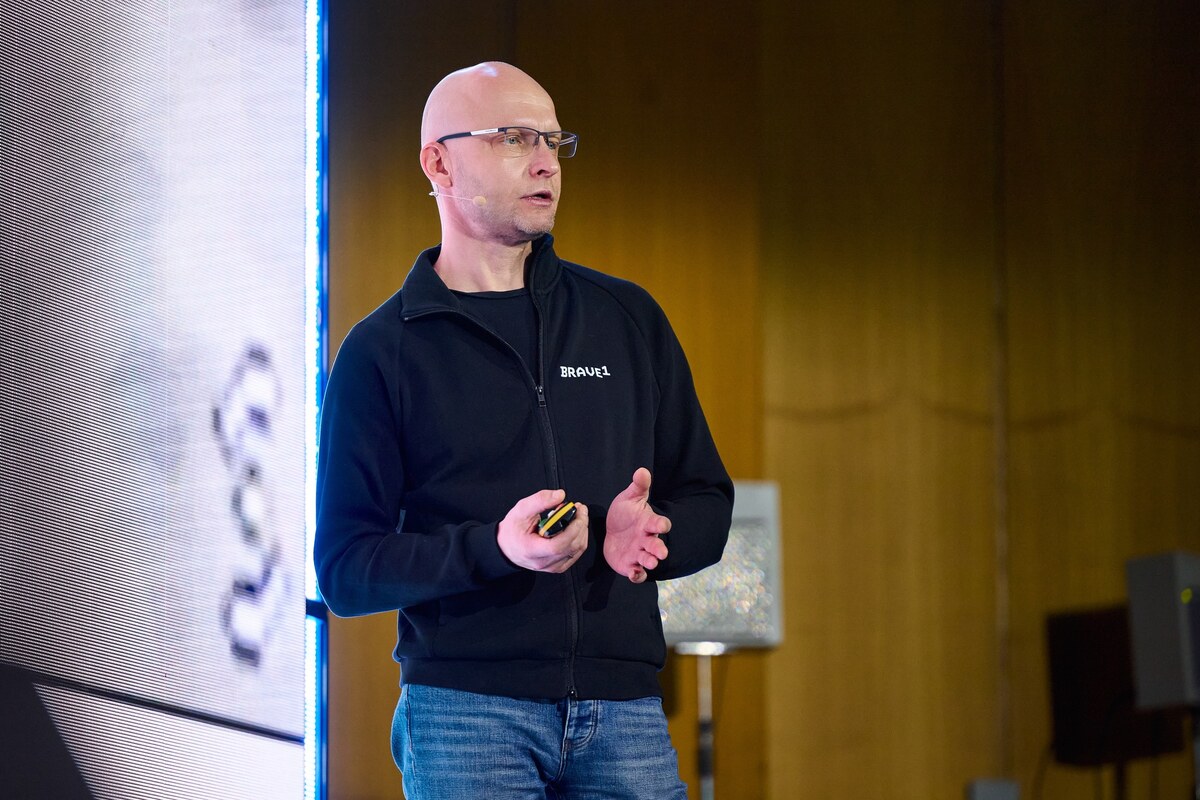
Andriy Hrytsenyuk during one of the events. Photo by Brave1
Here too, an ordering mechanism appeared, and thanks to it, delivery times were reduced from several months to several weeks or months. This is an example of a radical and unconventional change, which our Western partners are generally delighted with.
We have decentralized decision-making on the types of products to be purchased and a drastic reduction in delivery times. This is much better than someone in Kyiv making the final decision instead of the military, and they receive the weapons late and not quite what they expected.
It is wrong when the military is forced to work with what they are given, rather than with what is needed.
In addition, we see that there were many great products that were purchased by volunteers and charitable foundations, but the state did not purchase centrally. Because of this, manufacturers had significant underutilization of production, sometimes even 10-20% instead of full capacity.
Now, the performance of companies that made quality products but did not have centralized orders has skyrocketed thanks to our marketplace and DOT Chain Defence.
— In order for a manufacturer to enter the Brave1 Market, it needs to pass a compliance check. These checks have at least two types. How do they differ and how do they pass?
— There are actually more types of these checks than the two you mentioned. We do the checking. Banks do the checking — before they open accounts for customers and then at certain intervals.
The Defense Procurement Agency DOT conducts inspections when a supply contract is concluded. There are even inspections that we conduct with the involvement of the SBU — when an in-depth inspection is required. It all depends on what kind of service the manufacturer receives from Brave1 — that is how the inspection is carried out.
— And if the manufacturer does not pass the inspection, what should I do next?
— Depending on what exactly we are talking about — about the marketplace, or about receiving a grant, about large-scale financing for a specific project. As a rule, the comments that we make during compliance are either technical, or the manufacturer is able to eliminate them quickly enough. And they do it. But in some cases — it is a refusal. Unfortunately, there are also such examples.
— On Brave1 Market, defense products are sold not only for money, but also for eBalls. Is it worth stimulating the eBall system, which is criticized by many military personnel and volunteers, at all? It seems that there is really something to criticize it for — for example, for the fact that in the pursuit of points, units have stopped sharing information with their counterparts.
— If someone rides a bicycle and later buys a car, then of course they might not like something about that car, right? But I think it’s important not to forget that you rode a bicycle before.
There are no perfect models, but there is a process and it is constantly being improved. If we did something and thought it was perfect and correct, and didn’t want to change it anymore, then that would be bad. But there is no such thing.
A certain innovation has been introduced, and we constantly receive feedback about it. We see things that we like, and we see things that we don’t like. In some cases, we make appropriate decisions together with the General Staff or the Ministry of Defense. For example, when the eBall system was first launched, points for mining were not taken into account. But we received feedback and changed it. The same applies to the accrual of points for logistical missions of the NRC, or artillery. Then the reconnaissance pilots began to say: «Where are our points?» There was also a question about changing the methodology for accruing points for interceptors. That is, this is a process that is constantly being improved. It is important to understand this.
As for the negative, there is always one. But compared to the benefits that this system has brought, it is very insignificant. You noted that the brigades are starting to hide information, not share it with their neighbors. We have not seen this at all, perhaps these are isolated cases.
By the way, brigades always share technical developments with each other — this is what the Manticora battalion, the Third Assault Battalion, Charter, and Nemesis do. Charter, for example, has built a unique model for managing the NRC, and, of course, they tell others how you can do it in a similar way in your brigade.
— If you’re talking about brigades, many of them, as you know, have their own R&D departments. Theoretically, could brigades also receive grants from Brave1 for their own developments?
— Currently, Ukrainian legislation, in particular by-laws, prohibits financing developments that are created in teams. Therefore, I am not sure that there is a legal structure where the State Innovation Development Fund will be able to finance teams. I do not think that this is realistic to do.
And here the main thing is that when we provide funding, we want the result to be not just new products, but also scaled production. After all, teams can’t be large manufacturers anyway. The manufacturers that Brave1 works with are still private companies.
The state simply transferred the license for its production to private companies for free, and 15 of them have already signed relevant contracts.
— These 15 companies you mentioned — have they only signed contracts, or have many of them already started production?
— They are all in the process of launching production, and some have already started it. Some have done it faster, some are moving more slowly. But you have to understand that this all happened quite recently.
Many companies have already made the first samples and are testing them. And it’s great that manufacturers are also making great suggestions for improving the product and the production process itself — to make it simpler and cheaper.
Again, it’s a very good synergy when something cool was created directly in the military, and Western partners helped create it, and after that, Ukrainian industry started producing it. Everyone benefits from that.
About Brave1's plans for 2026
— Our interview is taking place at the beginning of the year, so it’s logical to ask about your plans for Brave1 for 2026. What milestones do you have to achieve?
— Actually, there is a lot I want to say, but I can’t say everything. It is important that we work on innovations that will change the situation on the battlefield in «silent mode» and that this is unknown to the Russians for as long as possible. They are following what we are doing very closely.
This, of course, is not an answer for journalists and is not very interesting for readers, but it is due to the safety of those who work on this.
But if we take it at a higher level, the first task is to close the sky as tightly as possible using Ukrainian developments. Moreover, in such a way that it would be unprofitable for the Russians to scale the number of «shaheeds» they use.
They should have understood that there is no point in wasting money and time to do this. We believe that by the end of this year there will be good progress in this direction, we are actively working on it.
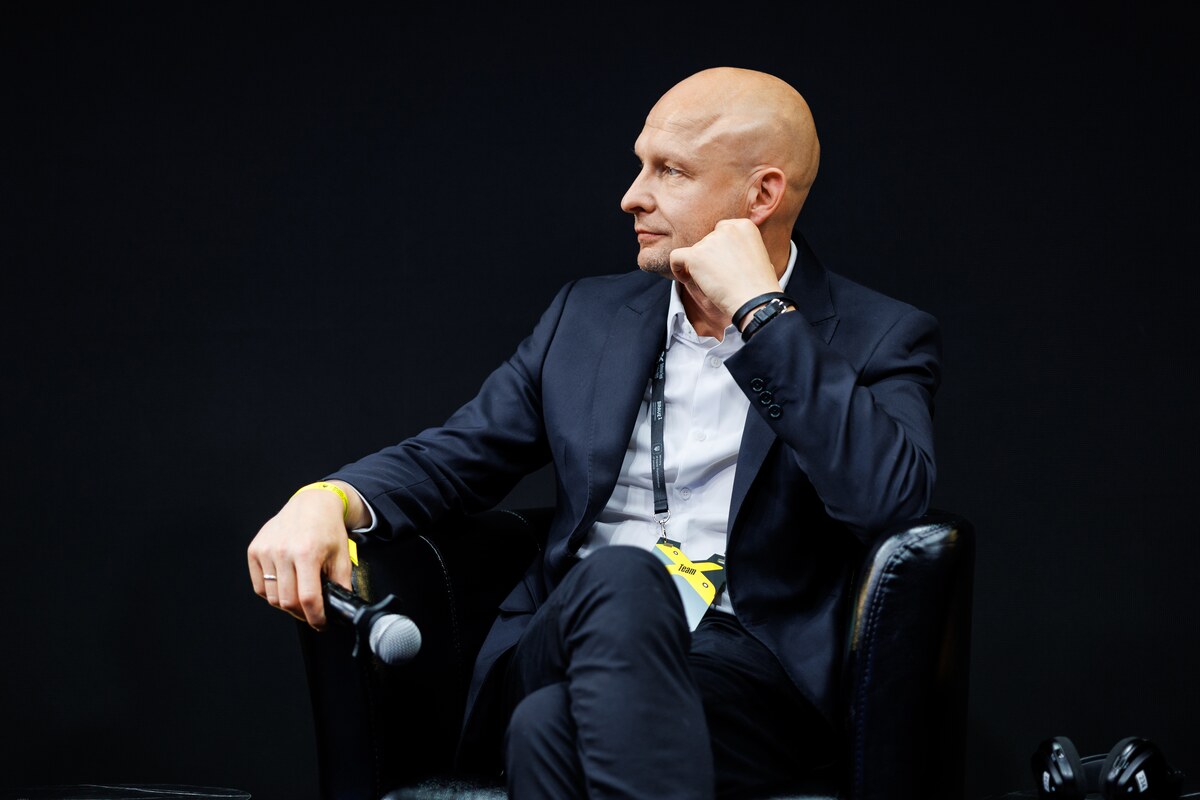
Andriy Hrytsenyuk promises something big for 2026, which we will all learn about later. Photo from FB Brave1
The second direction is autonomous technologies. That is, technologies that allow for mass destruction of enemy targets without the ratio of one drone to one person. It is important for us that the indicators of destroyed enemy equipment and personnel go up, and that thanks to effective technologies we have the opportunity to kill as many Russians as possible. But these should be technologies that will not require an increase in the number of our soldiers on the battlefield. And the third… No, I can’t say for sure about that.
— Do you suggest depicting this with some kind of smiley puzzle, as the former head of the Presidential Administration liked to do?
— I think readers will definitely be able to read about it in the news over time.