Anthropic reveals 10 professions most vulnerable to AI. Programmers on the list
Anthropic has presented a research paper announcing the start of monitoring factual data on the impact of AI on the labor market.


Anthropic has presented a research paper announcing the start of monitoring factual data on the impact of AI on the labor market.

Anthropic has presented a research paper announcing the start of monitoring factual data on the impact of AI on the labor market.
“We are introducing a new AI workforce displacement risk score. It combines the theoretical capabilities of large language models (LLMs) with real-world usage data. This score gives more weight to automated (as opposed to assisted) and professional scenarios for technology use,” the company says .
Developer Claude notes that this data could be really useful for researchers and policymakers, who will likely want to use these findings to protect future workers from large-scale displacement from the labor market.
The study analyzes indicators such as the ratio of theoretical to actual penetration of AI in different types of professions, the most vulnerable positions, as well as differences in the levels of impact of AI.
Rather than being purely a job loss warning system, Anthropic says this research can help companies identify areas where employees need support in upskilling.
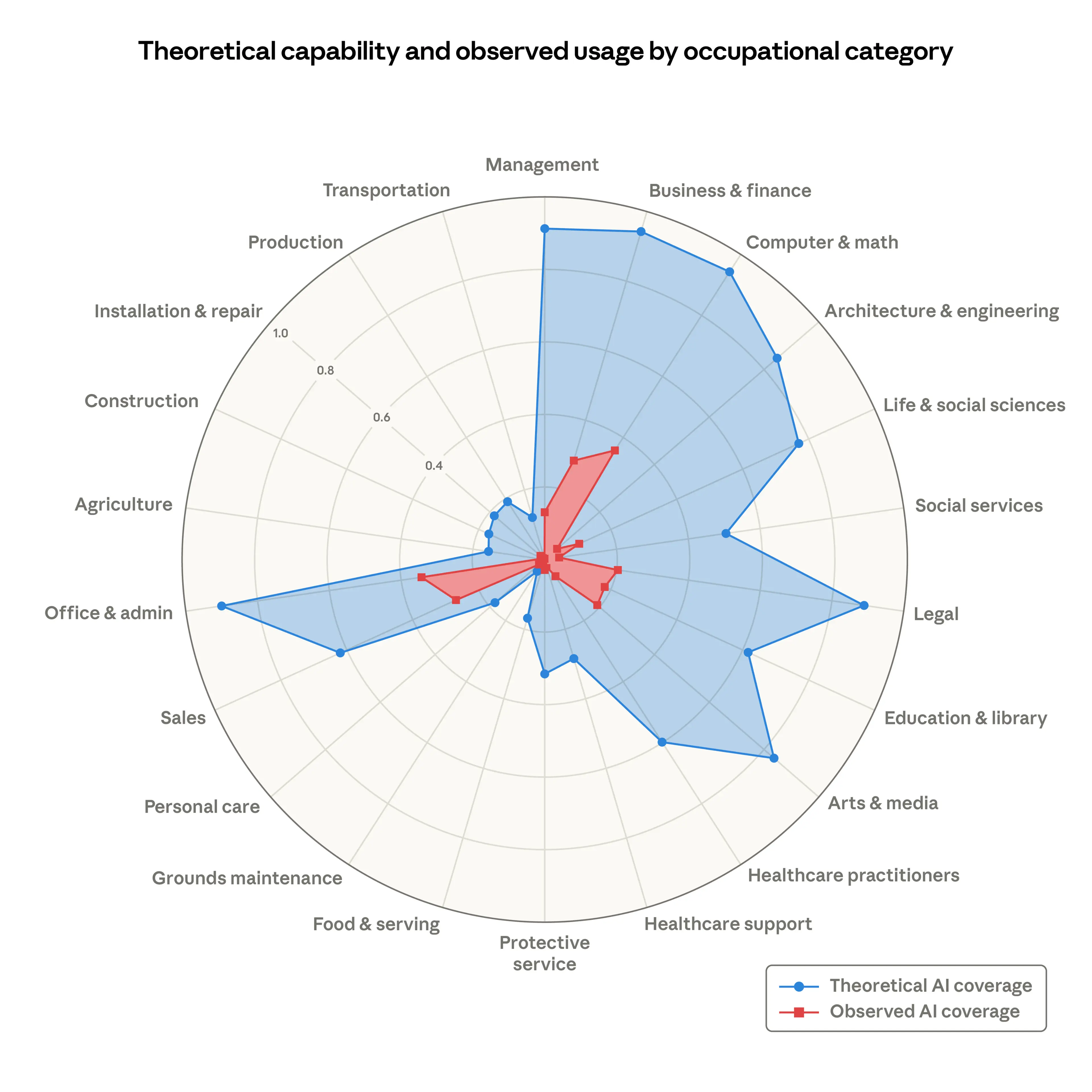
One dataset shows not only the theoretical coverage of professions by artificial intelligence, but also the actual one. The fields of management, business and finance, computer science and mathematics, natural and social sciences, law, arts and media, and office and administrative activities are among those that could be most affected, but the reality is that the actual penetration levels of AI in these fields are several times lower.
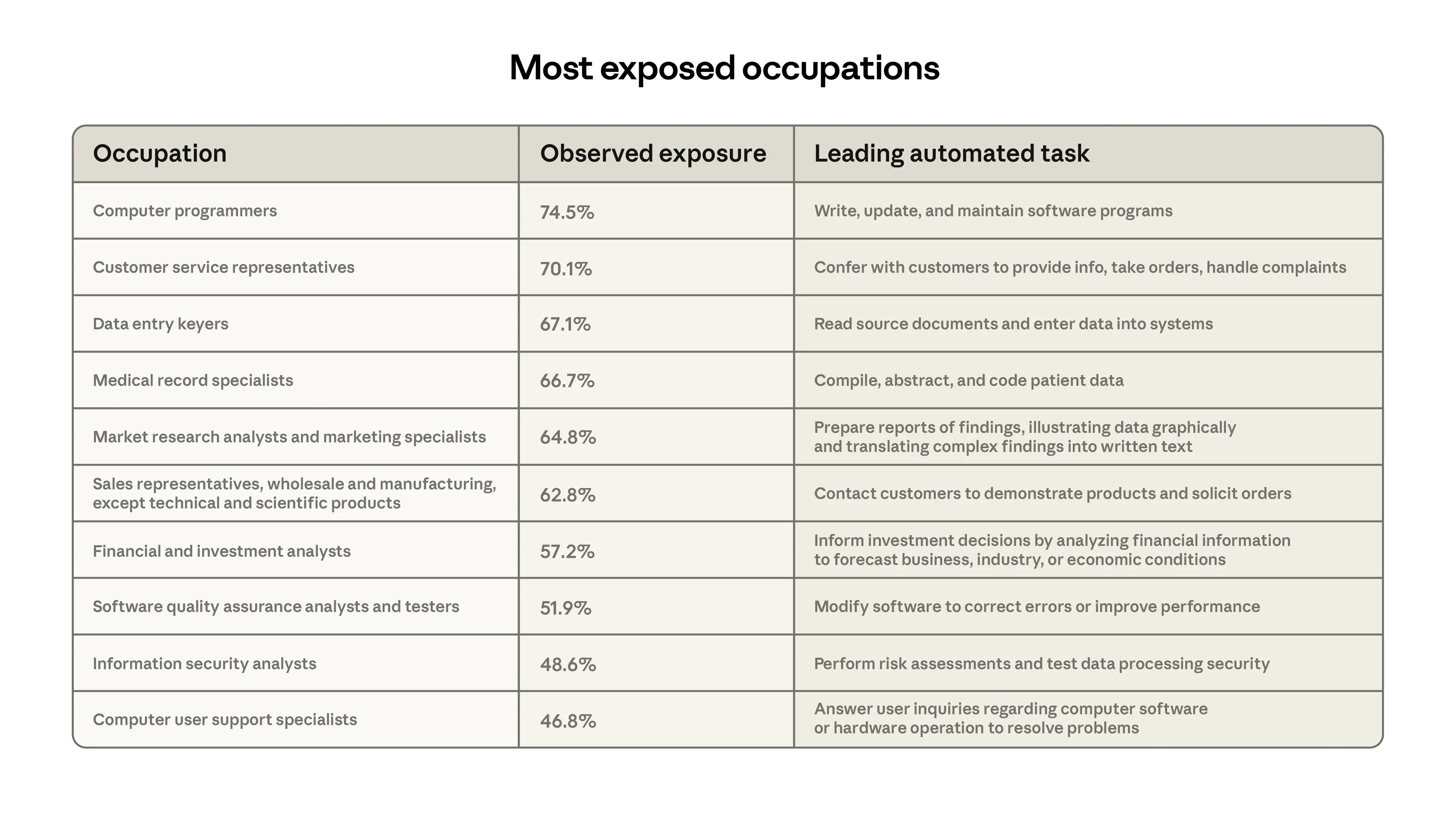
Anthropic also revealed the top 10 jobs most likely to be impacted by AI. In line with other data showing the widespread use of Claude for writing code, programmers came in first place (75% of job coverage). They were followed by customer service representatives, whose primary tasks we increasingly see in the traffic volumes of our own APIs. Finally, data entry operators, whose primary job — reading source documents and transferring data — is subject to significant automation, have a coverage rate of 67%.
Anthropic also suggests conducting more research into how graduates are adapting to changing hiring trends—more data and context could suggest they are finding opportunities in other fields, despite some data indicating a slowdown in entry-level offerings, for example.