What will happen to Bitcoin? Globally. By the end of the day
Looking at the panic surrounding the halving of the Bitcoin price, one wants to understand what would happen if we played the long game and did not engage in temporary speculation (and whether speculation took place at all).
Looking at the panic surrounding the halving of the Bitcoin price, one wants to understand what would happen if we played the long game and did not engage in temporary speculation (and whether speculation took place at all).
And here’s what immediately came to mind. Once I managed to interview Nassim Nicholas Taleb, the author of the popular book «The Black Swan» today. He was (and is) also an experienced American trader who, as they say, made a living trading derivatives.
I asked (it was 2021, and Bitcoin was worth a little over 60K at the time and it was the peak at the time):
— And what will happen to Bitcoin anyway? Globally, in the end.
Taleb gave a disappointing answer.
He was sitting there wearing a shirt and a rather thick gold chain was visible from under the shirt. Taleb was in a good mood. He picked up the chain with his finger and emphasized: this one will definitely last forever. And Bitcoin?
— And Bitcoin will be worthless, in the end.
I walked around with this answer in my head for a long time. I scrolled it back and forth.
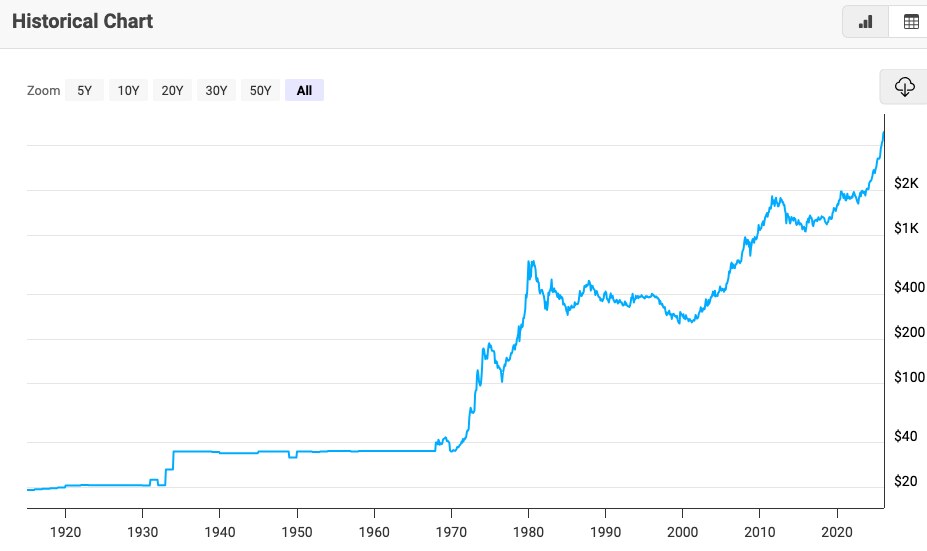
Indeed, if you look at the price of gold, it has almost never dropped significantly over the past 90 years. There have only been small corrections at times.
Do you know when gold made its biggest jump? It was 1971. The dollar began to be untied from gold. This event was called the «Nixon shock» when US President Richard Nixon announced a temporary, and later permanent, suspension of the free convertibility of dollars into gold at a fixed rate ($35 per ounce).
In 1980, an ounce was already worth $662.
The floating dollar exchange rate actually began to depend not on gold, but on the strength of the US economy, the American nation, and faith in it. And if it was going through difficult times (such as, for example, at that time, the Vietnam War), the national currency depreciated significantly.
Gold rose tenfold again in the 2000s, when the economy of China, the main competitor of the United States, began to grow rapidly.
And gold began to rise sharply from 2024, when the US again began to show its weakness, both militarily and economically.
Thus, from $35 per ounce in 1971, the precious metal reached $5,000 in 2026.
How much was the gold worth?
Globally, Nicholas is right. If you want to play long, buy gold. But there are also disadvantages. You won’t make quick money on gold. It’s not Bitcoin or a stock for you.
Why gold and not the dollar?
So what does gold have that the dollar doesn’t? The simplest answer, in my opinion, is: the dollar has no limit. It can be printed as much as needed. Yes, of course, large one-time emissions can greatly harm the economy. But if you do it gradually, «smartly,» then you can solve one-time problems in this way.
The COVID epidemic has arrived — you can print dollars and give them to people so they can survive it.
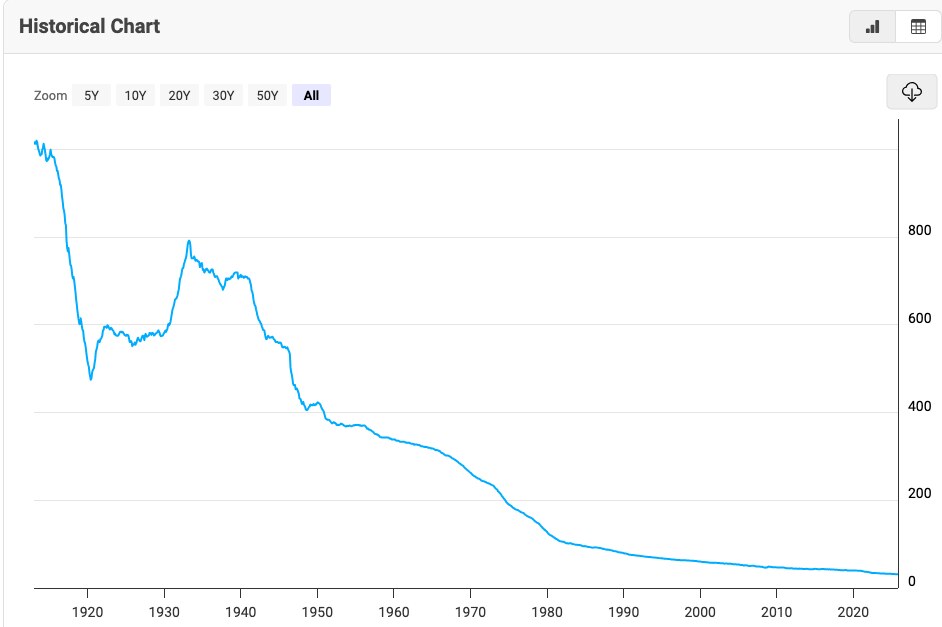
Of course, in the global game, this gradually devalues the dollar. That’s why its purchasing power is constantly falling. And it will continue to fall. And of course, that’s why you can’t buy a dollar, put it under your pillow, and hope that in five years it will be the same money. No, it won’t be. Even if you put it in a bank with interest, it still won’t be.
Purchasing power of the dollar
How Bitcoin is Like Gold (and Not Like the Dollar)
As for gold, you can’t print it anymore. It has to be mined from the Earth. And it’s getting more and more expensive every day.
Here gold is similar to Bitcoin, oddly enough. Bitcoin also has quantitative limits.
As of early 2026, there are over 19.9 million bitcoins in circulation, about 95% of their maximum supply. The total emission limit is limited by the program code and will not exceed 21 million coins. The last bitcoin is expected to be mined around 2140.
So why is Bitcoin so hot, but gold isn’t?
The simplest answer is that Bitcoin is still considered a risky (and young) asset that investors exit when bad times begin (and times are really bad, as we can see from the soaring value of gold).
So investors started to exit Bitcoin and move into less risky assets, such as bonds or gold.
Why is this correction so dramatic?
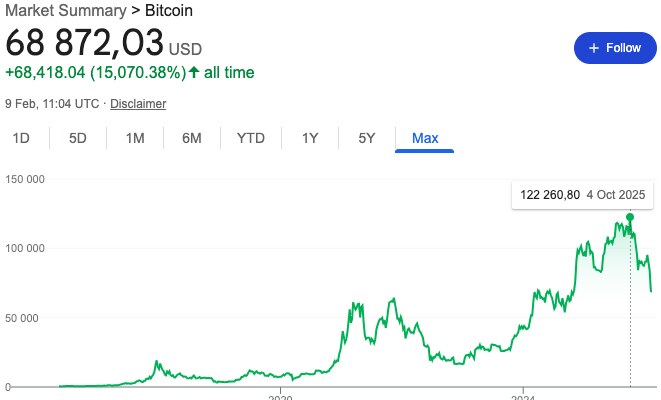
Bitcoin was worth $122,000 in October — and now it’s $68,000. So what?
How much is Bitcoin worth now?
This is primarily due to the fact that Bitcoin has gone from being an asset for geeks to an asset for the masses in recent years. And the stakes have risen significantly. And with them, the wins (and losses).
Remember, in 2024 the US (and some other countries) finally recognized the Bitcoin ETF (Exchange-Traded Fund)? This is an investment fund whose shares are traded on traditional stock exchanges and are directly tied to the price of Bitcoin.
This means that Bitcoin, its value, has actually been equated to a regular security on the stock exchange. You don’t need to understand cryptocurrency, wallets, crypto exchanges. You can simply invest in a stock tied to Bitcoin.
Of course, insurance companies, banks, funds that previously did not have access to this asset, were afraid of it, etc., started buying Bitcoin in its current form. And when times got worse (i.e. now), they got out. The price fell.
And this is normal. The cryptocurrency has actually gained mass acceptance and this is its first significant test of strength.
So what, will the ball hold up?
Well… nothing has changed yet for the same investors (or maybe new ones) to get back into the game.
Bitcoin is not much more .
Access to it was not lost .
Trust in the asset is also maintained .
There has been no other promising marginal asset that could grow as rapidly as bitcoin.
So for now, there is every chance that the ball will jump again. And perhaps with an even greater amplitude.
But Bitcoin is not gold. Still!
In the case of gold, the only scenario where it starts to lose its value is if we learn to extract it quickly and in large quantities. Fantastic — but, for example, it turns out that there is a lot of gold in the bowels of the Moon and we learn to get it to Earth quickly and cheaply.
The scenario, as you understand, is not very realistic.
In the case of Bitcoin, Taleb’s black swans could be much more numerous. Bitcoin depends on several factors that can change rapidly — in the short term.
The first is software computing. Artificial intelligence is unlikely to kill Bitcoin, but quantum computers are already a risk. They are, in principle, a risk for encryption of any kind. And if your main value is encryption, you are definitely at risk.
The second is data centers and the global Internet itself. Can you imagine a situation where data centers are damaged and key oceanic submarine cables are severed? Theoretically, yes. Even if only the largest American data centers of Amazon and Google are hit, the global Internet will have a very difficult time. And no Internet means no access to cryptocurrency. It has no physical substitute, unlike regular money (by the way, a physical substitute for Bitcoin would be a cool project, a kind of coin apocalypse).
The third is electricity itself. No electricity means the data center is not working. Of course, data centers are reserved, have diesel generators, etc. But what if the delivery of the next batch of diesel is impossible during a mass blackout?
The conclusion here is this: Bitcoin is not an asset that will survive global, and sometimes even local, cataclysms. Bitcoin is also unlikely to survive progress (when more powerful technologies replace the current ones). This is its finitude, this is its limit.
So if we put Nicholas Taleb’s gold chain and a ledger with one bitcoin in a safe deposit box, and then think about them in 50 years, I think the results of these two accumulations will be radically different. Guess which asset wins?
Well, for now, the three factors I listed are not on the horizon, but in the coming years — so why not go into the crypt? :) I’m not calling anyone out, of course.