Наталя ХандусенкоMoney
28 May 2026, 09:59
2026-05-28
60% of payments made by Ukrainians are made from mobile devices: which do they use more often — Apple Pay or Google Pay?
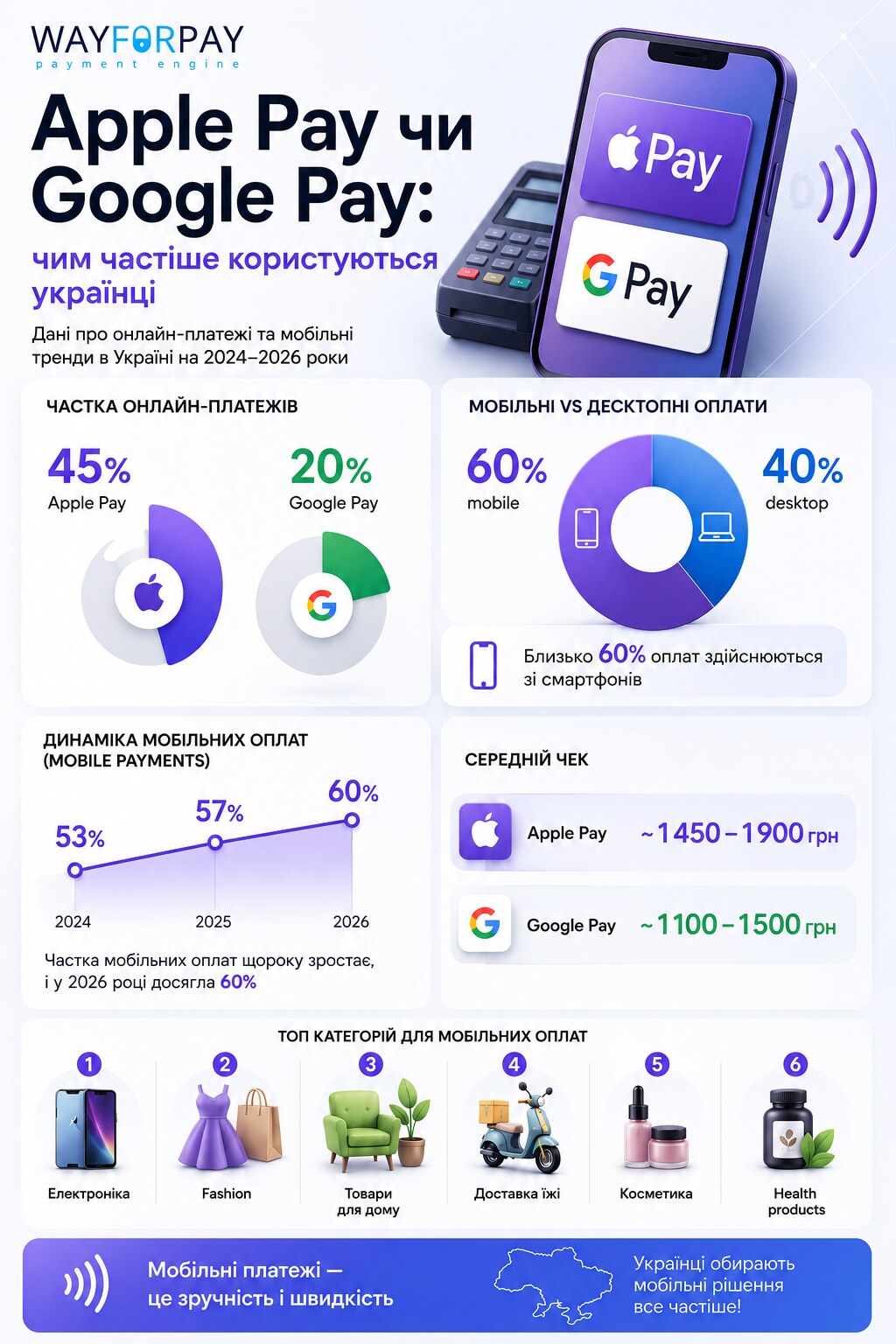
Smartphones are finally winning: according to WayForPay, Ukrainians already make 60% of online payments from mobile devices, while computers account for only 40%.
At the same time, payment habits are changing. Apple Pay is now the leader, with 45% of all transactions, while Google Pay’s share is half that — 20%. Interestingly, iPhone owners spend more: their average check is $35–46, while Android users’ average check via Google Pay ranges from $27–37.
Smartphones are finally winning: according to WayForPay, Ukrainians already make 60% of online payments from mobile devices, while computers account for only 40%.
At the same time, payment habits are changing. Apple Pay is now the leader, with 45% of all transactions, while Google Pay’s share is half that — 20%. Interestingly, iPhone owners spend more: their average check is $35–46, while Android users’ average check via Google Pay ranges from $27–37.
Smartphones have become the main tool for online shopping in Ukraine
According to WayForPay, the share of mobile payments is growing every year and in 2026 reached 60% (compared to 53% in 2024 and 57% in 2025).
General digitalization is also confirmed by the NBU statistics for 2025:
Ukrainians made over 9.5 billion card transactions worth over 7.1 trillion UAH.
over 95% of these transactions were non-cash (more than 65% of the total).
The average online payment receipt increased to UAH 608 (last year it was UAH 561).
The popularity of digital wallets (Apple Pay, Google Pay, etc.) is growing rapidly. In 2025, the number of tokenized cards increased by 25.9% to 20.7 million units. Now every third active card in the country is tokenized, and about 98% of cashless payments in stores are made contactless or via NFC.
Apple Pay is confidently leading the way
Despite the greater number of Android devices in Ukraine, the leader in online payments is Apple Pay with a share of 45%, while Google Pay accounts for only 20%.
The reason lies in user behavior: iPhone owners are more active online, have a higher average check, and are more likely to make one-touch purchases thanks to Apple's seamless ecosystem (Face ID, Apple Wallet, etc.). At the same time, Google Pay's audience is larger but less homogeneous - many Android users still enter card details manually or choose cash on delivery.
Why mobile payments continue to grow and what it means for business
Mobile payments are no longer a trend but a new standard for online commerce. This is because users (especially young people) spend more and more time on their smartphones, apps are replacing computers due to their convenience, and banks are actively promoting digital wallets, making the payment process as short and automated as possible. Businesses, in turn, are actively adapting to the mobile-first model.
Key takeaway for business: With 60% of payments now made from smartphones, mobile checkout is now critical to sales, not an optional feature. To avoid losing customers, online stores need to ensure:
maximum speed and minimum steps during payment;
mandatory integration of Apple Pay and Google Pay;
perfect adaptation of the site to mobile devices (UX).
What is the situation in the world like?
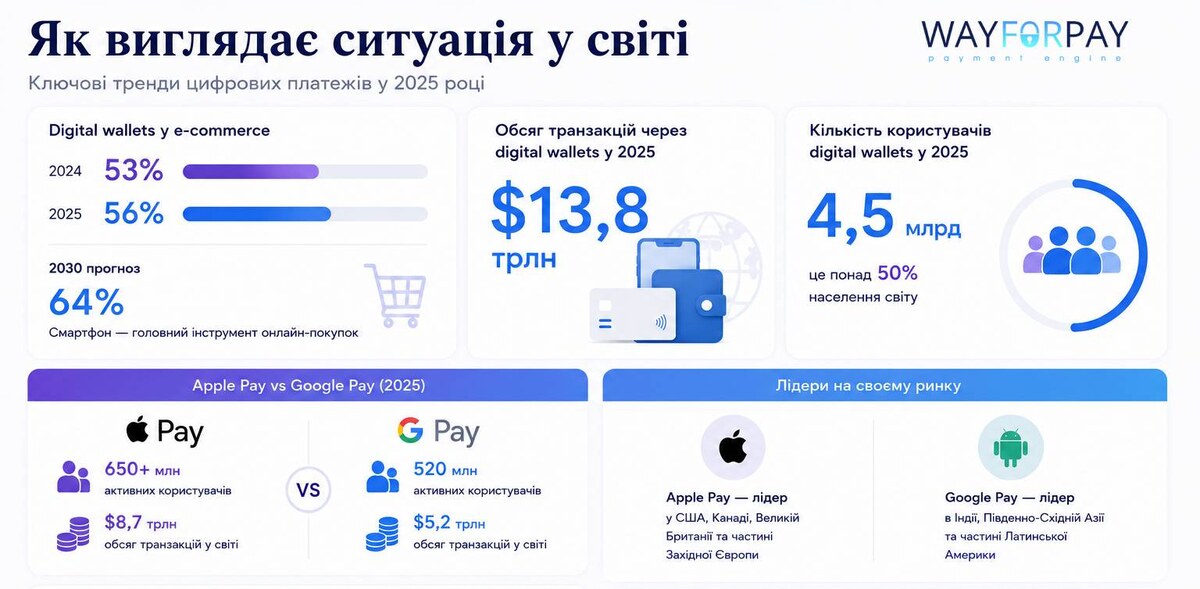
According to Worldpay, in 2025, digital wallets became the most popular online payment method in the world: their share in global e-commerce increased to 56% (versus 53% in 2024), and the total transaction volume exceeded $13.8 trillion. As of 2025, digital wallets were already used by about 4.5 billion people, and it is predicted that by 2030 this figure in global online payments will reach 64%. In the global online payments market, PayPal leads with a share of 47.4%, followed by Apple Pay (14.2%), Amazon Payments (10.2%), and Google Pay (8.9%). At the same time, Apple's service in 2025 had over 650 million active users and generated $8.7 trillion in transactions, while Google Pay had about 520 million users with a volume of $5.2 trillion.
The geography and usage patterns of the services differ significantly: Apple Pay dominates developed markets like the US (where it is chosen by 71% of shoppers and accepted by 92% of retailers), providing businesses with higher customer solvency. In contrast, Google Pay provides mass coverage in countries with a high share of Android (India, Southeast Asia, Latin America) and demonstrates high technological compatibility (covers 93% of Android smartphones and works in 76 countries compared to 81 countries for Apple).