Марія БровінськаУвійти в ІТ
28 April 2026, 10:00
2026-04-28
Why does an IT professional need international education in 2026? Three real stories of American University Kyiv students who prove that modern knowledge has a qualitative impact on career development
When people talk about international education for IT professionals, they usually imagine moving to the States or Britain, a sky-high price tag, and years of waiting. But the reality of 2026 looks different: you can get an American diploma, study English, and do internships in global companies — and at the same time stay in Ukraine, without giving up your job and family.
American University Kyiv (AUK) is a university in partnership with Arizona State University, where both fresh bachelors and experienced engineers who decided to add systems education to their practice study. We asked three students to tell their stories — from doubts before admission to the real impact on their careers.
When people talk about international education for IT professionals, they usually imagine moving to the States or Britain, a sky-high price tag, and years of waiting. But the reality of 2026 looks different: you can get an American diploma, study English, and do internships in global companies — and at the same time stay in Ukraine, without giving up your job and family.
American University Kyiv (AUK) is a university in partnership with Arizona State University, where both fresh bachelors and experienced engineers who decided to add systems education to their practice study. We asked three students to tell their stories — from doubts before admission to the real impact on their careers.
«I’ve known how to do it for a long time. I wanted to finally understand why.»
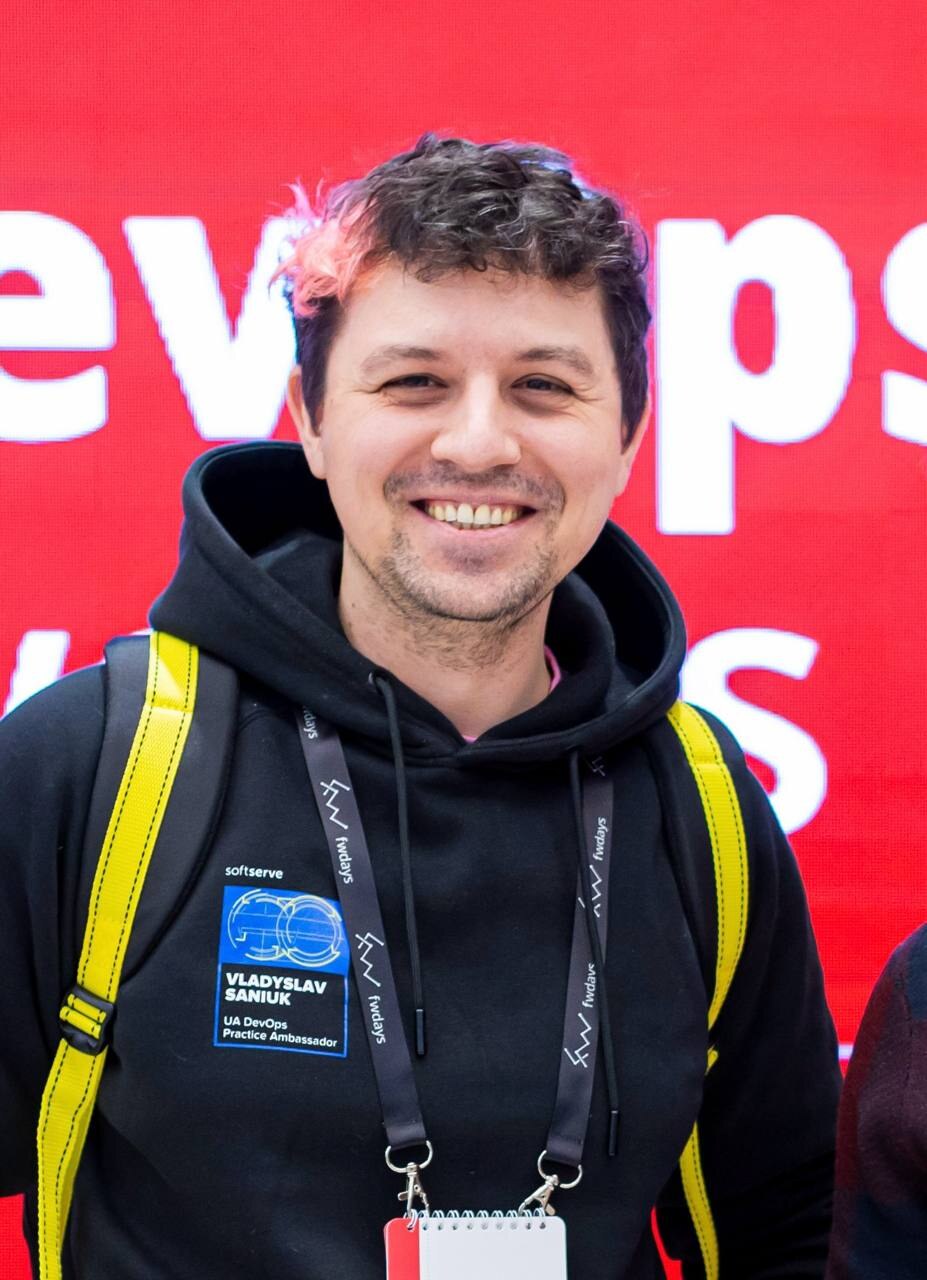
Vlad, 34 years old — Lead DevOps Engineer Defense AI Center «A1», Master’s degree in Software Engineering at AUK
My name is Vlad, I’m from Kyiv. Over the past twelve years, I’ve been an HR person, a project manager, and eventually settled in engineering — I’m currently a Senior Engineer at SoftServe, and I’m planning to take the Tech Lead assessment at the end of the year. I have a son, a wife, a mortgage, and a habit of learning: before entering AUK, I kept up with at least two certifications a year — AWS, Kubernetes, Terraform, and others.
So when I say that I didn’t go to university «for a degree,» it’s true. I wanted to back up my practice with theory. Not with books from 50 years ago, but with industry bestsellers. And get rid of the imposter syndrome, which at a certain point begins to hinder growth.
Why not leave?
I asked myself this question too. But when you have a job, family, mortgage, pension contributions and investments, going to study for a few years becomes a task with an asterisk. Around twenty it’s simple: you live, study, your parents help. At 34 it’s an application for a sabbatical or a complete restructuring of your life. And there’s also the war with the travel ban — also a factor, although to be honest: even without it I would count.
When AUK announced a partnership with Arizona State University, I thought, «Oh, cool. I hope they pull it off.» And when it did, I decided to give it a try. Plus, the Software Engineering program fit my idea of what to study. Plus, the campus is in historic Richport—I even took my family and colleagues there on tours.
What surprised you about the study?
In the architecture course, we read Kleppman and Richards. Viktor Tursky came as a guest lecturer. Len Bass gave a talk on AI research. Isn’t this the kind of education you’ve dreamed of?
I told my colleagues in the first semester that the textbooks here are the bibles of the industry. Not «Textbook on Subject X», but real bestsellers that are read by practitioners all over the world. I was also pleasantly surprised by the material and technical base: all lectures, homework, projects — in the LMS, no need to run anywhere. MS Outlook and Teams as communication tools. And a subscription to O’Reilly at the entrance — all books in one place.
But what impressed me most was the format of the classes. In undergraduate studies, we were given lectures, we took notes, and then answered them at seminars. Here, it’s the other way around. You come to the lecture already prepared: you’ve read, watched videos, and you know the material. And the lecture turns into a discussion, where the lecturer provides the backbone of the conversation, and the details are discussed between the participants. Sometimes we break into groups. This is a completely different level of involvement.
What has changed at work?
Vlad, 34 years old — Lead DevOps Engineer Defense AI Center «A1», Master’s degree in Software Engineering at AUK
First, the imposter syndrome is cured. When you communicate with people of the level of a technical director, architect, or service technician on an equal footing, understanding what they are talking about, self-doubt simply disappears.
Secondly, I look at the role of an engineer differently. One of the courses in Arizona clearly distinguished between the concepts of «programmer» and «engineer». The former — those who are worried about the automation of their work — really have reason to worry. The latter — about the price, even in the world of AI. Code has become cheaper than ever. But understanding the system, making an architectural decision, explaining it to the business — is a different job.
In the final lecture on Software Architecture, one slide had the following written in large letters: «Architect should fluently navigate corporate politics.» I’ve been repeating this thesis to my colleagues for over a year.
If you thought you could be a good engineer your whole life and ignore «nasty corporate politics» — you probably won’t rise above the senior level. And that’s exactly what AUK teaches: engineering in the context of business and soft skills as a mandatory part of the job, not an option.
Networking is an unexpected bonus
Among the master’s students there are many people of the senior engineer, tech lead, architect level. The teachers themselves are practitioners: the deputy dean of the faculty is a CTO at Empat. Denys Yuvzhenko, an architect at Intellias and one of the former hosts of the DoU DevOps Podcast, teaches here. I have already mentioned Viktor Tursky.
I found one of the new projects through an acquaintance with a classmate from the Faculty of Management. I also actively work at the AUK AI Research Center — we implement an agent system in the field of educational systems. And at the AUK AI Cafe, inspired by the Scottish coffee house — a platform where the state, business engineers and scientists meet.
During my studies, I got a promotion, new projects, and an offer. But most importantly, I know that I am an engineer. Not just a good coder. And this confidence is worth much more than any certificate.
«I wanted to understand not how to do it, but why»
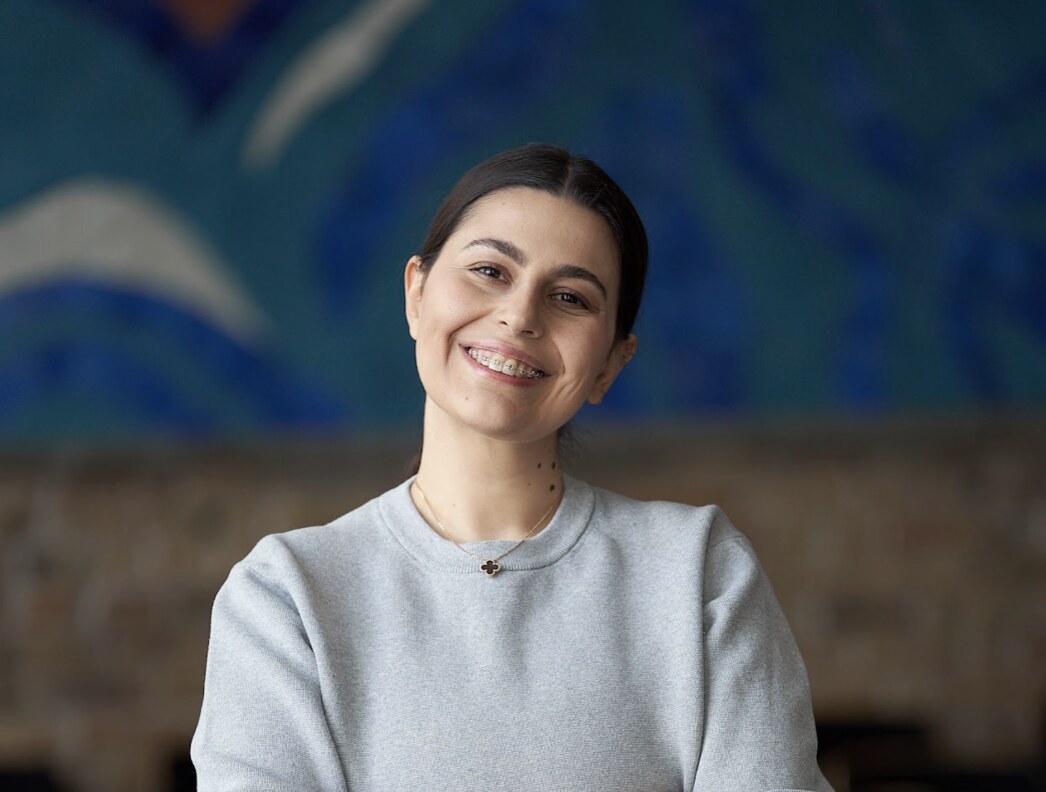
Ksenia, iOS Engineer at Rozetka, graduate of the master’s degree at AUK
I’m Ksenia, an iOS engineer from Ukraine. I’ve been developing mobile products for several years — e-commerce, fintech. At the same time, I studied for a master’s degree at AUK.
I didn’t come here to retrain. I wanted to broaden my horizons: to stop thinking only as a developer and start thinking as an engineer who understands the product and the business. And, frankly, not to fall out of the market in the process.
Why not leave?
For me, it was about finding a balance between quality and reality. I wanted to get an international approach to education — but not put my career on hold. Leaving for a few years would mean «putting my career on hold.» But I wanted the opposite: to invest in the global level while continuing to grow as a specialist.
Two main doubts before entering: whether the level would be truly international — and whether there would be enough practice, not just theory. Both were dispelled by the AUK format: teaching in English, partnership with Arizona State University, emphasis on practical tasks. It gave me the feeling that I was investing in a global career — but not stopping it.
Expectations and reality
I expected a more academic, theoretical program. Instead, there were a lot of practical tasks, an emphasis on thinking, not just on code, working with cases close to real business. The international approach and strong focus on communication and presentation came true. But the practice turned out to be a bigger surprise than I thought.
How thinking has changed
I used to think, «How do I implement this?» Now I think, «Why does the business need this? What is the impact? What is the optimal architecture for scaling?»
I started thinking in systems, not in individual features. The role of an engineer is not to «write code.» It’s to be part of a product solution. It seems like an obvious idea, but there’s a huge difference between knowing it and actually thinking like that in your work. Learning helped me move from knowledge to habit.
The most valuable project
Ksenia, iOS Engineer at Rozetka, master’s degree at AUK
For me, this is an applied project with sentiment analysis. Working with real data, building an end-to-end solution, finding a connection between technology and business. The main difference from classic university assignments: there is no right answer. You need to form your own approach — and be responsible for it. This is a completely different responsibility than «handing in the assignment correctly.»
English: difficult at first, then an advantage
At first, academic vocabulary was difficult. But adaptation happens quickly — already in the first semester. Now it gives a tangible advantage: more comfortable in international teams, more confident in technical interviews.
There is another nuance that I noticed: academic English and working English are different. The university improved both. Academic English through essays, articles, presentations. Working English through team projects and real-life tasks. This structures not only the language, but also the way of thinking.
Where to next?
The career horizon has changed a lot. I used to see myself as an iOS developer growing in my niche. Now I see myself as an engineer who understands systems, works with the product, and can influence business decisions. I’m considering internships and jobs in the US, but for me, the main thing is not location, but competitiveness on a global level. No matter where I am.
«I thought Data Science was about tools. It turned out it was about solutions»
Sofia, 3rd year of undergraduate Data Science
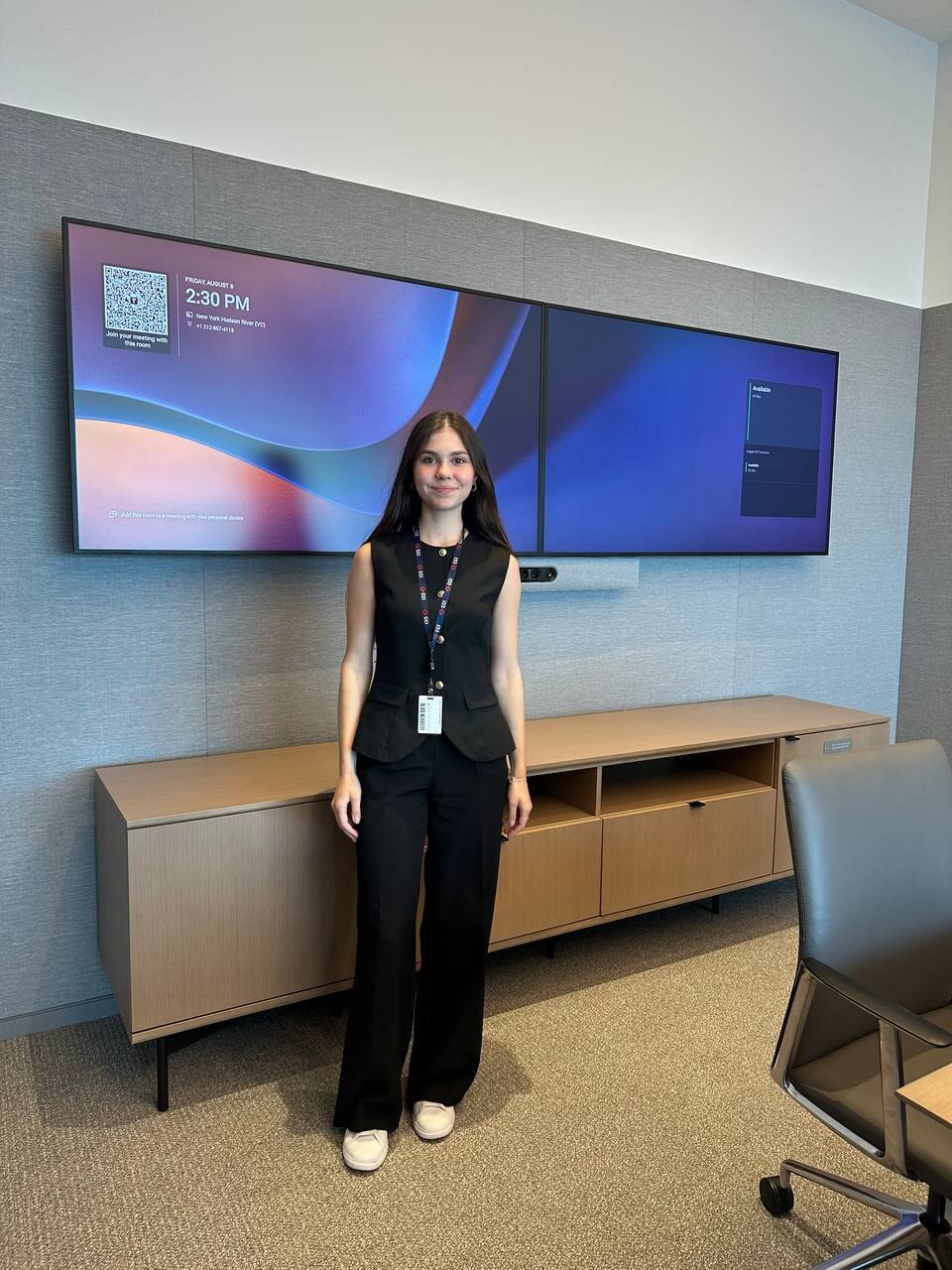
My name is Sofia, I am a third-year student of the Bachelor’s program in Data Science at AUK. I live and study in Kyiv. Last summer I interned in the USA — at Castleton Commodities International, one of the largest private energy traders. Now I work in parallel in a Ukrainian company in the energy sector.
A year ago, I couldn’t have said that about myself.
Why AUK, and were there any doubts?
It was important for me to stay in Ukraine — but study according to international standards and in English. When I learned about AUK, I was immediately interested: an American diploma, an international level — but here, at home, and at a much more affordable price than studying abroad.
But there were doubts. The university was just starting to work — will the quality be sufficient? The decisive argument was the presentation of the partnership with Arizona State University. I understood: the courses are built according to the American system, taught by both Ukrainian and foreign professors. This does not look like a compromise — this is a real international standard.
What turned out to be unexpected
I expected a strong theoretical base in mathematics and programming — and I got it. But the surprise was the emphasis on practice from the first year. Large-scale projects, preparation for a career — not abstractly, but concretely. Critical thinking as a separate focus: many subjects where you need to analyze information, check sources, argue with data.
I was also surprised by the breadth of opportunities: student clubs in programming, mathematics, sports, and art, an AI Lab where you can do research, and international paid internships — in Ukraine, the USA, Britain, and Ireland. I didn’t expect a university to be so eventful.
How the understanding of Data Science has changed
Sofia, 3rd year of undergraduate Data Science
Before studying Data Science, I thought it was a set of tools for analyzing data. Now I understand: it is a process of making decisions based on data. It is completely different.
We studied many technologies — analytics, forecasting, machine learning. But at the same time, we learned how to correctly formulate business problems, evaluate and interpret results. Understanding the business context affects every stage: what data to collect, from which sources, which metric is most important for a specific task.
I began to perceive an IT specialist not as a person who writes code, but as a specialist who analyzes, finds solutions, and has a real impact on the business.
Breakthrough project: full cycle in a real case
The most valuable project for me was a project on time series forecasting based on electricity consumption data — during my internship in the USA (ed.: AUK has a Global Internship Program for students). For the first time, I went through the full cycle of working with data: from preparation and EDA to building a model and assessing its accuracy. And most importantly, the results of the model were actually used to make decisions for the company.
In real-world problems, there is no right answer. You have to determine your own approach, make decisions, and be responsible for the outcome. It’s a completely different feeling than turning in a problem with the correct answer.
I also worked on a few other business cases during my internship. The main difference with university assignments is that here you go through the entire process from start to finish. And you decide how.
English is not a difficulty, but an investment
At the beginning of my studies, it was difficult to adapt to a completely English-speaking environment, especially because of the new terminology. But after the first semester, everything became familiar: understanding lectures, conversational skills, basic academic vocabulary.
Now, after three years of studying English, I don’t experience any difficulties. Even during my internship in the USA, I felt confident — both in a team and during presentations in front of a business audience. English in IT is not an option. Most of the resources, documentation, discussions are in English. This opens up a completely different scope of opportunities.
Previously, I thought about developing mainly within the Ukrainian market. Now I am focusing on the global level, studying with international resources, and considering a master’s degree abroad.
A reason for pride
The most important achievement for me was my internship at Castleton Commodities International. I presented my work to business teams — people without a technical background. It gave me unexpected but very valuable experience: explaining the complex in a simple way, defending my solution, hearing feedback from people who care about the result, not the algorithm.
After the internship, I had the opportunity to continue my development in a Ukrainian company in the energy sector. And I am proud of my work at the university’s AI Lab: we conduct research in the field of artificial intelligence, write scientific articles, and discuss new ideas.
I went from having a vague understanding of what Data Science is to working on real-world problems that have a direct impact on business decisions. And this journey took three years.
Why education is an advantage
Three different people with different backgrounds — a freshman bachelor, an experienced engineer, and an iOS developer with real-world commercial experience — give a similar answer. International education in Ukraine now is not a compromise. It is a way to gain systemic thinking, an English-speaking environment, an international diploma, and access to the global market — without a career break or relocation.
From code to systems thinking. The most important common conclusion of all three is a rethinking of the role of an IT specialist. All describe a similar shift: from a performer of a technical task to a participant in the business process. Vlad calls this the difference between a «programmer» and an «engineer». Ksenia calls it a change in the question from «how to do» to «why business». Sofia understands that Data Science is not a set of tools, but a decision-making process.
AUK is consciously building its program around this shift: a mandatory course in technological entrepreneurship using the Y Combinator methodology, subjects in Public Speaking and Business Communication, and a focus on business cases instead of abstract tasks.
Practice from day one — and real responsibility. None of the three describe the training as purely theoretical. Vlad — a discussion format of lectures, where the student comes already prepared. Ksenia — end-to-end projects without a correct answer. Sofia — a full cycle of working with data in a real case, where the results influenced the company’s decisions. Common: here they don’t teach «to pass the assignment» — here they teach to be responsible for the decision.
Combining study with work: difficult, but real. All three combine study with full-time employment — and everyone says: it is possible, but it requires self-discipline. Vlad frankly: «There are no more days off.» Ksenia and Sofia note that the practical orientation of the program helps — knowledge can be immediately applied at work. The flexible format, online classes and support of the AUK Career Center are also a plus.
Networking as part of the value proposition. In the master’s program, there are many people at the senior, tech lead, architect level among students. Teachers are practitioners: service technicians, architects, authors of industrial books. Vlad found a project through a classmate. Sofia got a job in Ukraine through an internship. This is not spontaneous networking — it is a structured ecosystem.
Code is getting cheaper. Engineering thinking is not. And this is what education at AUK seems to be built on: not to teach a specific language or framework, but to educate a specialist who understands the system, the business context, and their own role in it.
Мануал для джуна. Що треба знати новачку у frontend-розробці перед співбесідою на проєкт мрії: запитання для інтерв'ю та приклади тестових
Створювати ІТ-продукти можна на різних рівнях і вдосконалювати їх як зсередини, (backend), так і ззовні (frontend). Візьмемо, наприклад, сайт. Спеціаліст може працювати із завданнями «під капотом», а може розвивати інтерфейс сайту, застосунку чи спеціальне програмне забезпечення для бізнесу, щоб вони були зручними, зрозумілими та функціональними.
Останнім якраз займається frontend-інженер. Що ще треба знати джунам про frontend-розробку, що не варто робити перед співбесідою та на які запитання відповісти, щоби бути готовим на 100% — Frontend Engineer у Levi9 Олексій Горбунов розклав все по поличках у цьому матеріалі.
«Після випуску про IT-Generation хочеться зробити тред про те, як IT-школи вас най**ують». Відомий IT-блогер Діма Малєєв розповів, що думає про IT-освіту
Відомий IT-блогер Діма Малєєв розповів своє ставлення до IT-курсів, які наразі продукуються в Україні. «Після сьогоднішнього випуску про IT-Generation, хочеться зробити невеликий тред про те, як IT-школи вас най**ують, продаючи курси, які вам ніяк не допоможуть. І навіть якщо ви виграєте грант від програми — ви просто згаєте час», — написав він у Twitter.
Публікуємо його допис із частковою цензурою.
50 питань та відповідей щодо програмування для підготовки до технічного інтерв'ю
Готуючись до співбесіди, багато програмістів-початківців поняття не мають, яких питань очікувати від інтерв’юрів — чи це співбесіда в стартап, чи в технологічний гігант на кшталт Amazon, Microsoft або Google. У статті на Hacker Noon розробник Джавін Пол зібрав питання, які люблять ставити на таких інтерв’ю, а також відповіді на них та додаткові ресурси для підготовки.