Хочете будувати кар’єру в Data Science та AI? Vodafone Big Data Lab відкриває новий набір —>
Ігор Вишневський That's Life
27 November 2024, 09:00
2024-11-27
«Altruism alone cannot help here». We figured out what is being done in Ukraine to dispose of used batteries, how it happens and how much it costs and why the state stays away
Today, everyone is used to the fact that there is a plastic bottle for used batteries in almost every entrance. Standardized containers for used batteries are also placed in a number of retail chains and gas station chains. It is not uncommon to sometimes see them in the halls of some administrative buildings or schools. But do many people know what happens to batteries afterwards and where they go, leaving these containers for collection? Especially considering the toxicity of this waste, the difficult cycle of its processing and the lack of appropriate enterprises in Ukraine. We will try to answer this question in this material.
Today, everyone is used to the fact that there is a plastic bottle for used batteries in almost every entrance. Standardized containers for used batteries are also placed in a number of retail chains and gas station chains. It is not uncommon to sometimes see them in the halls of some administrative buildings or schools. But do many people know what happens to batteries afterwards and where they go, leaving these containers for collection? Especially considering the toxicity of this waste, the difficult cycle of its processing and the lack of appropriate enterprises in Ukraine. We will try to answer this question in this material.
For example, in the author’s house in Irpen, batteries are stored in a plastic bottle on the first floor. The «Fortuna-2» condominium, which serves the building, said that they do not collect batteries centrally, but welcome this initiative of individual active residents. Neighbors who put bottles for batteries say that when they are full, they simply take the used batteries with them to «Silpo» or «Epicentr» when they go shopping there. However, it is not possible to immediately bring a conditional bag of batteries to the network — to avoid unforeseen situations, they are accepted at the rate of 50 pieces per day at one point of the network per person.
All-Ukrainian movement «Batteries, surrender» cooperates with these networks, as well as with many other companies. It arose as an environmental initiative of several people from Dnipro, and since 2013 (that is, for 11 years of its existence), it has been able to become a key stakeholder in Ukraine in the process of recycling batteries. The website of the movement states that there are currently 1,602 collection points in Ukraine, as well as written instructions on how to join this process.
«Batteryki, surrender» cooperates, in turn, with the licensee company «Ecological Investments» LLC, in whose warehouses this toxic cargo is stored. Used batteries from all over Ukraine are sent here before being recycled in Europe (usually neighboring Poland and Romania).
Where does toxic cargo go and what happens to it
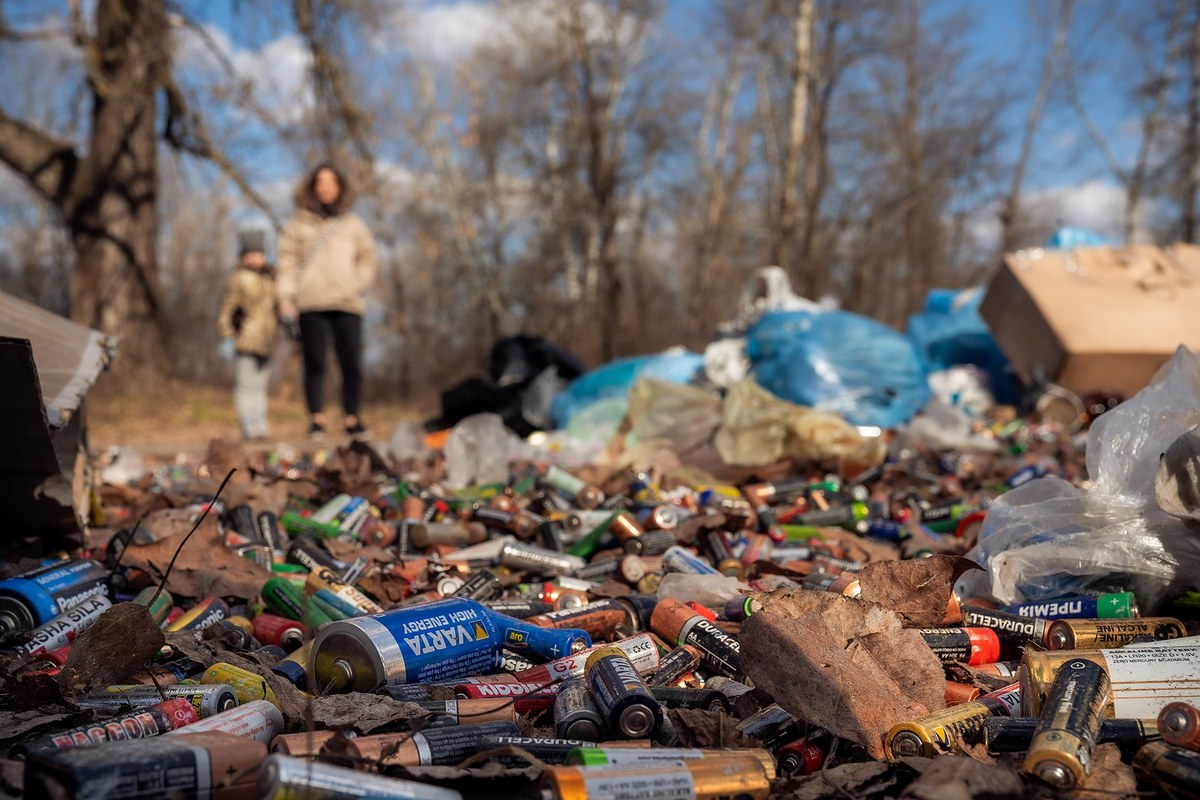
We have already explained many times why batteries should not end up in the trash cans of Ukrainians, and then in spontaneous (or organized) landfills, so we will not dwell on this topic in detail again. Although, despite all these explanations, more than 90% of batteries in Ukraine are not disposed of. Usually, ecologists operate with figures that one battery completely poisons about 16-20 square meters. meters of land.
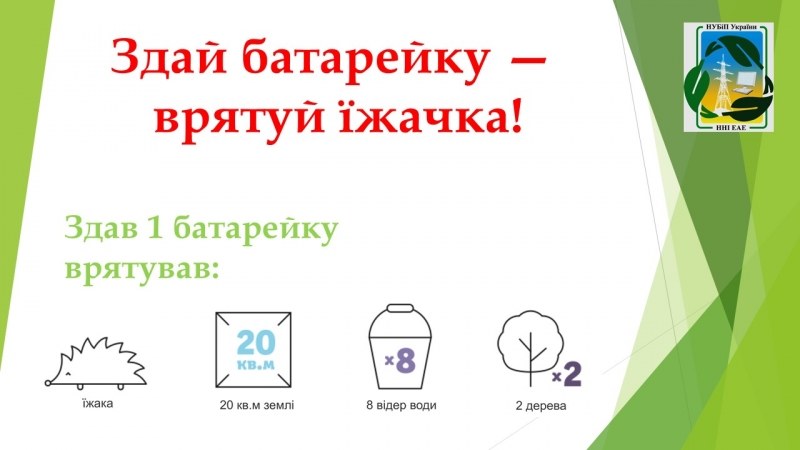
«Batteries themselves are hazardous waste because they contain heavy metals inside. And if they are simply thrown into the environment, in the open air, they will significantly pollute the soil. Up to 20 square meters around the battery will simply be destroyed, grass will not grow there, and hedgehogs may suffer. That’s why batteries must be collected», — noted in a comment on dev.ua, environmentalist, head of NGO «Ukraine without garbage» Evgenia Aratovska (not everyone can understand why hedgehogs are the most affected by batteries, but the environmentalist here used a reference to the well-known social campaign «Hand in the battery — save the hedgehog»).
Photo of NUBiP
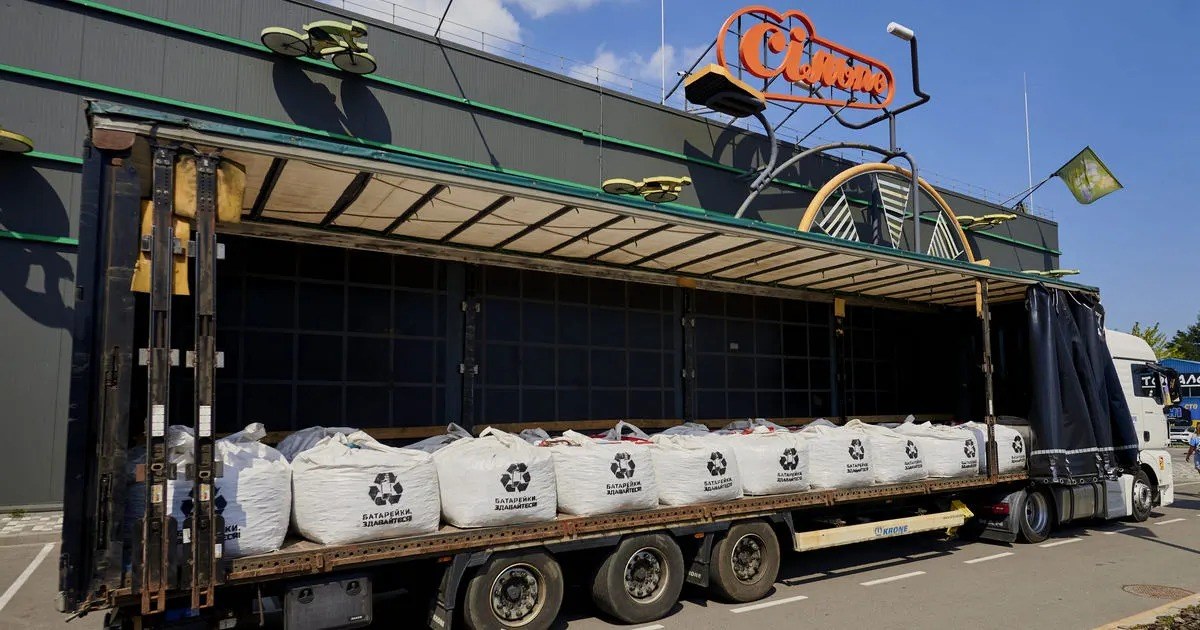
Provided that the batteries do end up in the containers of the «Batteries, Surrender» organization, after that they are first transported to a warehouse in Ukraine, and then to one of the factories in Europe. Trucks with used batteries are loaded and sent to the European plant when a sufficient number of them accumulates in the warehouse, which is about 20 tons (the content of at least one truck). At which factory — it depends, first of all, on the type of batteries.
On the website of the company «Ecological Investments», which is a partner of the «Batteries, Surrender» movement, the following types of batteries and their features are listed:
those containing manganese and zinc. The most common batteries that work thanks to nickel-metal-hydride connections.
lithium-ion (Li-ion) and lithium-thionyl chloride (Li-SOCl2). These are mostly batteries. This type has long been a concern of environmentalists, because lithium is active and dangerous for the environment, chlorine is simply poisonous, and batteries usually contain a large mass of these reagents;
silver-nickel. This type of batteries is subject to recycling, first of all, for economic reasons;
nickel-cadmium. The most dangerous species. Cadmium very strongly pollutes the soil and causes tangible damage to the ecosystem for a long time;
Ukrainian organizations, in particular, the «Battery, Surrender» eco-movement, now most often send batteries for recycling to the Recupyl plant in Poland (previously the main one was the GreenWEEE plant in Romania). As reported by the «Batteries, Surrender» movement itself, after the digitalization of the waste sector began in Romania in 2022, it actually had the opposite effect and it became difficult to work with this enterprise due to bureaucratic procedures. Since then, the Polish plant has become a priority.
At these factories, in turn, after the sorting of batteries is completed, some of them can be sent to their subsidiary companies or partner companies in another country, if they do not recycle a particular type of battery themselves.
For example, this year finger batteries (NiMh) collected by the movement in Ukraine were also sent to the EraSteel plant in France, and lithium batteries and batteries from phones, laptops and other gadgets — to the Fenix Battery Recycling plant in Great Britain.
As for the recycling process itself, some may, due to ignorance, have the misconception that old used batteries are somehow recycled into new ones, but this is not the case. Let’s turn to another explainer from the company «Ecological Investments», where the stages of disposal/recycling are indicated. But it is important to understand that this is a generalized explanation, because the cycle of disposal and recycling of batteries depends on their type.
Stages of disposal and recycling of batteries:
sorting used power sources according to their type and size (for the convenience of further processing);
primary processing (processing) — grinding of power sources for convenient separation of individual elements;
separation of iron (steel) using a strong electromagnet. If necessary, the procedure of crushing and separation of magnetic metal is performed several times;
neutralization of the electrolyte and other active reagents contained in the remains of power sources;
separation of elements by chemical methods, recovery from manganese and zinc salts, separation of graphite;
packaging of cells obtained from batteries and sending them to enterprises for reuse.
«Environmental Investments»
«The main products of battery recycling (processing) are scrap non-ferrous metals, which after briquetting is transferred to remelting and processing, as well as rubber mixture and polymer waste, which are used to obtain fuel by the pyrolysis method,» the company’s website states .
Why is this not done in Ukraine?
In 2011, Lviv factory «Argentum» announced the beginning of accepting salt and alkaline batteries for recycling. SE «Argentum» declared that it has been working on this topic together with the Institute of Inorganic Chemistry of NU «Lviv Polytechnic» since 2005. True, this work was mainly theoretical and consisted of conducting laboratory experiments on various ways of disposing of batteries.
But, judging by the archival video of TSN, in fact, there was no question of large-scale processing and it was a kind of profanation. On the footage, we see how one employee of the plant walks around a room littered with bags of batteries, and then grinds some of them on a unit of unknown age.
As Argentum’s management stated at the time, it was unprofitable to build an industrial line due to the too small volume of battery collection and disposal — because Ukraine does not have this cycle. At the same time, at the enterprise itself, batteries began to accumulate in a geometric progression after the application for disposal, and it was not possible to process them using existing methods either. Such a paradox arose, and finally, in 2018, the plant announced that it was closing this line as well, focusing only on their collection.
The «Batteries, Surrender» movement positions this activity of «Argentum» at that time as fake.
«When we first started the project, there was such a state enterprise „Argentum“ in Lviv, which declared that they were ready to accept batteries for recycling free of charge. At that time, we did not really understand the topic of recycling waste, and batteries in particular, so we thought — how simple it is! Only later, when we already had more than 40 tons of batteries from all regions in our warehouse, we learned the harsh reality: recycling batteries at the factory in Lviv is a fake, and there is basically no such factory in Ukraine that would recycle them. Why? Because the industrial process of recycling batteries is unprofitable. Everywhere in the world, the factory must pay it,» the organization’s website states .
A similar explanation regarding the economic factor of the absence of such an enterprise in Ukraine is given by the ecologist Yevgenia Aratovska in a comment on dev.ua.
«There is one big problem with batteries: there are so many different types. There are batteries from which you can get valuable metals, and there are those that are very harmful and should only be disposed of. These batteries must first be sorted, which is an expensive process. It is impossible to recoup any investment by selling the precious metals contained inside the batteries. At that time, very few batteries were collected in Ukraine, and the plant must work with a certain capacity,» she explains.
Actually, since the time when the management of «Argentum» abandoned the idea of full recycling (or stopped imitating this process), activists focused on building a network of collecting batteries and their organized export for recycling abroad.
How many batteries require recycling and how much does it cost
According to the documents of the «Batteries, Surrender» organization itself, only 6% of batteries in Ukraine are still being recycled. In the report of the movement for all years, it is stated that during its activity, 481.5 tons of batteries have been collected: 419.4 tons have been recycled, and 62.1 tons are in the queue for shipment.
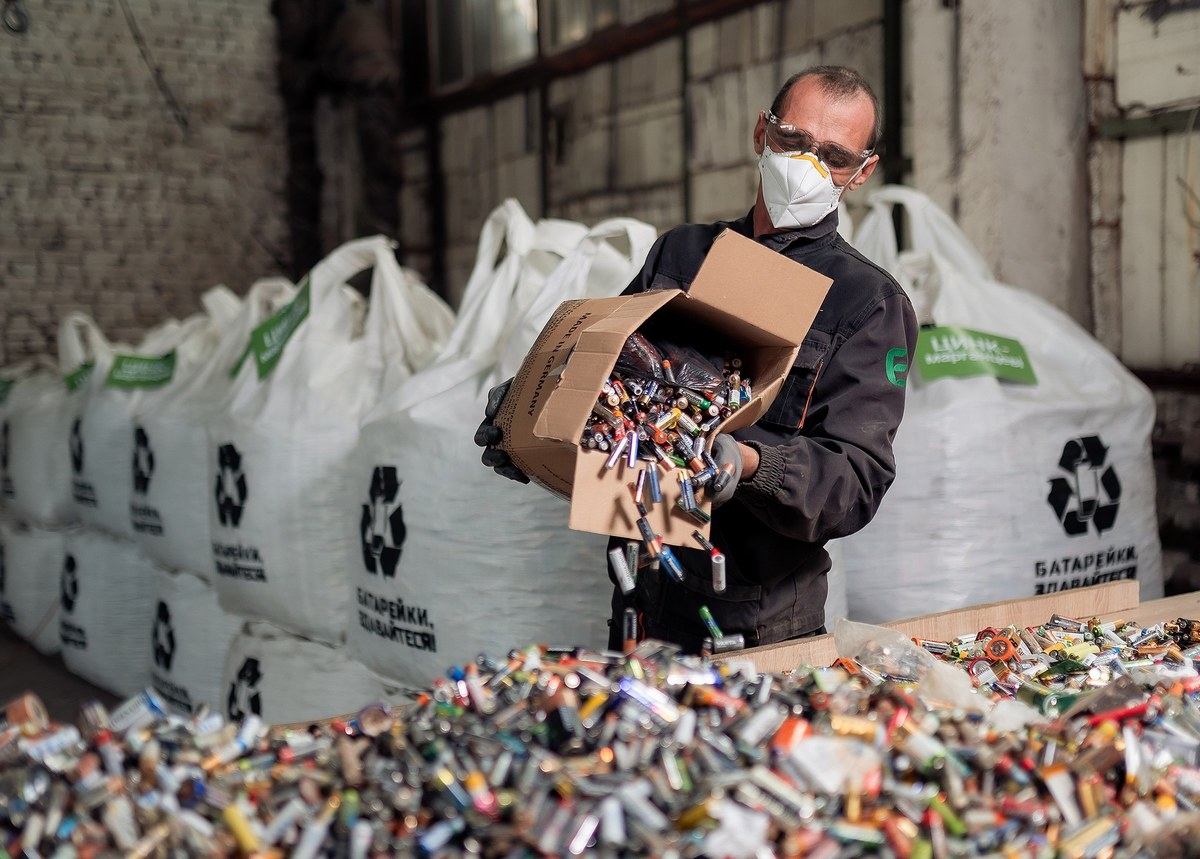
Photo of the «Batteries, surrender» movement
If we turn to simple mathematics and divide the rounded figure of 480 tons by 20 tons, which is occupied by one truck, it turns out that during the entire time, plus or minus, only 24 truckloads of batteries were exported from Ukraine. It will not be superfluous to note here that the export of used batteries for recycling abroad on the initiative of the «Batteries, surrender» movement began only in 2020, that is, this activity has been active for only four years (and a large part of it fell during the period of a full-scale invasion, which inevitably affected the process).
At the same time, about 3,250 tons of batteries are imported into Ukraine every year, and the absolute majority of them after use still end up in landfills, where they pollute the environment. As of the beginning of the winter of 2022, the trend had already improved and was at least moving in the right direction, but force majeure intervened in the form of the imperial ambitions of the Russian dictator.
«Last year, we sent 7 truckloads of batteries for recycling, but these batteries were collected in Ukraine for the previous eight years. Now we have sent 5 vans, which were assembled in one year, 2021,» — noted in the Eco-Rus on the eve of the «great war». But then a full-scale invasion of the enemy began, and a number of processes were put on hold not only for the movement, but for all Ukrainians. It was possible to return to the approximate rates of collection, which were demonstrated in 2021, only as of 2023.
At the same time, the minimum price of processing at factories in Europe is approximately 400-500 euros per ton, and maybe even a little more expensive. Again, here again we focus on the types of batteries, so there is no unified cost. «This is an expensive process. As far as I know, the cost of recycling a ton of batteries, depending on the type, can be from 500 to 800 euros per ton. It is quite expensive,» says Yevgenia Aratovska.
Where to get funds for disposal
In this connection, the readers may have a question: if the disposal of a ton of batteries is worth such money, then where will the conditional public organization get them? In this context, the fundraising launched on the website of the «Batteryky, Surrender» movement should not be taken seriously. «Our current goal is to attract regular support in the amount of UAH 20,000 per month from our supporters,» the website of the movement states. If such an amount is announced as a goal, then it is logical that currently it is less, and even if the fundraising goal is achieved, then this, conditionally, will be enough to dispose of only a ton of batteries. And one way or another, you need to take into account operational costs and logistics.
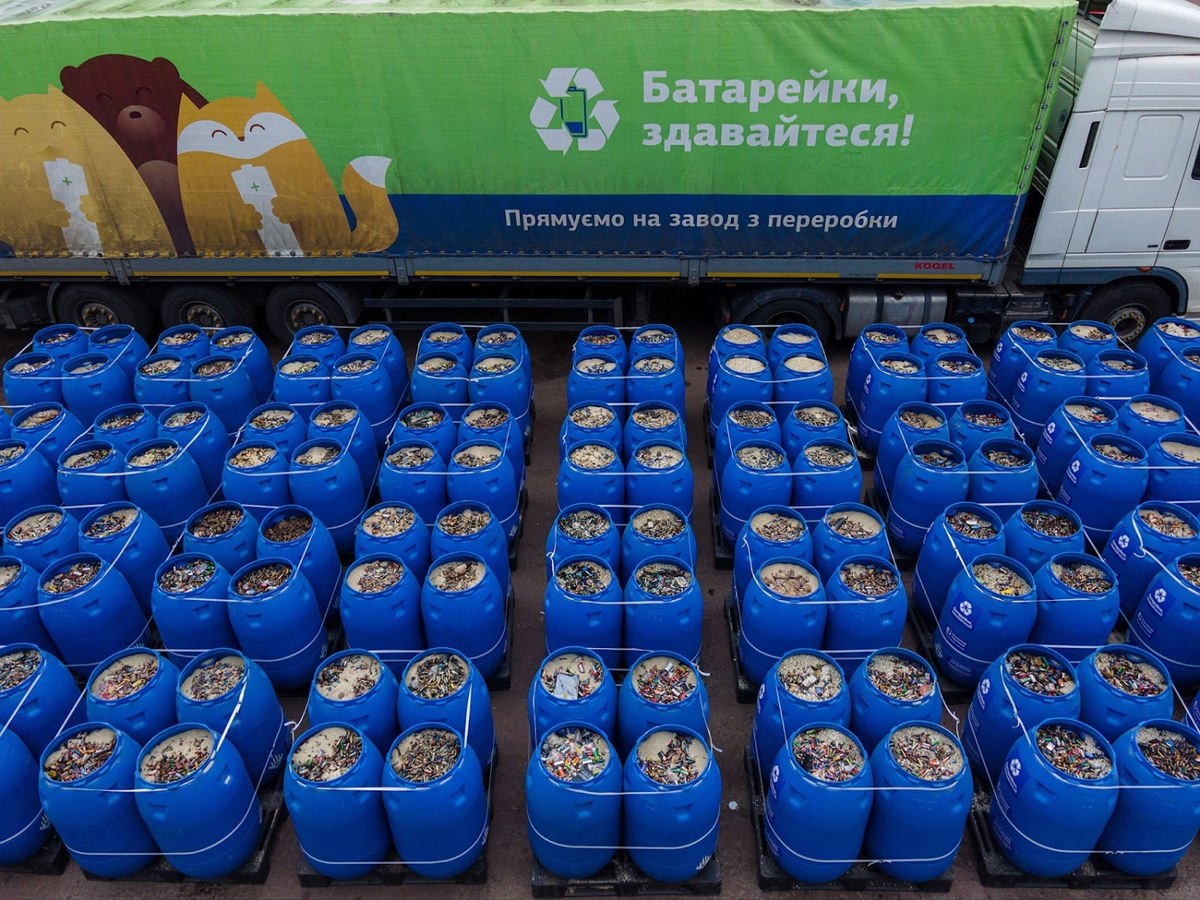
Photo of the «Batteries, surrender» movement
So, in this context, as serious sources of funds for recycling can be considered, firstly, charitable funds of trade networks that are involved in the collection, and other donors, as well as, secondly and most importantly, their cooperation with the battery manufacturers themselves — when a certain amount from the sale of each battery in the networks is laid specifically for its disposal.
«From the sale of each battery, a certain amount, which, most likely, is measured even in kopecks, not hryvnias, goes to a special fund. And when such a fund reaches a certain level, this money should finance the preparation of documents, transportation and payment for processing batteries abroad. This is a very correct and established model, when the entire chain from collection to recycling is financed,» Yevgenia Aratovska, head of the NGO «Ukraine without garbage», notes in a comment to dev.ua.
For example, at the end of last year, «Epicentr» announced that it would pay for the recycling of batteries from 1,000 schools and entrances. The network declares that in 2019 they were the first in Ukraine to start collecting batteries in all shopping centers, financing recycling according to this model — from the income from the sale of new batteries. At that time, the initiative was co-financed by such battery brands as Duracell, VARTA, GP Batteries and Hausmark.
In response to dev.ua’s request, the Silpo network replied that the financing of battery recycling is carried out jointly by the network and suppliers — Panasonic, GP Batteries, VARTA, Duracell, Energizer, VIDEX, whose products are sold in stores. «So, when you buy batteries from Silpo, you directly support the initiative and help dispose of used batteries properly,» the network’s press service noted.
What else was said in the networks
In the Allo press center, we were informed that they collect used batteries (as well as waste paper) at the company’s office.
«Until 2022, we handed over containers with batteries from the Allo office twice a year (depending on the capacity) to the representatives of the all-Ukrainian eco-movement „Batteryki, surrender!“: they sent the collected batteries and accumulators to processing plants in Europe,» they said in response to dev.ua request.
However, at the time of the full-scale invasion, this joint activity of the eco-movement and the network somewhat «slipped». «We are currently resuming cooperation with this team: we trust this eco-movement and are sure that the batteries will definitely be sent for recycling,» Allo reported.
«Silpo» has partnered with the initiative «Batteries, surrender!» from 2021. «Collection containers can be found in our stores on the packing tables or next to the waste sorting bins. In just one year — from August 2023 to August 2024 — we managed to collect more than 2.2 million batteries, or 44 tons. In total, guests brought about 90 tons of batteries during the initiative,» the network’s press service notes.
Photo of the press service of the «Silpo» network
«Silpo» added that used batteries collected in their stores were sent to the already mentioned factories in Romania (GreenWEEE) and Poland (Recupyl). There, the most popular zinc-manganese finger batteries underwent a full cycle of safe disposal and recycling. And other types of batteries went to Accurec factories in Germany, Erasteel in France and Fenix Battery Recycling in Great Britain, where they were redirected by partner factories from Romania and Poland.
«The process of collecting and disposing of batteries is carefully controlled. We cooperate with licensed operators who have permits for the transportation and processing of hazardous waste, and fully ensure the transparency of this process,» Silpo assured.
The Rozetka network responded to our publication’s request that they sell tens of thousands of batteries per month, and collect used batteries in 28 stores of the network.
«On average, it is 230 kg per year. It is planned to install tubes for collecting batteries in another 150 stores throughout Ukraine in the near future,» the press service shared the plans.
All collected used batteries are transferred to the warehouse of PP «Promo service» as a licensed contractor of this project, where they are sorted and then exported to the Polish company BatEko for recycling.
«Rozetka, for its part, controls how many batteries it sent for recycling and receives information in which truck the batteries were exported and recycled. This volume is also confirmed by acts of completed works based on BatEko reports. The control of the general collection is on the side of the contractor „Promo Service“, which annually reports to the Ministry of Environment of Ukraine in accordance with the current legislation,» the press service of the network noted.
Fakes, competition or environmental wars?
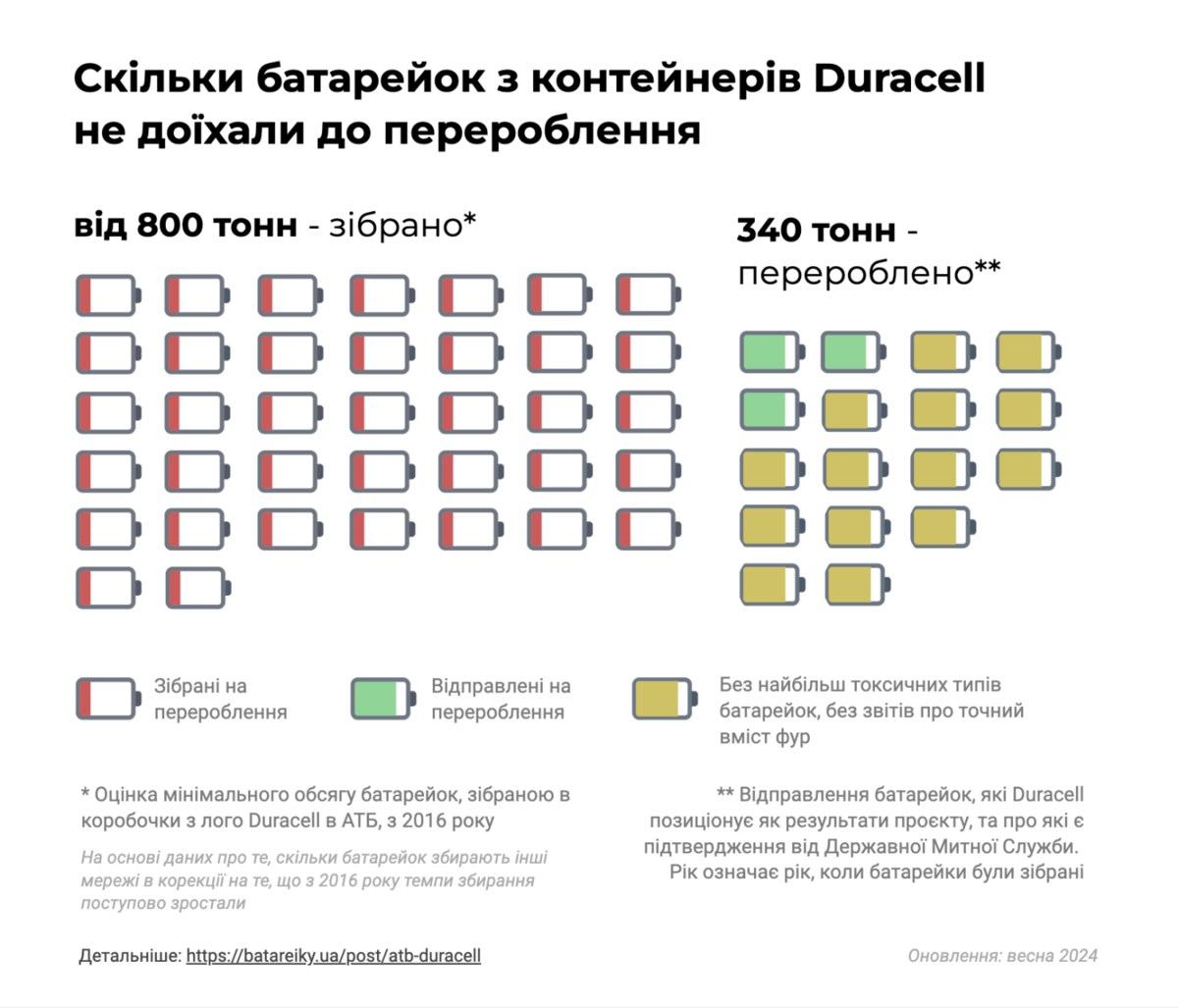
In the process of getting acquainted with the materials on the topic of battery disposal, it turned out that the «Batteries, surrender» movement calls into question the safety of the battery disposal process currently carried out by other retail chains, in particular ATB.
An explainer with the telling title «Why you can’t trust ATB batteries — more than half don’t make it to the factory» is posted on the website of the movement. Here, in particular, it is indicated that in the fall of 2016 the Duracell brand started collecting batteries in partnership with ATB, but these batteries were not recycled until 2021 (for the sake of fairness, it is worth mentioning that with the participation of the «Batteries, Surrender» movement, the first truck with used batteries went to processing abroad only in 2020 year).
In the above-mentioned explainer, the difficult history of the negotiations of the «Batteries, surrender» movement and the ATB network, as well as the main factors that make us doubt the correctness of the process of safe disposal and the selection of contractors, are outlined.
Infographics of the «Batteries, surrender» movement
«Batteries, surrender» also indicate that the movement checked the register of licensees of the Ministry of the Environment, in particular, information on whether PP «Promo service» has a permit to export hazardous waste to the BatEco plant in Poland. «It turned out that it was not, only a 'green list,'» the material notes. The movement also emphasized the fact that the BatEko plant in Poland does not have permission to accept the most dangerous types of batteries.
At the same time, the partner of ATB and Rozetka PE «Promo service» on its official website also points out the exclusivity of its activity in recycling batteries in Ukraine. «We are the only enterprise in Ukraine that implements the full cycle of recycling used batteries: from the manufacture and placement of boxes for collection to the transfer to the actual recycling of power cells,» they note there. At the same time, judging by the same website of the company, its main activities are merchandising and promotion.
On another site called BatterFly, which, apparently, is a separate site of the Promo Service PE for the environmental part of the company’s activities and to which the press service of the Rozetka company gave a link, in particular, it is indicated that the partners of the initiative are also «Aurora «, ROST supermarket and SAV Orbico. It also states that with the participation of the company and its partners, 25,731,400 batteries have already been recycled.
«Aurora Multimarket and BatterFly environmental project join forces. The joint project of collecting and recycling used batteries became a step in the direction of sustainable development and environmental responsibility. In a short period of time, it was possible to collect more than 60,000 batteries, of which 20,000 have already been successfully recycled at the European plant,» — noted in the recent press release of Aurora.
dev.ua does not undertake to evaluate certain accusations of participants in the battery disposal market, but we sent a request to PP «Promo service» regarding a number of issues. We also contacted Lyubov Kolosovska, head of the «Batteries, Surrender» movement, for an interview in order to understand in more detail how this market works.
What needs to change
Environmental activists claim: another problem area in the topic of disposal and recycling of batteries is weak legislative regulation. If it were proper in Ukraine, it would create additional conditions for disposal to take place in a civilized manner. As a result, we have a big gap in the field of separate waste sorting, which is still the prerogative of a small percentage of conscious citizens, but by no means a state policy.
The first thing Yevgenia Aratovska drew attention to was the need for separate garbage collection, which, according to the environmentalist, will make the relevant communal services only slightly more expensive, but will create essential prerequisites for improving the environmental situation. According to the head of the NGO «Ukraine without garbage», economic principles should be created, according to which it will be more profitable for people to sort garbage instead of throwing it away. There is some opposition to this, because, as Aratovska says, the populists are afraid of a significant increase in garbage tariffs. But many buildings in the capital already pay up to UAH 300 per month, and often more, for the removal of garbage from the territory of the complex. So will conditional +100 hryvnias to this value be so critical?
Photo of the «Batteries, surrender» movement
«When we calculated how much the separate fee will cost and what the tariff for people should be, the cost of such a separate fee will be about 100 additional hryvnias per month. Sometimes it’s like one cup of coffee in an establishment. In fact, it’s worth just looking at the truth in the eyes and calculating how much we spend on health care and medicine if we live near a landfill and suffer from this pollution. Whole generations can grow up with certain defects and diseases,» she notes.
According to Yevgenia Aratovska, now separate collection does not work, because the cost of burying garbage in Ukraine is much cheaper than the efforts that the garbage hauler would spend on setting up the sorting system.
Yevgenia Aratovska, head of the NGO «Ukraine without garbage»
«If the cost of burying garbage at the landfill in Pidhirtsy near Lviv is 5-6 euros per ton, and the environmental tax is 5 UAH per ton of household waste, then separate collection of collected, sorted and prepared waste costs the operator 200 euros per ton. These are incomparable scales, and altruism alone cannot be dispensed with here.»
This is precisely what requires the intervention of the state as a regulator, as the expert believes.
The second thing that the environmentalist focuses on is the need to introduce the so-called principle of extended producer responsibility, according to which each company must bear both financial and organizational responsibility for the full life cycle of its products, even when they become waste.
«In Europe and America, it is often the producer companies that are responsible for setting up sorting sites, purchasing garbage trucks that carry out separate collection, and ensuring that haulers cover their costs for this. Otherwise it doesn’t work. It would be unfair to transfer these large funds to the consumer’s wallet. The company has more resources, plus it encourages the companies themselves to adhere to environmental standards,» commented Aratovska, noting that this principle applies equally to battery manufacturers and to any other industrial producers whose products harm the environment.
The only thing that can inspire: fewer and fewer modern gadgets work on batteries, or at least most of them are becoming much more energy-efficient, due to which the operation of one set of batteries is extended. This is unlikely to be of any real comfort to environmental activists and those concerned about the issue, but at least it provides an opportunity to see the light at the end of the tunnel. Somewhere very, very far away.
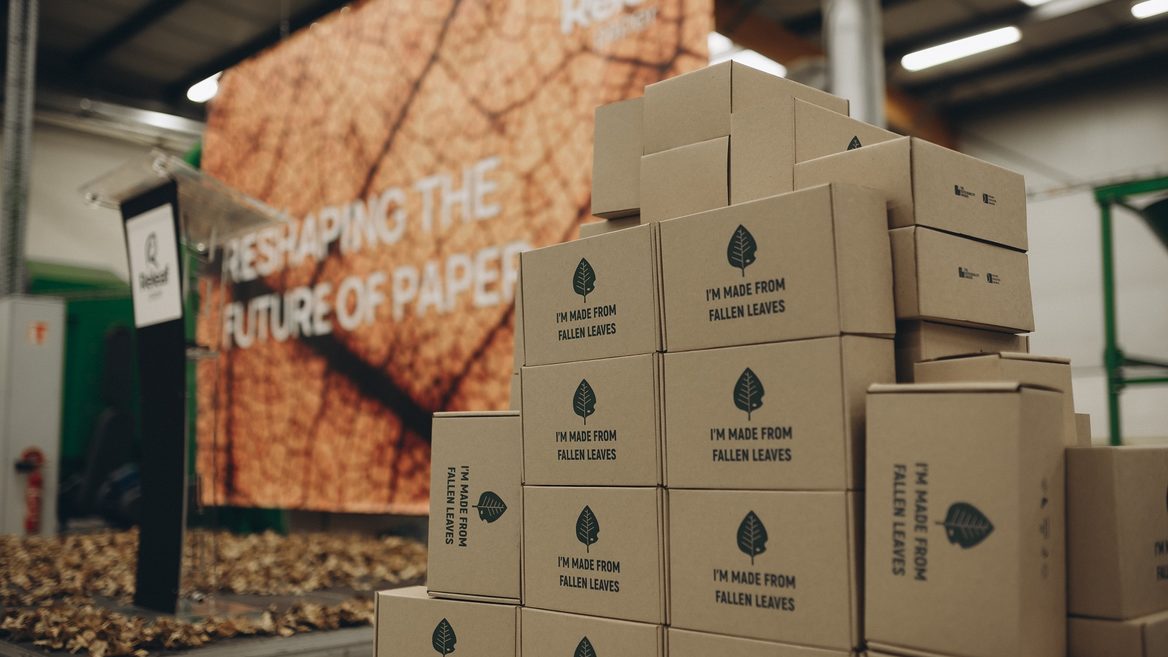
Ukrainian eco-startup Releaf Paper, which processes fallen leaves into paper, has launched production in France. In the next five years, the company plans to launch leaf processing throughout Europe