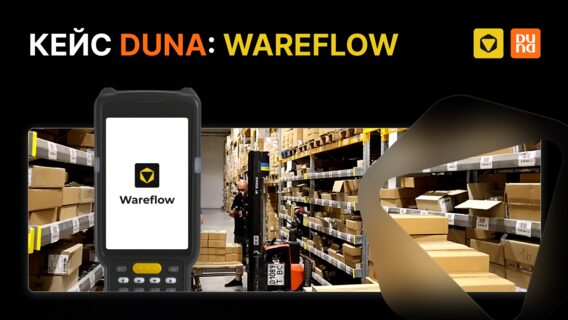
Wareflow best practice library: WMS implementation case for DUNA
WMS (Warehouse Management System) Wareflow is a Ukrainian product created to increase warehouse productivity from the first weeks of use.
According to Statista, the global warehouse automation market is growing at 15% annually and will reach a size of US$41 billion in 2027. The European warehouse automation market is expected to grow to US$13.35 billion by 2033 with a compound annual growth rate (CAGR) of 8,8% from 2026 to 2033.
WMS (Warehouse Management System) Wareflow is a Ukrainian product created to increase warehouse productivity from the first weeks of use.
According to Statista, the global warehouse automation market is growing at 15% annually and will reach a size of US$41 billion in 2027. The European warehouse automation market is expected to grow to US$13.35 billion by 2033 with a compound annual growth rate (CAGR) of 8,8% from 2026 to 2033.
How does WMS work?
WMS functionality includes:
automation of receiving, placing, packaging and shipping of goods;
inventory and balance control;
facilitating transport planning;
formation of a functional warehouse map and optimization of product placement;
analysis of the performance of each employee’s tasks;
analytics and reports for management decisions.
What makes Wareflow different from other WMS?
«We visit the warehouse at almost all stages, including the product owner or project manager and often senior management. On the client side, the logistics or warehouse manager is involved. This is true teamwork, in which solutions are born directly on the spot, and not in endless correspondence or meetings,» — Nazariy Dmytriv, co-founder and COO of Wareflow.
The WMS team provides full support at every stage. It conducts an audit of the warehouse and existing business processes, sets up exchange with ERP, configures the system for the business, tests modules, conducts inventory, trains employees with a visit to the warehouse. This makes it possible to select the truly necessary functionality, optimize the implementation process and minimize potential blockers.
Wareflow participated in the Google for Startups program and was included in the list of 35 Ukrainian startups that received $100,000 in funding and mentoring support from Google experts. The use of artificial intelligence in warehouse logistics has become an advantage. An AI module is currently being developed that will analyze data at the client onboarding stage: based on the given parameters, the system will select the best work scenarios from the built-in best practice library. In the future, AI process analytics, optimization tips, and inventory assistance.
DUNA case: best practice library
The best practice library is a directory of the best solutions tested in practice by top companies: Leo Ceramics, Yarych. UkrPol, etc. Based on previous cases, Wareflow offers either a ready-made solution or adapts it to the specifics, needs, and conditions of the company’s warehouses. All processes are configured through an internal configurator.
DUNA, the leader and the only Ukrainian factory with a completely full range of hosiery products, introduced a motivation function for storekeepers and within six months the system showed who was working with full dedication and who was lacking in engagement. This allowed us to reduce the number of employees by up to 30% and, with a smaller number of personnel , reduce the picking time by 35% .
Thanks to the best practice library, companies gain access to the experience of the best market players. This is especially useful for those who want to get results quickly but do not have the resources for long-term process design.
How to understand that WMS is needed?
The warehouse is not keeping up: goods are being received, picked or shipped with delays
The staff is growing, but productivity is stagnant or even falling. The increase in the number of people does not make orders processed faster.
The company is scaling, but the warehouse is not handling new workloads.
Product losses: something disappears or spoils, it is difficult to track and monitor the integrity of the product at each stage of storage.
The market is moving to a new level: competitors have introduced automation and started processing orders faster, more accurately, and without errors.