Хочете будувати кар’єру в Data Science та AI? Vodafone Big Data Lab відкриває новий набір —>
Марія БровінськаCrypto
15 December 2024, 23:10
2024-12-15
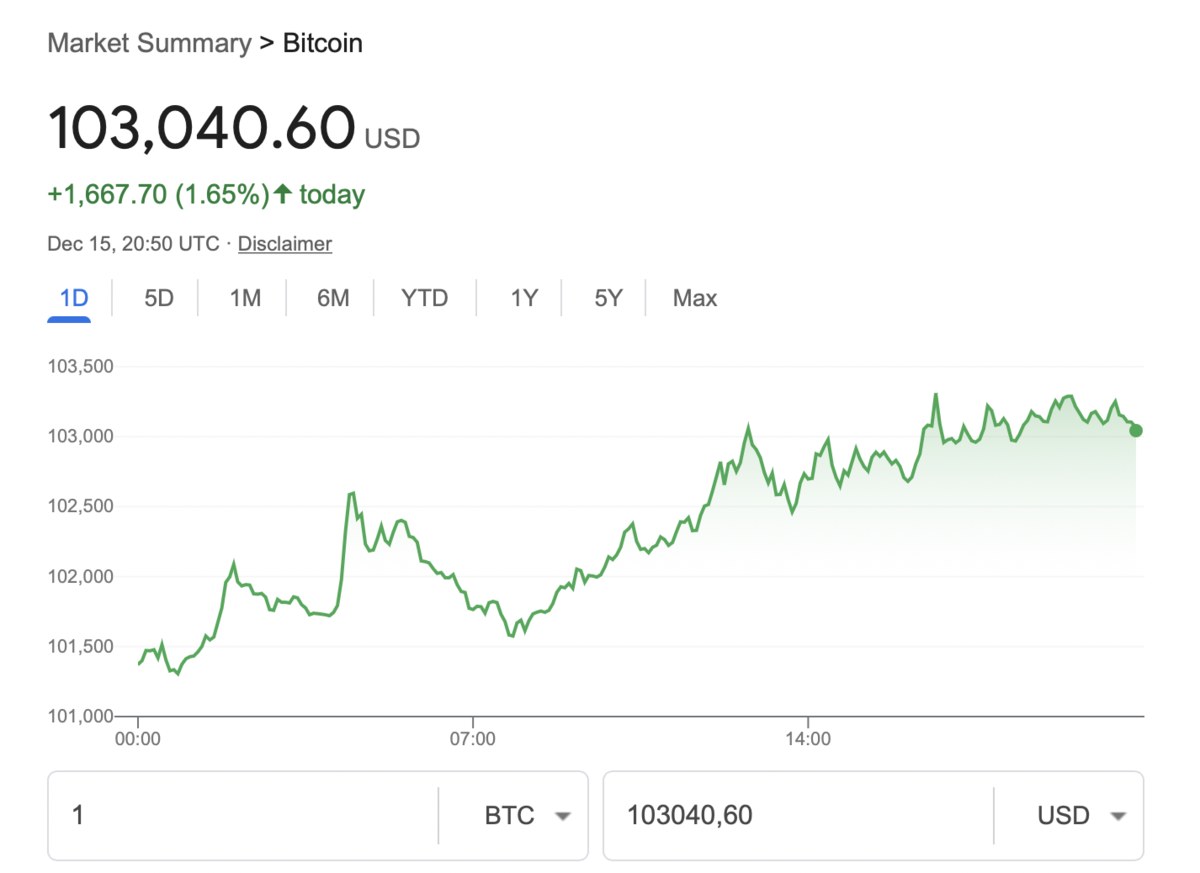
Bitcoin is once again on its way to a record high, having jumped above $103,000. Will the coin break the previous record of $103,679, and what does the USA, Japan and the Russian Federation have to do with it?
The price of Bitcoin has almost set a new record — the most popular cryptocurrency is already worth over $103,000. What’s happening?
The price of Bitcoin has almost set a new record — the most popular cryptocurrency is already worth over $103,000. What’s happening?
According to crypto analysts cited by cryptopolitan.com, this dynamic is being driven by the efforts of several countries to quickly integrate crypto into their economies. In particular, the United States wants to buy a million bitcoins over the next five years to solve its $35 trillion debt problem.
Japan and Russia are also getting into the game, with Japan focusing on financial innovation and Russia using Bitcoin to combat sanctions.
America sets the pace
US President-elect Donald Trump has announced plans to create a national bitcoin reserve with an ambitious goal of acquiring one million bitcoins within five years. The strategy aims to solve the $35 trillion national debt and restore America’s leadership in the digital economy.
The US already has a decent head start on this plan. Federal agencies hold an estimated 200,000 bitcoins seized from criminals, currently valued at $20 billion. Senator Cynthia Lummis has led the legislative push to create bitcoin reserves by introducing the Bitcoin Act into Congress.
This law not only supports Trump’s vision, but also positions Bitcoin as a long-term strategic asset. Lummis sees Bitcoin as a hedge against traditional financial instability and a necessary tool for ensuring economic stability.
Japan sees Bitcoin as a financial lifeline
Japan is creating its own narrative about Bitcoin. Satoshi Hamada, a cryptocurrency advocate, has called for converting some of Japan’s gold reserves into Bitcoin. His argument is that Bitcoin is an opportunity to break free from the constraints of traditional currencies such as the US dollar and yen.
Hamada believes this could increase Japan’s financial independence and spur innovation in blockchain technology. But there’s one caveat: The proposal doesn’t have broad political support.
His party has only two seats in parliament, but his ideas are gaining traction among lawmakers seeking to modernize Japan’s fiscal strategy. The government, however, has yet to formally approve anything.
Russia uses Bitcoin to fight sanctions
Meanwhile, Russia, which is under the burden of crippling Western sanctions, is seeing Bitcoin as a lifeline. Anton Tkachev, a deputy, has proposed creating a national Bitcoin reserve to protect the country’s economy from external pressure.
He explained that Bitcoin offers an alternative to traditional currencies, which have become geopolitical weapons in the hands of Western countries such as America and the UK.
The Russian government is gradually warming up to the idea. Recent changes to crypto regulation include tax exemptions for Bitcoin transactions and legalization of mining in certain regions. Also, as we reported, President Vlad Putin signed a law declaring cryptocurrency «legal property» just a few weeks ago.
All of this lays the groundwork for a more Bitcoin-friendly economy. Tkachev sees Bitcoin as a hedge against inflation and a tool for maintaining financial stability in times of geopolitical uncertainty.
The dollar, long the world’s reserve currency, is now facing a decentralized competitor in what some analysts are calling a «crypto-cold war.»
Risks of adopting Bitcoin as a reserve asset
Despite all the hype, Bitcoin is no magic bullet. Its notorious price volatility makes it a risky choice for economies. Over the past year, the price of Bitcoin has fluctuated by 65%, far more than traditional reserve assets such as gold or the US dollar.
A sudden drop could be terribly destabilizing for a country’s economy, turning Bitcoin from an asset into a liability and erasing years of tireless work to prove its worth.
There is also a regulatory nightmare. Creating a national bitcoin reserve would require a complete overhaul of existing financial policies. That can’t be easy.
Governments will need to navigate many complex legal frameworks, address money laundering concerns, and gain public trust in this still relatively new and obscure asset class.
How will crypto traders behave?
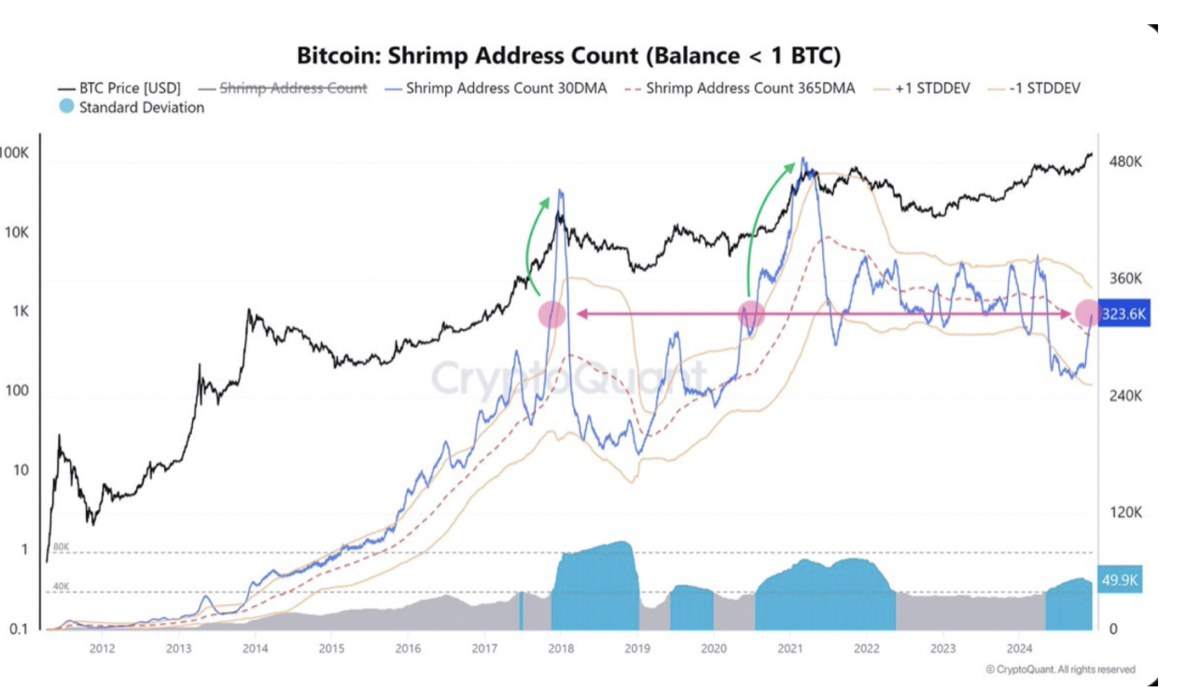
Bitcoin wallets holding less than 1 BTC are expected to grow by about 9% in the near term as retail investors continue to accumulate funds despite the asset surpassing the $100,000 mark, according to a crypto analyst.
«Despite being called ‘shrimps,’ these holders demonstrate strong confidence in Bitcoin’s growth by continuing to accumulate coins even at current price levels,» noted Axel Adler, author of CryptoQuant, in a post on December 14.
The trend indicates an upward movement for Shrimp wallets. Shrimp wallets are an important indicator for crypto market participants, allowing them to understand the level of «retail interest» in Bitcoin.
Axel reported that the average number of Shrimp addresses holding less than 1 bitcoin is currently 323,000, and he expects this number to grow by another 8,67% in the near term.
Bitcoin Shrimp address count graph. Source: Axel Adler
«Given the current trend, I expect the number of addresses to continue to grow, reaching 351,000 in the near future.»
Adler explained that this growth began when Bitcoin was trading at $61,000 and had 265,000 shrimp addresses. He said that since that price level, the number of shrimp addresses has increased by «21.9%.»
While the «shrimps» continue to accumulate, long-term holders — wallets that have held bitcoin for at least 155 days — have been unloading recently.
On December 9, Cointelegraph reported that long-term holders sold 827,783 BTC in the past 30 days.
Some analysts say that heavy selling by long-term holders could signal a potential top that could turn markets bearish and catch traders offside when demand from buyers begins to wane.
However, according to one crypto analysis, Bitcoin’s short-term price drop is unlikely to be as deep as the recent 10% drop in early December, as selling pressure has eased significantly since its first spike above the six-figure mark.
American MicroStrategy will become the first «bitcoin company» included in the Nasdaq-100 index. This is a new step towards even greater recognition of the crypto