Хочете будувати кар’єру в Data Science та AI? Vodafone Big Data Lab відкриває новий набір —>
Наталя ХандусенкоAI Eng
2 May 2025, 17:54
2025-05-02
World's first. American engineers have developed a chip that runs on light, speeds up AI training and reduces energy consumption
Engineers from the University of Pennsylvania have developed the first programmable chip capable of training nonlinear neural networks using light — a major breakthrough that could significantly speed up AI training, reduce power consumption, and eventually lead to the creation of computing systems that run entirely on light.
Engineers from the University of Pennsylvania have developed the first programmable chip capable of training nonlinear neural networks using light — a major breakthrough that could significantly speed up AI training, reduce power consumption, and eventually lead to the creation of computing systems that run entirely on light.
Unlike conventional AI chips that rely on electricity, this new chip is photonic, meaning it performs calculations using beams of light, writes SciTechDaily.
Most artificial intelligence systems today rely on neural networks—software designed to mimic biological nervous tissue. Just as neurons connect together to allow biological creatures to think, neural networks connect layers of simple units, or “nodes,” together to enable AI systems to perform complex tasks.
In both artificial and biological systems, these nodes only “fire” after reaching a certain threshold—a nonlinear process that allows small changes in the input to cause larger and more complex changes in the output.
Without this nonlinearity, adding layers does nothing: the system simply reduces to a single-layer linear operation, where the inputs are simply added together, and no real learning occurs.
While many research groups, including those at Penn Engineering, have developed light-powered chips capable of performing linear mathematical operations, none have solved the problem of representing nonlinear functions using light alone—until now.
Transforming light with light
The team's breakthrough begins with a special semiconductor material that responds to light. When a beam of "signal" light (carrying input data) passes through the material, a second "pump" beam shines from above, correcting the material's response.
By changing the shape and intensity of the pump beam, the team can control the absorption, transmission, or amplification of the signal light depending on its intensity and the behavior of the material. This process "programs" the chip to perform various nonlinear functions.
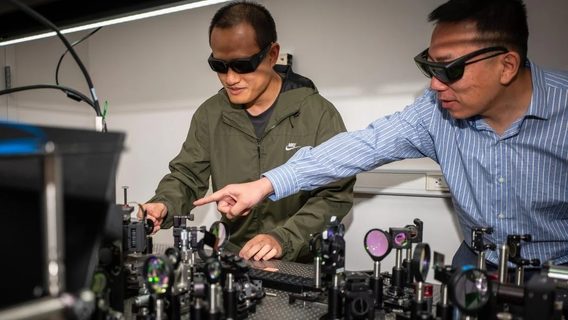
"We're not changing the structure of the chip. We're using light itself to create patterns inside the material, which then change how light travels through it," says Liang Feng, professor of materials science and engineering, electrical engineering and systems engineering, and senior author of the study.
The result is a reconfigurable system that can express a wide range of mathematical functions depending on the pump's operation pattern. This flexibility allows the chip to learn in real time, adjusting its behavior based on feedback from the output.
Learning at the speed of light
To test the chip's potential, the team used it to solve benchmark AI problems. The platform achieved over 97% accuracy on a simple nonlinear boundary value problem and over 96% accuracy on the famous iris flower dataset, a machine learning benchmark.
In both cases, the photonic chip matched or outperformed traditional digital neural networks, but used fewer operations and did not require power-intensive electronic components.
One striking result is that just four nonlinear optical connections on the chip are equivalent to 20 linear electronic connections with fixed nonlinear activation functions in the traditional model.
Unlike previous photonic systems, which are fixed after fabrication, Penn's chip starts as a blank canvas. The pump light acts like a paintbrush, writing reprogrammed instructions into the material.
“This is a real proof of concept for a field-programmable photonic computer,” says Feng. “It’s a step toward a future where we can train artificial intelligence at the speed of light.”