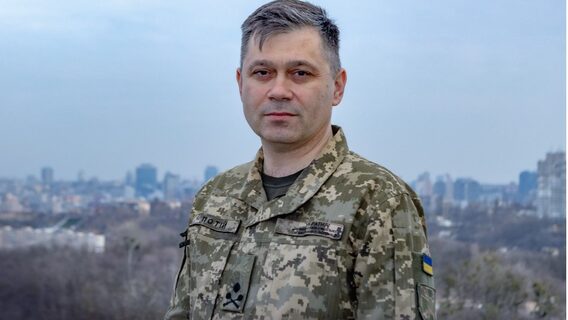
"Why do cyberattacks when you can just physically destroy everything?" We recorded a blitz with the brigadier general, head of the State Special Communications Service, about existing threats. He invited IT specialists to sign a contract with his department - the work is
Oleksandr Potiy, Brigadier General and Head of the State Service for Special Communications and Information Protection, in a conversation with dev.ua at the press center of the Kyiv International Cyber Resilience Forum 2026, explained why cyberattacks on the energy sector have receded into the background, how the national incident response system works, and why IT professionals with experience in cyber defense can sign a contract with the State Service for Special Communications and Information Protection now.
Oleksandr Potiy, Brigadier General and Head of the State Service for Special Communications and Information Protection, in a conversation with dev.ua at the press center of the Kyiv International Cyber Resilience Forum 2026, explained why cyberattacks on the energy sector have receded into the background, how the national incident response system works, and why IT professionals with experience in cyber defense can sign a contract with the State Service for Special Communications and Information Protection now.
— The MPs wrote that there was supposedly a cyberattack on the energy sector at the end of January. Even the metro wasn’t working, remember? Was it really a cyberattack?
— Look, we have very clearly established work with the community regarding certain incidents.
First, our national response team always comes out with relevant communications and it tells all this and shows what happened and what didn’t happen. That is, you can always watch it.
Regarding the metro: the response team immediately said that this was not the case. Perhaps there was some other failure related to electricity.
— What is happening with energy now?
— It is being physically destroyed. Why carry out cyberattacks if you can simply physically destroy everything? We have not observed any critical cyber incidents of a national scale recently.
— Are banks, mobile operators, railways under attack?
— Constantly. Everything is subject to attacks of one level or another. Something supercritical that requires the attention of the community — at this time, I hope, there is no reason for it to happen, I hope, because we are ready. But they (attacks — Ed.) can always happen, so let’s stick together and fight back.
— IT professionals read us. Do you need people and how can I reach you?
— Come and sign a military contract.
— What will this person do? Are there any positions?
— There are positions. Let’s see what a person can do — IT specialists are different. We have a research institute, a response team, a state cyber defense center with a SOC. IT specialists with a focus on cyber defense — please.
— Regarding salary — will there be bonuses or a standard rate?
— And what is the standard one?
— I don’t know.
— The salary will be in accordance with the norms provided for military personnel of the State Special Communications Service.
— Will he survive in Kyiv (laughs)?
— We are surviving. And why are you only Kyiv — there are also positions at the regional level.
Regional network of response teams
— By the way, you mentioned the beginning of the development of a regional network. These will be local response centers, right?
— These are regional response teams — CSIRTs. CERT is the national level, one per country, a point of contact. Everything else is CSIRTs.
— What does it look like physically?
— Officers sit in a modern room with monitors and computers. They interact with other teams, respond to incidents, answer calls, go to the scene if necessary. All the protocols, playbooks — all this is done by our officers.
— The first regional center — where will it be?
— Rivne. And then — according to plan, depending on readiness. In each district. And then we have plans for industry centers.
How businesses can collaborate
— If I am the owner of an information system, can I contact you?
— Yes. We protect state information resources in any case. If you have a critical system, you can hand it over to us for research. In the event of a cyber incident, let us know and the team will connect.