Хочете будувати кар’єру в Data Science та AI? Vodafone Big Data Lab відкриває новий набір —>
Марія БровінськаAI Eng
23 April 2026, 08:27
2026-04-23
AI-native engineers are replacing classic devs: who will IT companies hire in the era of AI agents? SoftServe and MIT Technology Review study
Artificial intelligence has already ceased to be just a «tool for coding» — it is gradually becoming the core of the entire development process. And this directly affects who the market will need tomorrow.
Artificial intelligence has already ceased to be just a «tool for coding» — it is gradually becoming the core of the entire development process. And this directly affects who the market will need tomorrow.
SoftServe, together with MIT Technology Review, presented a study called Redefining the Future of Software Engineering, which describes how agent-based AI is changing the approach to software development — and why classic developer roles no longer work the way they used to.
From copilots to development management agents
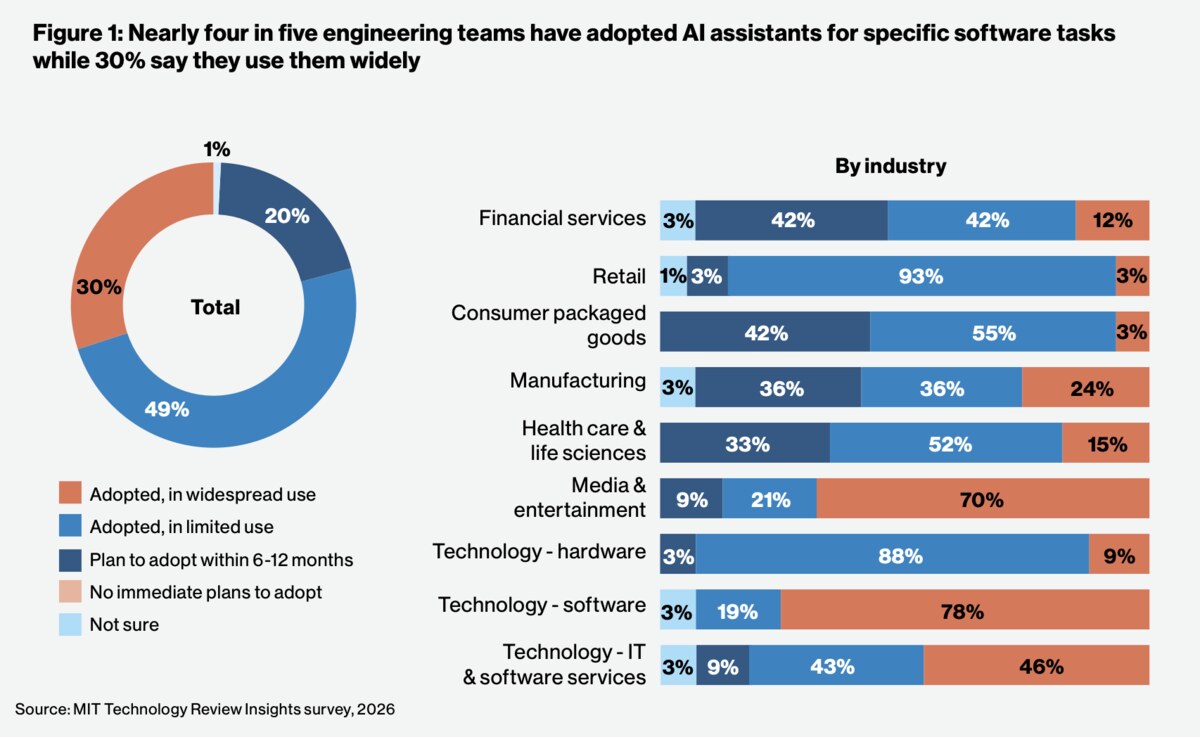
Today, AI assistants have become a part of everyday work: 79% of respondents use them for writing code, testing, or quality assurance. But this is only the first stage.
Companies are rapidly moving towards a fully agent-based model, where AI doesn’t just assist, but is involved in the entire SDLC. According to the study, 72% of organizations expect AI agents to manage most or all phases of development within two years. And 41% believe it will happen even faster — within the next 18 months.
In fact, it is about moving from «developer with AI» to «developer-driven agent system.»
A new type of specialist: AI-native engineer
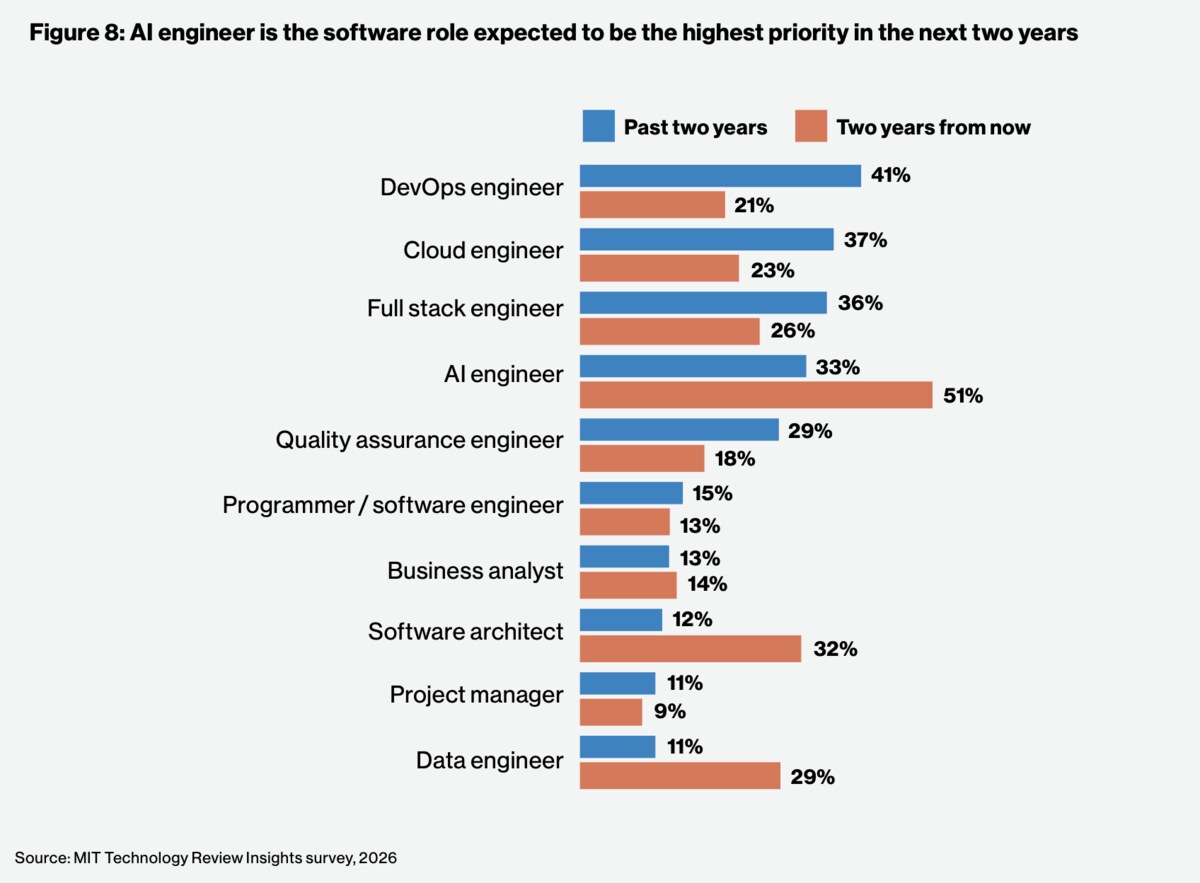
This shift is inevitably changing the very role of the engineer. While DevOps, cloud, or full-stack skills were once key, the focus is now shifting to something else: the ability to work with agents, build multi-agent systems, manage context, and correctly formulate tasks for AI.
The study directly states that AI engineers are becoming the most in demand (51% of responses). Next are software architects (32%) and data engineers (29%).
But the main idea is broader: the market will need so-called AI-native specialists — engineers for whom AI is not a superstructure, but a basic work environment.
It’s no longer about efficiency — it’s about new product quality
A separate interesting point: businesses no longer view AI solely as a way to save money.
The study participants talk about something else — about the ability of teams to experiment faster, find alternative approaches to development, understand users more deeply, and even learn from related industries.
«We are seeing a shift from isolated experiments with vibecoding to systemic agent engineering,» explains Serge Gaziev, CTO of Advanced Technologies at SoftServe. According to him, the real breakthrough will come not from the technologies themselves, but from rethinking the entire system — processes, people, and tools.
But there is a nuance: it is difficult and expensive.
Despite optimism, implementing agent-based AI is not a painless process.
44% of respondents cite the cost of computing resources and the difficulty of integrating agents into real-world processes as the main barriers. In other words, the problem is no longer to «plug in AI,» but to make it work stably in production.
This means that companies will have to change not only the technology stack, but also the very logic of how teams work.
However, despite these challenges, business has no doubts about the direction of movement: already half of companies call agent AI an investment priority, and by 2028 this will be 84%.