Хочете будувати кар’єру в Data Science та AI? Vodafone Big Data Lab відкриває новий набір —>
Марія БровінськаAI Eng
29 October 2026, 09:52
2026-10-29
A Ukrainian created Poly Duo — a free tool that makes ChatGPT and Claude check each other's answers
Ukrainian independent AI researcher Vadym Chernets has developed Poly Duo, an open-source tool that allows you to run ChatGPT and Claude together on an iPhone. One AI generates the answer, the other checks it and looks for errors. The user receives a short summary with areas of agreement, disagreements, and questions to check for themselves.
Ukrainian independent AI researcher Vadym Chernets has developed Poly Duo, an open-source tool that allows you to run ChatGPT and Claude together on an iPhone. One AI generates the answer, the other checks it and looks for errors. The user receives a short summary with areas of agreement, disagreements, and questions to check for themselves.
How Poly Duo works
Poly Duo, according to the author of the development, automates a scenario familiar to many users of several AI assistants: first ask a question to ChatGPT, and then transfer the answer to Claude to check its reliability.
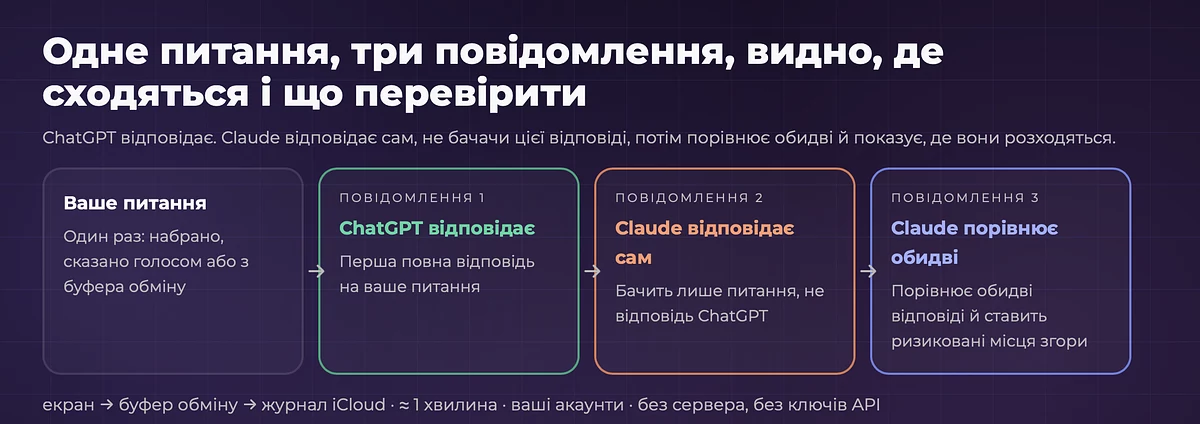
The tool combines two services into one process. ChatGPT generates a response, after which Claude analyzes it and tries to find errors. The result is divided into three blocks: what the models agree on, where their conclusions differ, and what the user should check additionally.
According to the developer, the entire process takes about a minute. The result is displayed on the smartphone screen and also goes to the clipboard.
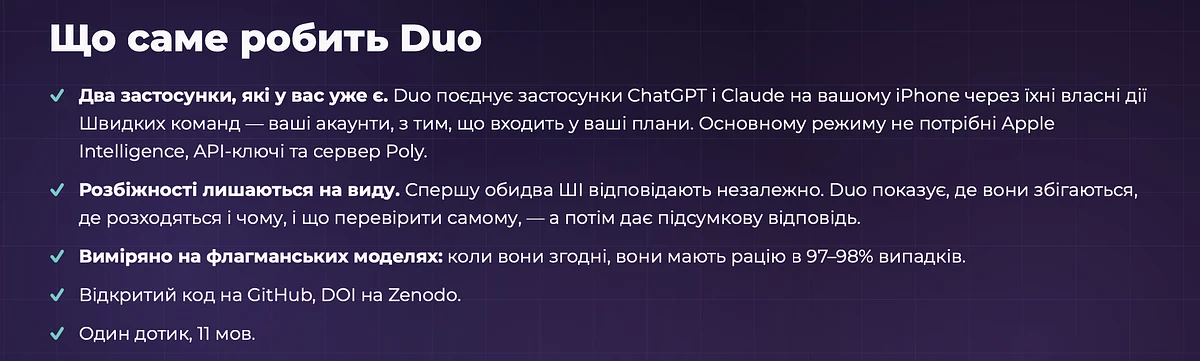
Poly Duo works through the iPhone’s Shortcuts app and the official Ask ChatGPT and Ask Claude actions. According to the author’s idea, this does not require a separate server, your own API keys, or a computer: the tool uses the accounts that the user already has in the OpenAI and Anthropic services.
There are several ways to launch a script, including via the Action Button on compatible iPhones, double-tapping the back panel, Siri, or a shortcut on the lock screen.
12 interaction modes and Android support
Poly Duo, says Chernets, offers 12 modes of working with model responses. Among them are finding a compromise between AI conclusions, a map of discrepancies, synthesizing responses, and displaying results side by side. According to the author’s description, the tool supports iPhones with iOS 18 and newer versions of the system, works, in particular, on iPhone 14, and has 11 language options, including Ukrainian.
The developer also claims Android support. Separately, he describes the Poly Trio, a variant that adds a third model from another company to the process using a free dongle.
Poly Duo is free to use and its source code is open. The author claims that the service does not require a paid AI hub or intermediary server. However, the available capabilities and quality of responses depend on the models, accounts, and limitations of the respective services.
Can two models really verify each other?
Vadym Chernets also cites his own research into the consistency of AI model responses. According to him, in a test on October 26, 2026, GPT-6.1 Sol and Claude Opus 5.5 independently answered 100 new factual questions via the companies’ own command-line applications, using regular subscriptions.
Of the 74 cases where the models gave the same answer, 72 were correct—about 97 percent. The author also notes that in none of the 100 questions did both models give the same confident but incorrect answer.
For comparison, in August 2026, according to a recalculation of data from a companion study, the two flagship models of the time matched the correct answer 98% of the time in a sample of 1,459 public factual questions.
These results are provided by the developer. They do not mean that any answer that two AIs agree on is automatically correct. Models can be wrong at the same time, and matching answers alone are no substitute for checking sources, especially when it comes to medicine, finance, law, or other sensitive topics.
Chernets calls himself an independent AI researcher with a PhD. According to him, two of his papers on AI evaluation and verification were accepted for the NeurIPS 2026 workshops.