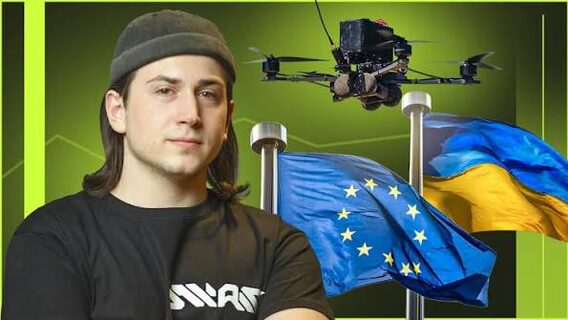
"Our drones are fast food, and this is our advantage": 10 insights from an interview with DWARF Engineering CEO Vladyslav Piotrovsky
In the latest episode of our show about artificial intelligence, Sho on AI, we spoke with Vladislav Piotrovsky, co-founder and CEO of the Ukrainian company DWARF Engineering. They create technological weapons for the Armed Forces of Ukraine, as well as innovators in the infrastructure for mass production of AI drones. In particular, the company has developed a unique operating system that allows you to deploy any applications on any UAV, and its own autonomous co-pilot.
In the latest episode of our show about artificial intelligence, Sho on AI, we spoke with Vladislav Piotrovsky, co-founder and CEO of the Ukrainian company DWARF Engineering. They create technological weapons for the Armed Forces of Ukraine, as well as innovators in the infrastructure for mass production of AI drones. In particular, the company has developed a unique operating system that allows you to deploy any applications on any UAV, and its own autonomous co-pilot.
We have selected the 10 most important insights from this conversation about «terminators» on the front, the technological race with the Russian Federation, and the future of robotics.
But if you want to watch the full version of the interview, it’s here, please:
The main problem is not to create the technology, but to scale it
Creating a homing system (auto-target acquisition) is a task that Ukrainian engineers solve quite quickly. The real challenge is to transfer the code to factories in a way that ensures the security of intellectual property, establish interaction protocols between different developers, and massively deliver updates to the front. Ukraine has already learned how to build innovations, but is only learning to scale them.
DWARF Engineering created «Android for drones»
To solve the scaling problem, the company developed an operating system that works on the principle of Android. It allows you to glue different software with different hardware. Thanks to this, any new efficient technology from third-party developers can be instantly deployed on thousands of boards with different electronics.
True autonomy of war is yet to come
Western media (such as New Scientist) write about Ukrainian autonomous drones as the «era of killer robots.» However, Vladyslav emphasizes: current autonomy (when the drone itself flies to the coordinates and hits the target) is conceptually no different from the operation of conventional missiles.
«True autonomy will come when artificial intelligence plans missions itself, with humans only partially participating.»
Russians win in speed of execution due to totalitarianism
Ukraine has strategically avoided monopolizing the drone market — the state has contracted many different companies, creating fierce internal competition that pushes innovation forward. There is no free market in the Russian Federation. They either copy us or create their own, but as soon as a solution starts to work — the totalitarian regime stamps it out in tens of thousands, without regard to shareholder rights or economic feasibility.
Automation is a matter of survival due to the lack of people
Ukraine is forced to automate air and ground combat. First, there are so many enemy aircraft and Shaheds flying that there are physically not enough human air defense operators to intercept them. Second, the Russians are pressing with small infantry groups. It is impossible to destroy all the occupiers' UAVs manually: operators interfere with each other on radio frequencies, and an FPV drone can only see the target at 50–100 meters through the camera and flies only for reconnaissance. Autonomous loitering munitions are the only way out.
The army does not yet need a swarm of drones in the classical sense
The military does not ask for complex horizontal interaction of drones (like bees). The most popular use case for a «swarm» today is the ability for one operator to lift 10–20 drones into the air on autopilot so that they hover over a square, and the pilot selects them one by one, like cartridges in a revolver, for guaranteed destruction of equipment or clearing of buildings.
«Making an autonomous drone is like making Microsoft Word. Making a swarm is just adding italics to it.»
«Kitchen Drones» are a decentralized network that cannot be destroyed by a missile
Initiatives like FPV assembly in the kitchen (as in Victory Drones) are a superweapon. Mass UAVs do not have on-board computers, they are simple in design, and such decentralization of logistics saves production from enemy missile strikes. Manual assembly gives flexibility: the assembly line can be scaled in two weeks, simply by hiring people, and quickly change frequencies or boards. However, complex AI systems with additional guidance should be assembled exclusively in factories with serial soldering and strict quality control.
Ukrainian drones are «fast food.» And that’s a compliment
Western military giants (like Rheinmetall) sometimes disparagingly say that drones in Ukraine are assembled by «housewives.» However, Vladyslav explains: European standards (MIL-STD) require that a drone withstand years of storage at ±50°C or immersion in salt water, which is why they cost a fortune.
«Our drones on the front line are fast food. We don’t have long supply chains. They go straight to the end consumer, like McDonald’s. Yes, they’re cheaper, but we can use 100 of these drones for one tank.»
Ukraine is fighting with «weapons of Wi-Fi modems and Raspberry Pi»
Ukraine is still limited in access to high-tech military components (laser gyroscopes for missiles, high-frequency radars, etc.) due to strict international regulations. That’s why our engineers create miracles from civilian hardware. For example, the on-board computers of autonomous drones are massively equipped with Raspberry Pi single-board computers.
«The Raspberry Pi may have killed more Russians than the HIMARS,» says Vladislav.
Ground-based work (NRK) lags behind aerial work by two years
Robotization on the ground is much more difficult than in the air. For the UAV autopilot, errors of plus or minus 10 meters will do nothing, but for a ground platform this is critical. Complex navigation technologies (SLAM) are required, there are problems with cross-country ability. So far, NRCs are controlled by operators (even sensational cases of Russians being captured by a ground robot are human operations via audio communication). The real autonomy of NRCs will appear when the robot can independently move to a position, dig in (after all, everything on the surface is destroyed in two hours), maintain defenses and return to the base for recharging.