Хочете будувати кар’єру в Data Science та AI? Vodafone Big Data Lab відкриває новий набір —>
Олександр КузьменкоScience Pop
21 September 2026, 09:41
2026-09-21
Swiss scientists have created a fully autonomous robotic hand that resembles Thing from The Addams Family
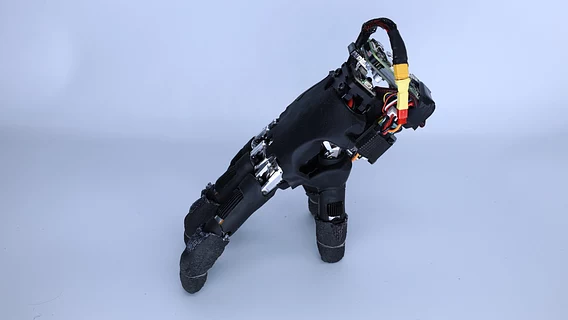
Engineers at the ETH Zurich Soft Robotics Laboratory have created an 818-gram autonomous robotic hand that moves on its own fingers and resembles the iconic character Thing from The Addams Family. The device is able to navigate difficult surfaces, press keys, push small objects, and pick itself up after falling without being connected to an external manipulator or power source.
Engineers at the ETH Zurich Soft Robotics Laboratory have created an 818-gram autonomous robotic hand that moves on its own fingers and resembles the iconic character Thing from The Addams Family. The device is able to navigate difficult surfaces, press keys, push small objects, and pick itself up after falling without being connected to an external manipulator or power source.
Details of the scientific study "Fingers as Legs" by authors Amirhossein Kazemipour, Hehui Zheng, and Robert Kutchmann were published on the project page, in a preprint on the arXiv service, and on YouTube.
The device is based on a standard anthropomorphic robotic arm with five fingers and 20 actuator joints. The researchers adapted it by installing a compact on-board module with a battery, sensors, and a Raspberry Pi Zero 2 W microcomputer. Thanks to this, the limb weighs only 818 grams and functions completely autonomously, moving without the rest of the body.
To control the robot, the Proximal Policy Optimization (PPO) reinforcement learning algorithm was used in an asymmetric “actor-critic” architecture. Training took place in a specialized simulator with 4096 parallel environments. During training, the critic model had extended access to simulation data (contact forces, joint moments), while the actor network directly relied only on short sensory indicators — joint angles, tilt and angular velocity. Engineers applied the concept of virtual springs relative to the support points, which allowed to achieve a higher walking speed than when using traditional models for quadruped robots.
During testing, the autonomous hand successfully navigated 14 different types of indoor and outdoor surfaces — including asphalt, metal, tile, grass, gravel, and damaged stone. In addition, the device showed high durability: the recovery algorithm after a fall worked with an efficiency of 84% (in 21 out of 25 tests, the robo-hand got up in less than 20 seconds). Without using a camera, the device is able to sequentially press keys on a keyboard, and with external visual feedback — move objects to a target.
"Such an autonomous hand can provide greater freedom to a large robot, for example, an industrial manipulator: if it needs to reach an object out of reach, the hand simply detaches and approaches it," the project authors explained.
Prosthetics with the sense of touch: two brothers from Ukraine presented their project at the NASA Space Center, beating thousands of competitors in an international competition