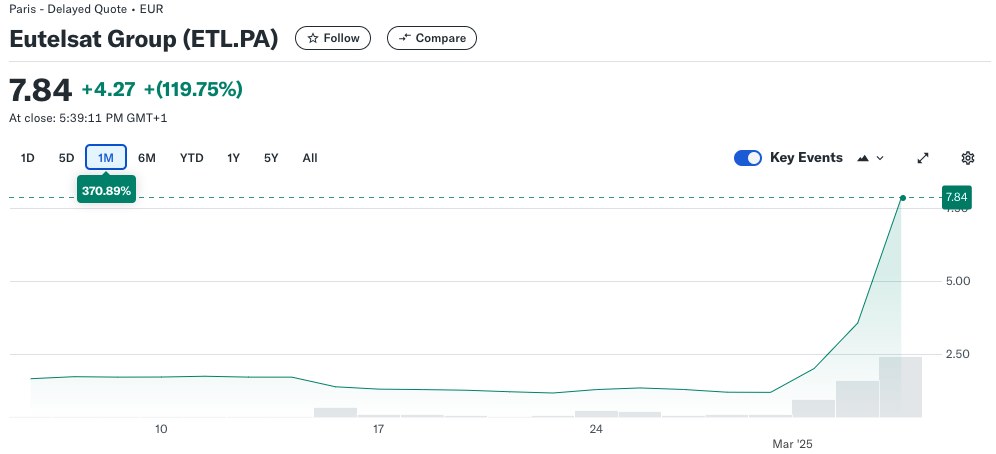
The capitalization of the European satellite company Eutelsat has grown 7 times in 5 days. Is it really capable of replacing Starlink for us? Let's figure it out
In the morning news, we learned that amid talk of a possible Starlink shutdown in Ukraine and the search for alternatives, shares of the European satellite group Eutelsat have more than tripled.
In the morning news, we learned that amid talk of a possible Starlink shutdown in Ukraine and the search for alternatives, shares of the European satellite group Eutelsat have more than tripled.
Another day passed (Wednesday, March 5), and by the evening, the satellite operator’s shares had increased several times more — to 7.8 euros per share. The company’s capitalization reached 3.7 billion euros (at the end of last week it barely exceeded 0.6 billion).
This is simply a phenomenal jump for a company whose stock price has been going down since 2021.
So what’s going on?
Is Europe’s Eutelsat (and its low-orbit satellite project OneWeb) a real alternative to America’s Starlink?
Here the numbers will speak for themselves, but not the stock market numbers, but the technical numbers.
But first, the back is important.
What is the difference between low-orbiting satellites (LEO) and geostationary satellites (GEO)?
Low-orbit satellite fleets have been built up not so long ago. Their goal is to provide high-quality Internet service, at a good speed, without signal delay. This is realistic to do only in low orbit up to a thousand kilometers from the Earth. Otherwise, the latency will be too high.
European satellite companies, such as Eutelsat or SES, have had developed satellite fleets for decades. But the problem is that their strong point is geostationary satellites (it is from them that the signal is sent to our satellite TV antenna). For television, the speed is enough, and the delay is not so important. But for the Internet, satellites that hang at a distance of 36 thousand km from the Earth are unlikely to be a modern provider.
Yes, in addition to television, geostationary satellites also provide internet as an additional service. But the quality leaves much to be desired.
Think about it: if the average latency from a Starlink satellite is 20-40 milliseconds, then from a geostationary satellite this figure will be approximately 600 milliseconds. There is approximately the same difference in speed.
OneWeb versus Starlink
Now the European Union wants to use Eutelsat’s OneWeb division as an alternative European source of fast broadband and replace Elon Musk’s Starlink.
However, OneWeb only has about 650 active low-earth orbit satellites orbiting the planet. And that’s very few, since the range of each LEO satellite is severely limited by its proximity to Earth. So with that number, it’s hardly possible to talk about full coverage.
If we compare this with Starlink, its fleet already exceeds 7,000 satellites. That is, it is 10 times more powerful than the European one.
There is also no need to talk about the rapid expansion of OneWeb’s fleet.
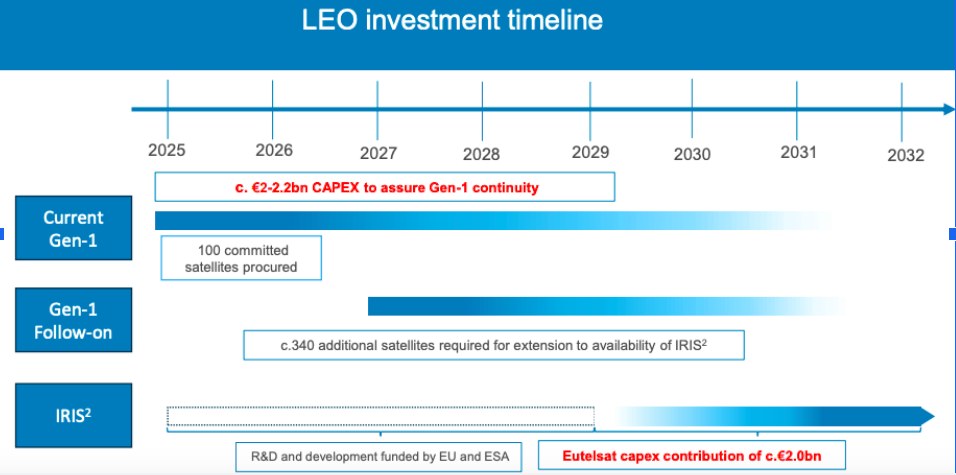
On December 17, 2024, Airbus Defense and Space signed a contract with Eutelsat to create a new batch of satellites, the delivery of which is planned for the end of 2026. But we are talking about only 100 new satellites. This tells us that by the beginning of 2027, Eutelsat will have 750 satellites, not 650.
Of course, there may still be contracts. But the pan-European concept of satellite Internet development does not tell us that it (development) will be too restrained.
EU plans
The EU has a space consortium. It is called SpaceRISE. Eutelsat is a key member. This consortium should create a single European constellation of low-orbit satellites, IRIS², which should be put into operation in 2030.
The project is estimated at around €10.6 billion, with public funding accounting for around 60% of the total. Eutelsat will invest €2 billion for its part.
How will the IRIS2 flotilla develop?
But, according to the project, this is only 340 additional satellites. That is, by 2030, IRIS² is unlikely to have much more than 1,000 LEO satellites. This is 7 times less than Starlink has now. By the way, its plans are to increase the fleet to 34.4 thousand devices.