Хочете будувати кар’єру в Data Science та AI? Vodafone Big Data Lab відкриває новий набір —>
Олег ОнопрієнкоAround IT
10 June 2026, 09:00
2026-06-10
FBI vs. drones and AI vs. offsides. The main technological features of the 2026 FIFA World Cup
The 2026 FIFA World Cup kicks off tomorrow. The World Cup is no longer just a sports tournament, but a global event that will take place in three countries for 48 teams and billions of viewers. Behind the goals and emotions in the stands lies a colossal layer of technology that makes this championship the most advanced sporting event in history.
We tell you how the organizers created an environment where innovation works seamlessly, allowing fans to focus on the game while artificial intelligence and high-performance servers ensure safety, refereeing accuracy, and the comfort of watching the game both in the stadium and on TV.
The 2026 FIFA World Cup kicks off tomorrow. The World Cup is no longer just a sports tournament, but a global event that will take place in three countries for 48 teams and billions of viewers. Behind the goals and emotions in the stands lies a colossal layer of technology that makes this championship the most advanced sporting event in history.
We tell you how the organizers created an environment where innovation works seamlessly, allowing fans to focus on the game while artificial intelligence and high-performance servers ensure safety, refereeing accuracy, and the comfort of watching the game both in the stadium and on TV.
FPV drones protecting the sky
One of the most critical aspects of the training is protecting the airspace over stadiums, where drones have become a major challenge. Of course, there’s no need to shoot down “Shaheeds” and “Geraniums” in American skies (although who knows what the Iranian team will bring with them), but the FBI is actively training FVP operators, using an entire electronic arsenal of radars, cameras, and listening devices to detect threats in a matter of seconds.
Operators are trained to handle everything from “careless and reckless” amateur pilots who accidentally violate no-fly zones to serious terrorist threats. Security forces can intercept drones in flight or force them to land, all while remaining virtually invisible to spectators. Some of the drones are equipped with loudspeakers to warn potential intruders that their actions could disrupt the game.
Interestingly, such serious security measures are being implemented in the US and are not coordinated with Canada and Mexico, where local drug cartels have already shown how they skillfully use piloting skills to eliminate drug competitors. By the way, Mexico and Canada will host 13 World Cup matches each, while the US will have 78.
A song by the Bosnian band Dubioza kolektiv, which talks about the American dream, has become the unofficial anthem of the World Cup among fans.
Smart ball TRIONDA
The soccer ball itself becomes a real gadget in this tournament. Inside the TRIONDA , right opposite the valve, there is a special sensor that records every movement in three-dimensional space with an incredible polling frequency of 500 Hz.
The data received from the ball is synchronized with external tracking systems at stadiums in the USA, Canada and Mexico. Special optical cameras around the perimeter of the field track the movements of the players, and when combined with the TRIONDA sensor, the system creates a complete three-dimensional model of the game. The information is instantly sent to the video assistant referee (VAR) room for automatic and immediate determination of offsides and ball crossing the line.
About 15–20 such "smart" balls are prepared for each match, each of which requires charging and is capable of working for up to six hours in active mode.
Digital football players and referee POV
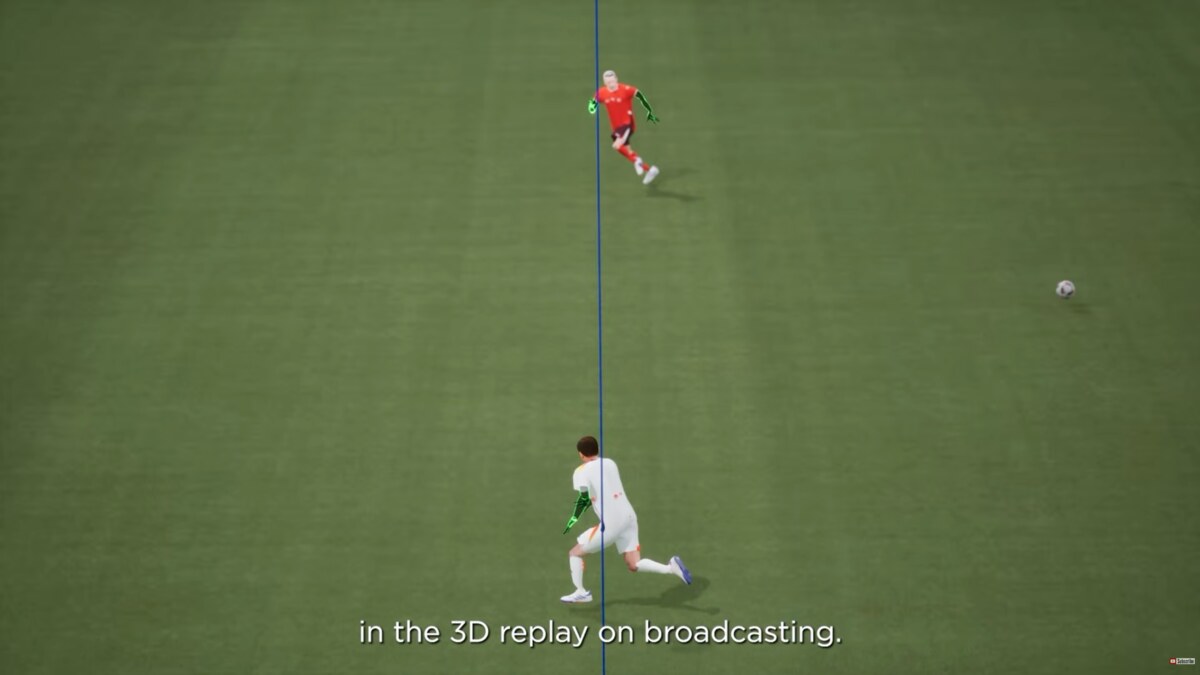
Refereeing is also taking things to a new level with the digitization of the players themselves. Before the tournament starts, each player passes through a special ring of cameras, and in just six seconds, the system creates a digital copy, capturing about 10,000 points on the body with an accuracy of one to two millimeters. This technology is actively used in football video games such as EA FC (formerly known as simply FIFA) and e-Football.
Digitization allows for the creation of realistic 3D avatars instead of the usual schematic figures, making viewing VAR replays much more understandable for fans. When the viewer sees an offside simulation on the screen, they see the real dimensions of the player's knee or shoulder, adding objectivity and transparency to the system.
Interestingly, technology will allow us to literally “get into the shoes” of a referee. Although the Ref Cam system, which is attached to the head or ear of a referee, has long been used at some football matches, it will be used at all matches at the 2026 World Cup.
Ref Cam will allow you to see the game through the referee's eyes, experiencing the real speed of elite football. However, since the referee's running creates a lot of camera shake, artificial intelligence intervenes, stabilizing the image and reducing the shake by 50%. This makes the picture pleasant for live broadcast and gives fans a unique experience of immersion in the thick of the action.
AI and stadium twins
To ensure that all this massive amount of data is processed without delays, Lenovo is creating a true “digital brain” of the tournament. More than 17,000 devices, from smartphones to laptops, will be integrated into a single network spanning stadiums, training facilities and team centers in Miami, where more than 200 engineers will monitor the entire tournament’s IT infrastructure 24/7.
In Dallas, powerful servers will operate, providing IPTV broadcasts with a delay of less than five seconds - almost synchronously with the events on the pitch. All this information flows to a single intelligent FIFA command center in Miami, which acts as a real "flight control center" for the entire tournament, covering three countries. From one place, specialists can monitor the situation in stadiums in the United States, Canada and Mexico simultaneously.
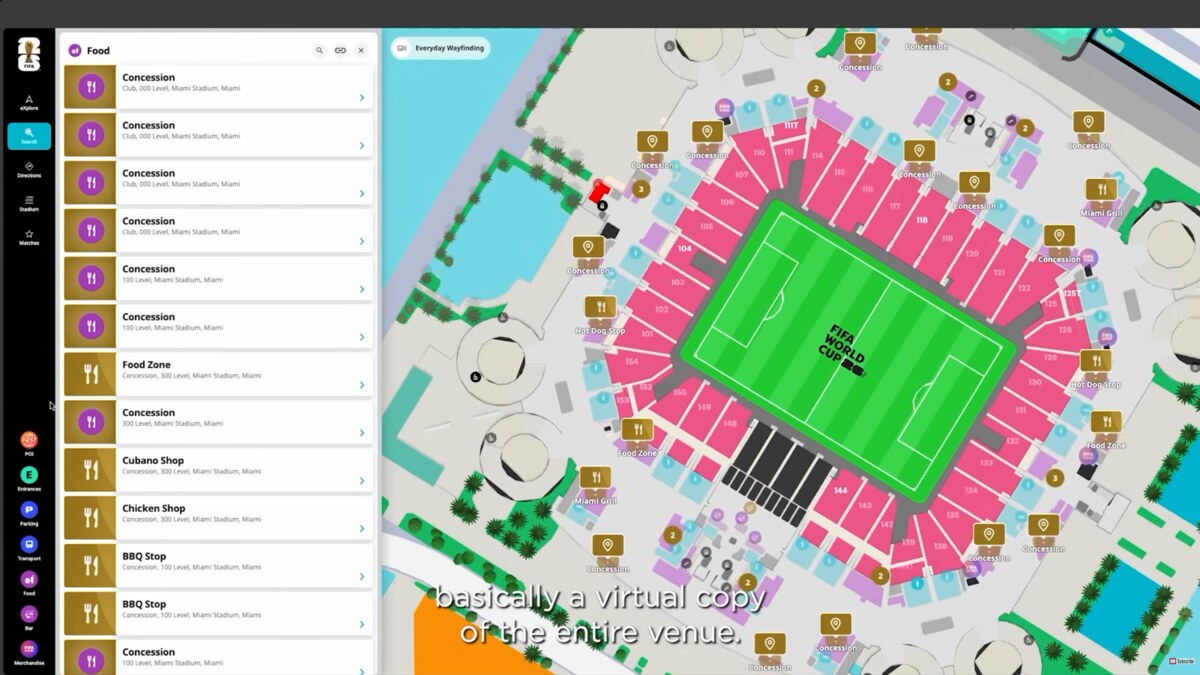
Even a fan's path to their seat in the stadium will be guided by algorithms. For each of the 16 stadiums, a "digital twin" has been created - a virtual replica that shows in real time where the crowds are gathering, where the lines are shortest and how to get to your seat in the stands the fastest.
Technology helps to avoid crowds and congestion and makes being in huge arenas safer and more enjoyable. And for those who want entertainment, special events will feature holograms and AI versions of legendary football players, with whom you can even chat.
Digital twin of the stadium in Miami
Artificial intelligence will also help level the playing field for all participants through the FIFA AI Pro platform. This tool gives all 48 national teams access to elite analytics, regardless of their budget. Coaches will be able to get instant answers to tactical questions by analyzing over 2,000 metrics for each player.
According to organizers, this democratizes football, where teams like Cape Verde receive the same digital advantages as the giants of world football, helping players and analysts make more informed decisions right when preparing for their next opponent.
Modern football analytics is branching out into unexpected areas, such as crystal science. Researchers are using models of the rearrangements of atoms in molecules to understand how 11 players interact on the pitch as a single entity. Each player is treated as a “node” in a complex network, and AI calculates the probability of a successful counterattack based on their relative positions.
The system sees patterns that the human eye cannot see, although experts are confident that no algorithm will ever be able to fully calculate pure human instinct or the genius of players of Messi's level, because it is in this unpredictability that the soul of football lies.
So, the 2026 World Cup will combine unprecedented security measures, "smart" refereeing, digital stadium twins and deep AI analytics. It remains only to wait for the starting whistle to see how this most complex "digital brain" in the world will work in practice. The opening match will take place on June 11 between the national teams of Mexico and South Africa at 22:00 Kyiv time.