Ukrainian FPV drones have learned to strike 102 km behind enemy lines thanks to removable wings. What does this mean for the front?
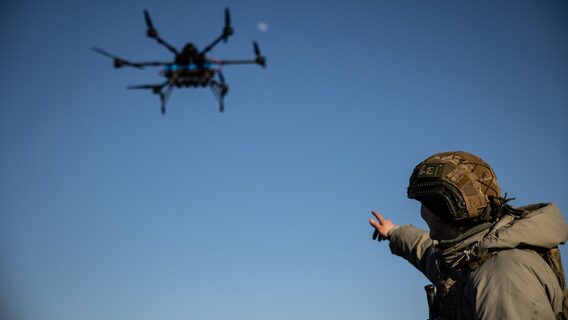
Ukrainian developers have made a technological breakthrough in the field of drones: a conventional FPV quadcopter was able to hit a target 102 kilometers away deep behind Russian troops. This was recently reported by Serhiy Sternenko, a volunteer and advisor to the Ukrainian Ministry of Defense on drone issues.
Ukrainian developers have made a technological breakthrough in the field of drones: a conventional FPV quadcopter was able to hit a target 102 kilometers away deep behind Russian troops. This was recently reported by Serhiy Sternenko, a volunteer and advisor to the Ukrainian Ministry of Defense on drone issues.
According to Sternenko, this record was achieved within the framework of one of his secret projects, and without the use of a carrier drone («uterus»). The released video captures a strike on the Russian logistics vehicle «Bukhanka». For comparison, at the end of 2023, the record strike of a conventional FPV was only 22 km.
A Forbes columnist published an analysis: what this news means for the front. We are retelling it.
Why it’s a breakthrough: a hybrid of a copter and a plane
Traditional quadcopters use too much energy to stay in the air, which limits their range. At the same time, fixed-wing aircraft fly much further, but lack the unique maneuverability of copters, which allows them to fly into dugouts or equipment hatches.
A new Ukrainian development combines the best of both worlds thanks to «wing-over-copter» technology:
How it works: A removable wing is attached to the top of a standard FPV drone. It creates lift, so the motors only work for forward motion, which significantly saves battery power and increases flight range.
Wing Drop: The main feature of the design is the detachment mechanism. The drone flies to the target area like an airplane, drops its wing and transforms into a super-maneuverable quadcopter for a precise final strike.
The American amateur kit Mini Qbit (developed by the University of Maryland) works on a similar principle, improving the endurance of a drone by 30–50%. However, Ukrainian engineers were able to scale and adapt this idea for heavy military loads.
Price issue and mass production
In early April, Sergey Sternenko announced a fundraiser for this secret technology, raising $2.3 million to purchase 3,600 of these upgraded drones. This means that the cost of one UAV is about $640 — only slightly more expensive than a standard FPV ($500).
According to estimates by former Canadian Forces officer and analyst Roy Gardiner, whose group Defense Tech for Ukraine is also testing a similar solution, in mass production conditions, a set of wings would add only about $25 to the cost of the drone.
«The main advantage over cheap aircraft is the ability to take advantage of the enormous availability and penny price of standard FPV drones,» Gardiner notes.
What are the occupiers doing?
The Russians are also trying to catch up with the technology, but they have chosen a different path. They use the KVN project («Prince Vladimir Svyatoslavovich») with a closed ring wing. During flight, this drone rotates 90 degrees to gain lift. The enemy claims an increase in range to 50 km, but the design is non-removable. Russian drones of this shape have already been detected and shot down by Ukrainian interceptors in April.
Prospects for the front
Until now, for medium-range strikes, Ukraine has massively used American Hornet drones, costing over $5,000 per unit, the number of which is limited.
The emergence of cheap wing kits for FPV will allow to scale strikes on the rear supply chains of the Russian Federation to thousands per month. Experts predict that 100 km is only the first iteration. With the improvement of the chemistry of the batteries and the optimization of the software, massive swarms of FPV drones will turn into strategic weapons that will surpass in range and accuracy the barrel artillery and missile systems.