Хочете будувати кар’єру в Data Science та AI? Vodafone Big Data Lab відкриває новий набір —>
Наталя ХандусенкоAI Eng
3 June 2026, 18:49
2026-06-03
GitHub switches Copilot to pay-as-you-go: developers are shocked as monthly credit reserves burn through in a day
GitHub's transition from fixed "requests" to limited usage has forced many developers to confront something they had previously largely ignored: how many tokens their daily code work "eats up" and how much it actually costs.
GitHub's transition from fixed "requests" to limited usage has forced many developers to confront something they had previously largely ignored: how many tokens their daily code work "eats up" and how much it actually costs.
Back in April, the company announced that starting June 1, it would be switching all Copilot plans to a pay-as-you-go model. Under this model, billing is based on actual AI resource consumption, measured in tokens. Under the old scheme, subscribers worked within limits for “regular” and “premium” queries — regardless of whether they asked a quick question or forced Copilot to work for hours on a complex code refactoring.
GitHub explained: under the previous model, the company was forced to cover “the lion’s share of the growing generation costs” for active users. This “altruism” is over. Now developers pay clearly according to a meter that counts everything: the volume of their prompts, the length of Copilot’s answers, and, most importantly, the AI model they choose to work with, writes TechSpot.
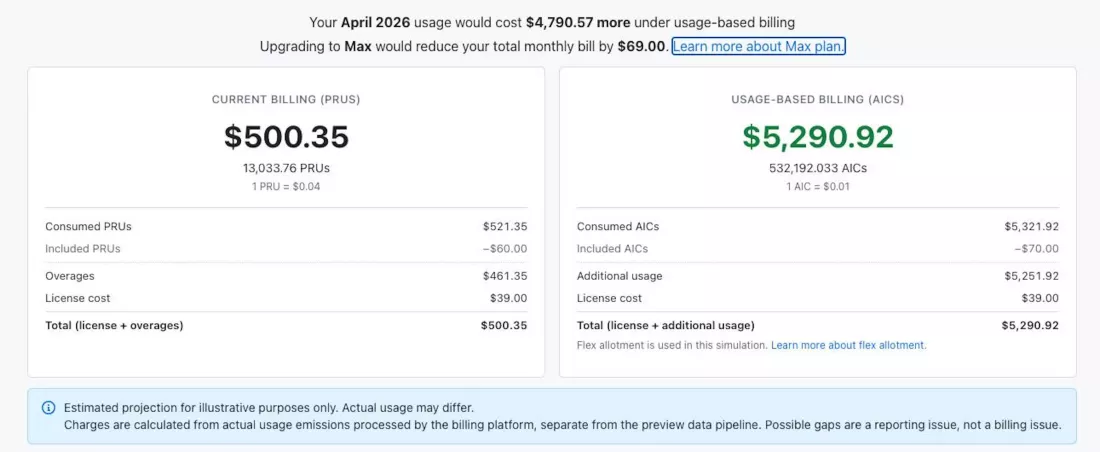
On paper, the new pricing structure looks pretty straightforward. Each paid plan includes a certain amount of AI credits, with one credit equaling one cent of the cost. The $10 per month Pro plan includes 1,500 credits, which is equivalent to $15 for AI usage. The Pro+ tier costs $39 per month and includes 7,000 credits, while the top-tier Copilot Max plan costs $100 and offers 20,000 credits, which is equivalent to $200 for using the service.
The catch is that these credit packages can melt away at dramatically different rates — depending on whether users choose lightweight models or rely on the largest and most expensive ones.
This difference becomes apparent when comparing the models. One million output tokens from a smaller OpenAI model, such as GPT-5.4 nano, costs about $1.25 through Copilot. Whereas the same amount generated by the advanced GPT-5.5 model would cost about $30.
For developers who typically use the default settings, this difference was easy to ignore as long as any action only charged a single “premium request.” However, with usage-based pricing, the same “let’s see what it does” approach can burn through a month’s worth of credits in just a few sessions.
The consequences of this are already visible in the numbers shared by users. A typical "create a Minesweeper game" prompt, run through Claude Haiku 4.5 in Copilot, "ate up" about 94 credits. For a fun mini-project, this may seem quite acceptable. However, when users move from amateur experiments to real-world production workloads, consumption can increase rapidly.
One user reported that just one complex prompt “ate up” 171 credits. Another noted that “just a few prompts” drained 700 credits. In one case, a pair of commits made using Copilot consumed 5,000 credits—a quarter of the entire monthly limit on the Copilot Max plan.
Even seemingly trivial routines are proving more expensive than some developers expected, with users complaining that they are spending 15 credits on what they describe as a “totally average query” or 100 credits to generate a small plan.
One developer shared that he was "extremely cautious" on the first day and limited his experimentation with Claude Sonnet 4.6, but still managed to spend 840 credits.
Another user, after seeing 21 percent of his Pro credits evaporate in one day, summed up: “I feel like I’ll be switching to another platform very soon.”
Some developers are seeing the new pricing model as an incentive to streamline their workflows, while others are rethinking old habits that made sense when token consumption was virtually invisible.
The outcry has led some users to seek alternatives with less aggressive pricing, at least for now. One developer described his experience integrating the DeepSeek model into GitHub and VS Code and estimated the cost at around “7 cents per 15 million tokens.” This figure clearly demonstrates how vast the price gap can be between different providers and models.
At the same time, there is a persistent feeling that GitHub Copilot's solution may soon cease to be an isolated case. If other AI programming assistants follow suit, the era of flat fees and unlimited access on an "eat as much as you can" basis may finally come to an end.
Instead of 50 specialists and $1 million in expenses, it was one person and $15,000 in tokens. Dmytro Dubilet coded an application for his company. What does RoaryAI do?
Як нейромережі бачать вільну та незалежну Україну? Тест dev.ua
Нейронні мережі для генерації зображень бачать світ по-своєму, їхню логіку зрозуміти часом зовсім неможливо. Але таки хочеться. На честь Дня Незалежності України редакція dev.ua вирішила провести невеликий експеримент.
Ми задали чотирьом різним нейронним мережам п’ять однакових запитів: «прапор України», «День Незалежності України», «український Крим», «перемога України» та «українці». Отриманими результатами ми ділимося з вами нижче.
У TikTok тепер можна генерувати фон за допомогою нейромережі. Ми протестували її та ділимося результатами
У TikTok з’явилася нова функція «Розумний фон». З її допомогою як фон для тіктоків можна підставляти згенеровані нейромережею зображення. Редакція dev.ua протестувала цю технологію і ділиться своїми враженнями.