Наталя ХандусенкоAI Eng
21 August 2026, 11:04
2026-08-21
GitHub processes 2.9 billion commits per month and can't keep up with the load
GitHub is facing the challenge of massive growth as the proliferation of artificial intelligence and autonomous agents has overwhelmed its infrastructure, leading to a nearly eight-hour outage on August 17, its second major incident in a month. In response, the company is accelerating the migration of its services to the Microsoft Azure cloud.
GitHub is facing the challenge of massive growth as the proliferation of artificial intelligence and autonomous agents has overwhelmed its infrastructure, leading to a nearly eight-hour outage on August 17, its second major incident in a month. In response, the company is accelerating the migration of its services to the Microsoft Azure cloud.
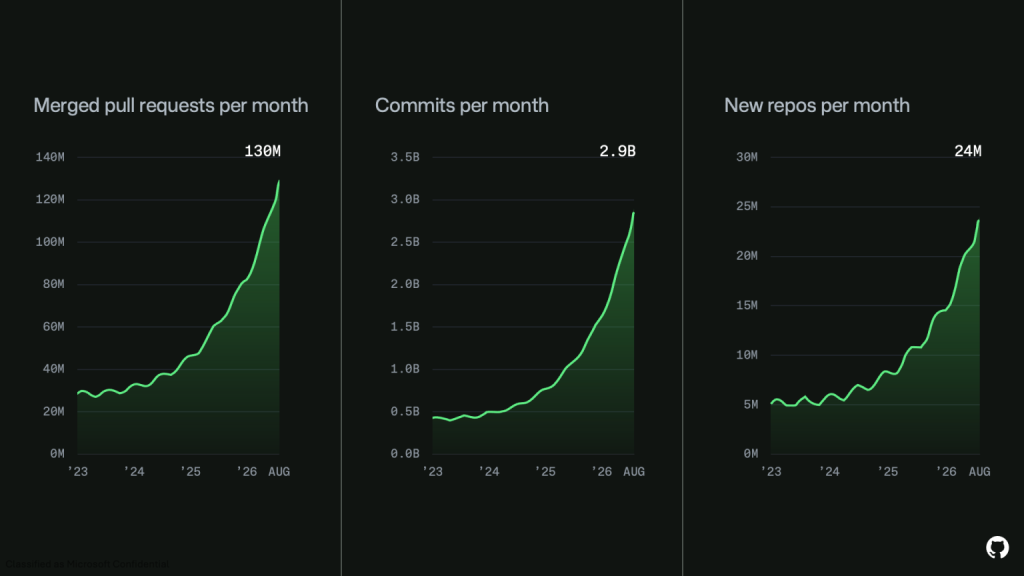
According to new data, GitHub's monthly workload has reached impressive proportions: the platform is processing 2.9 billion commits, which is more than double the April figure of 1.4 billion, 130 million merged pull requests, and 24 million new repositories, writes The New Stack.
The reason for this explosive growth is the rapid development of AI-based development tools and a change in the very approach to software development. Despite efforts to transition to a more modern architecture, the platform is unable to scale quickly enough.
What happened during the August 17 outage
According to a technical analysis from GitHub CTO Vlad Fedorov, the failure was caused purely by scaling issues, not by code changes.
“Our investigation showed that the outage began when traffic reached a new peak, and a critical infrastructure component in the Central US data center was unable to scale with it. As a result, the lack of capacity spread throughout all systems, causing authentication errors and failures in the operation of many GitHub services,” Fedorov explained.
3 million new CPU cores turned out to be not enough
The problem wasn't due to a lack of resource expansion. According to the CTO, the company has already moved 58% of the platform's workload to Azure (up from just 12% in May), and has also moved half of all Git operations to the cloud.
This year, GitHub has added over 3 million processor cores and 120 petabytes of high-speed storage.
However, the service's own data centers have reached their limit: as much equipment has been installed as the available energy capacity allows.
Fedorov also acknowledged that governance processes have not kept pace with the pace of change: the team has already redirected resources to improve availability, strengthen testing, monitoring, and notifications. In addition, work is ongoing to isolate critical systems and remove shared dependencies to reduce the likelihood of cascading failures.
To prevent "request storms" and infrastructure overload, GitHub already implements hard limits on connection retries and adjusts timeouts between services.
Чи може AI замінити кодерів: ось які завдання готові віддати штучному інтелекту українські айтішники
GitHub запровадив розширення Copilot, що за допомогою штучного інтелекту може писати код вслід за вже написаним рядком. І це не перша розробка в цьому полі.
Ми запитали розробників, керівників, кодерів та всіх, хто долучений до цієї теми, чи може штучний інтелект замінити людину, що можна довірити машині, та чи не підштовхне це працедавців до звільнень. На опитання відгукнулись 25 респондентів і їх відповіді нас зацікавили.
Штучний інтелект допомагатиме розробникам кодувати. GitHub запустив сервіс Copilot на AI за $10 на місяць
Спеціалісти GitHub від Microsoft розробили та запустили сервіс Copilot, що за допомогою штучного інтелекту додає пропозиції коду на основі попередньої строки або коментаря. Версія загальнодоступна для всіх розробників за $10 на місяць або $100 на рік.