Хочете будувати кар’єру в Data Science та AI? Vodafone Big Data Lab відкриває новий набір —>
Стас Юрасов
1 May 2026, 15:49
2026-05-01
"No longer a place for serious work": HashiCorp co-founder leaves GitHub and takes his project with him. Why everyone is talking about AI migration and constant failures
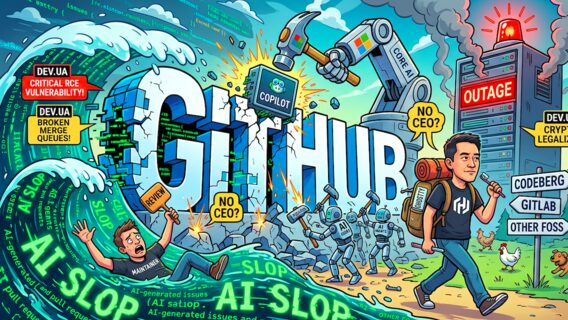
GitHub is going through perhaps the most turbulent times in its history. The platform that is the foundation of modern development is suffering from constant failures. And while Microsoft officially blames everything on infrastructure migrations, the real problem lies in the realm of artificial intelligence. The crisis has reached the point where iconic figures in the IT industry are openly slamming the doors.
GitHub is going through perhaps the most turbulent times in its history. The platform that is the foundation of modern development is suffering from constant failures. And while Microsoft officially blames everything on infrastructure migrations, the real problem lies in the realm of artificial intelligence. The crisis has reached the point where iconic figures in the IT industry are openly slamming the doors.
dev.ua has collected the main points about the crisis on the most popular platform for developers.
Mitchell Hashimoto’s demarche: «After 18 years, it’s time for me to go»
GitHub’s problems reached a new level of discussion after an emotional blog by Mitchell Hashimoto, a legendary developer and co-founder of HashiCorp (creators of Terraform, Vault, Consul).
Hashimoto was one of the platform’s earliest users, having registered there in February 2008 (his ID is 1299). He admitted that he loved the platform more than social media and read GitHub Issues even on vacation and during his own honeymoon. But now even his patience has run out.
«I started a diary where I put an „X“ next to every date when a GitHub glitch prevented me from working. Over the past month, I’ve been doing this almost every day. I want to build software, and GitHub won’t let me. It’s no longer a place for serious work,» the developer wrote in late April 2026.
Due to constant GitHub Actions crashes and pool issues, Hashimoto has decided to pull his current high-profile project, the fast terminal emulator Ghostty, from the platform. According to him, the team is already in talks with other providers (both commercial and FOSS) to gradually eliminate dependence on Microsoft services. Only a read-only mirror of the project will remain on GitHub.
When Microsoft bought GitHub in 2018, many feared the company would screw things up. It didn’t. But the demarche of a figure like Hashimoto amid the company’s steady decline is a worrying sign that the platform’s status as the «de facto home for all code» is under threat. Especially given that these infrastructure failures coincide in a strange way with Microsoft’s obsession with artificial intelligence.
RCE vulnerabilities and broken commit queues
GitHub’s problems aren’t just complaints from individual developers. Critical security holes are coming to light. Recently, researchers from Wiz discovered a terrible RCE (Remote Code Execution) vulnerability right on github.com.
Attackers could execute arbitrary code on GitHub servers simply through the " git push" command. The problem was that the platform did not sanitize the metadata in the XStat header (passed through " push options"). This allowed hackers to gain access even to other people’s private repositories. The vulnerability has already been closed, but the very fact of its existence on a platform of this level was shocking.
Add to this the April bug in the Merge Queue function (which, by the way, also broke due to Elasticsearch). The queue simply started generating «broken» commits. Developers spent hours trying to find a bug in their code, when in reality GitHub itself was broken.
At the same time, the official status page (uptime) of the platform often shows that «everything is fine», while unofficial trackers record regular degradation.
Traffic soared into space: how AI «put down» servers
It’s not that Microsoft engineers are writing code with AI and pushing bugs. It’s about the explosive growth of traffic. Thanks to AI code generators, the number of repositories, pushes, commits, and PRs created in 2025–2026 simply skyrocketed. People are massively generating pet projects that never get finished, and servers have to handle it all.
To cope with this, back in February 2026, management announced the need to increase the platform’s capacity by 30 times. The situation is complicated by the fact that GitHub is currently in the process of painfully migrating from old monolithic structures to the Azure cloud. Doing such a «repair» during a 30-fold increase in load is guaranteed to cause failures.
Open source is drowning in «AI-trash»
But the most painful problem lies in the ideological plane. Since the end of 2025, GitHub has been without a CEO. The platform was simply absorbed by the Core AI division within Microsoft. Now GitHub’s mission is not «a convenient platform for developers», but «a platform for implementing AI tools». Copilot and AI agents are being pushed everywhere, even changing billing models (metered AI billing).
This has left open-source project maintainers in a hellish situation. They are literally drowning in issues and pull requests of dubious quality generated by neural networks (the so-called «AI slop»).
A severe asymmetry has emerged: it takes minutes to generate code using three AI agents. But it takes hours for a human maintainer to review this generated spam and realize that it’s a hallucination. Instead of giving developers the tools to filter out AI garbage, GitHub continues to make life easier for those who generate it.
Will there be a mass exodus?
Some projects are really going well: SIG moved to Codeberg back in November 2025, now Ghostty is packing its bags for another platform. But will the mass business take off?
First, large companies are too tied to the infrastructure (the same GitHub Actions) to easily «get off» the platform. Pipeline migration will cost more than downtime. Second, there is no guarantee that a conventional GitLab would cope better with such an extreme influx of AI traffic (because they do not have Microsoft-level resources).
GitHub remains too important a hub for global development. The situation is objectively bad right now, but businesses will likely have to endure until Microsoft stabilizes its infrastructure in Azure and remembers that human developers are still more important than AI agents.
Чи може AI замінити кодерів: ось які завдання готові віддати штучному інтелекту українські айтішники
GitHub запровадив розширення Copilot, що за допомогою штучного інтелекту може писати код вслід за вже написаним рядком. І це не перша розробка в цьому полі.
Ми запитали розробників, керівників, кодерів та всіх, хто долучений до цієї теми, чи може штучний інтелект замінити людину, що можна довірити машині, та чи не підштовхне це працедавців до звільнень. На опитання відгукнулись 25 респондентів і їх відповіді нас зацікавили.
Штучний інтелект допомагатиме розробникам кодувати. GitHub запустив сервіс Copilot на AI за $10 на місяць
Спеціалісти GitHub від Microsoft розробили та запустили сервіс Copilot, що за допомогою штучного інтелекту додає пропозиції коду на основі попередньої строки або коментаря. Версія загальнодоступна для всіх розробників за $10 на місяць або $100 на рік.