Ігор Вишневський Hot News
13 October 2026, 09:00
2026-10-13
“Today, people are doing better and doing it cheaper.” Glovo co-founder Sasha Michaud on robot and drone delivery, AI applications, and business in Ukraine
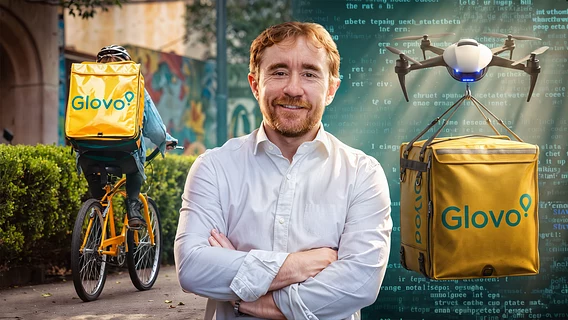
Glovo co-founder Sacha Michaud is one of the few top managers of large international companies who, despite the full-scale war and security risks, is a frequent guest in Ukraine. But this time we had the opportunity to talk to him not here, but in Barcelona, namely, at the Glovo headquarters.
Glovo co-founder Sacha Michaud is one of the few top managers of large international companies who, despite the full-scale war and security risks, is a frequent guest in Ukraine. But this time we had the opportunity to talk to him not here, but in Barcelona, namely, at the Glovo headquarters.
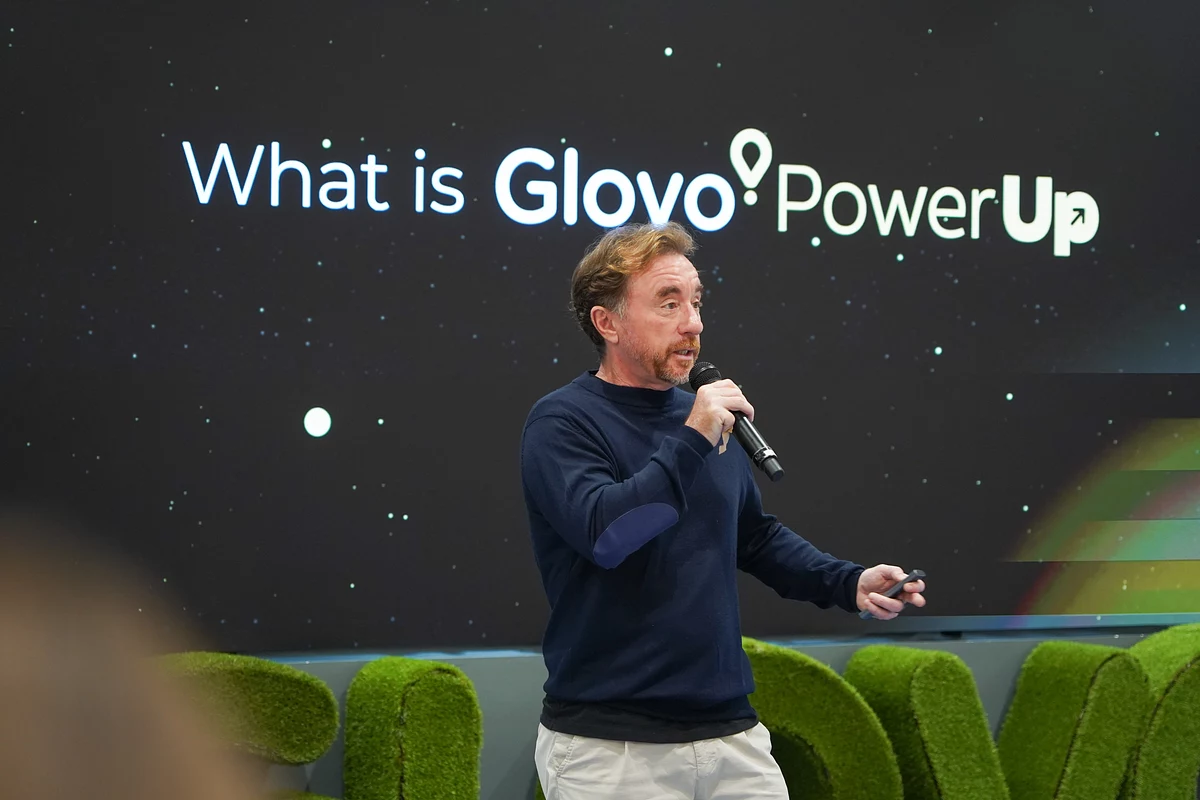
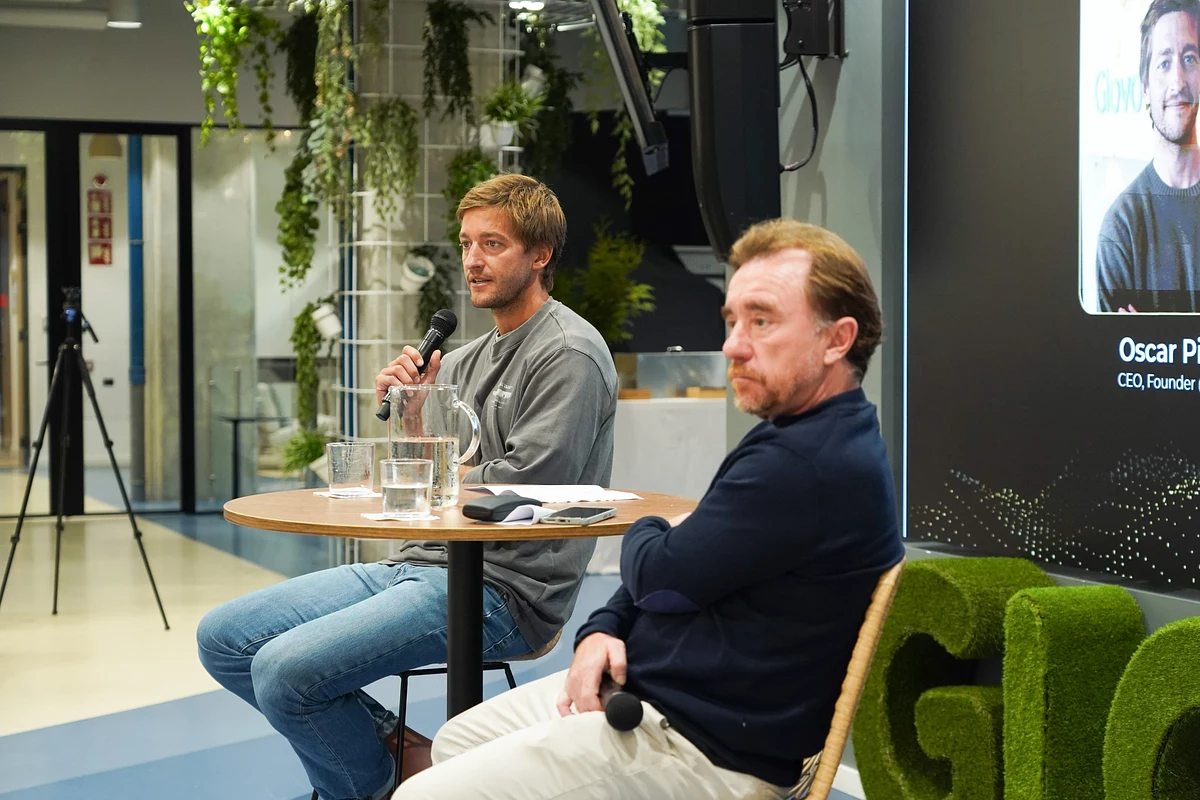
A dev.ua journalist visited Glovo Startup Campus 2026, a residency program for startups from different countries, which included three Ukrainian startups — RankinAI, PickPad, and Getpin. They had the opportunity to pitch their products and undergo a mentoring program from Glovo.
Our publication spoke with Sasha Michaud about the biggest challenges in Ukraine and Europe, the "pros" and "cons" of robotic delivery, and the use of AI in the company’s business processes. All this and more in an interview with the co-founder of Glovo.
— This year, Uber acquired your parent company, Delivery Hero. What impact will this have on both your global operations and directly on your business in Ukraine?
— Uber inspired me and Oscar (Pierre, co-founder of Glovo — Ed.) when they were just starting out with their ride-hailing service. Moreover, they inspired us to create Glovo — even though it’s not the same business: we started delivering things instead of transporting people around the city. But overall, I think it’s an amazing company.
I am confident that this agreement will be a logical continuation of everything we have already started to build for Glovo and Ukraine.
We have created a strong company in Ukraine, and it is one of the top five markets for Glovo — it is extremely successful and growing by double digits. So I believe that this will only consolidate the continuity of the project that we are implementing in Ukraine. I think that only positive things can happen around this.
— As a result of these acquisition processes, do you have a scenario to buy back Glovo? At least, you can read about it in some media.
— As we have already noted, neither Oscar nor I lead or discuss a management buyout of the company.
The deal is subject to lengthy regulatory approvals and is expected to close in the second half of 2027.
As previously announced, 14 Delivery Hero markets are being sold to an American fund, which will then look for a permanent buyer for them.
This creates many new opportunities, but it is too early to make any assumptions.
— We have an escalation of Russian attacks on major Ukrainian businesses. Your partner McDonald’s, due to constant airstrikes, cannot fully operate most of the day in Kyiv and some other cities. What are the biggest risks for Glovo’s business in Ukraine right now?
— As soon as the news of the Russian invasion broke, our first natural reaction here at the head office was to consider closing our business in Ukraine. We considered this step because we were not sure that the banking system would be fully operational, and that we would be able to receive and fulfill orders, as well as pay our associates. There are many things that we considered rational here at the head office.
But the team from Kyiv called us, and the CEO said, “Let’s get started again! Businesses want to work, couriers want to fulfill orders, and consumers want to receive their goods.” Of course, we consulted with the Ukrainian government, and they said, “Yes, we want you to really continue investing in our market.” Since that day, we’ve gotten used to it — security is the most important factor, but we’ll have to adapt the business in Ukraine to local needs and scenarios.
So the situation today is no different globally from what we had a year or two ago — we adapted then, we will adapt now. The number of attacks has really increased over the past few months. Obviously, this can affect our business, the business of our partners, and our couriers. But the most important thing is security, so we are starting from this first. We are convinced that in the end Ukraine will win, and this is the market in which we should continue to make solid investments.
Overall, I consider the launch of Glovo in Ukraine to be one of the highlights of my global career. I was there when we launched. I was there for the first anniversary. My mobile phone constantly reminds me of various events from Ukraine, showing me memories from photos. Even now, during the war, I return from Ukraine energized, just from spending a few days there.
And the Russian invasion, I am convinced, was not only aimed at military goals. The Russians wanted to stop the rapid economic development that we saw in Ukraine. Russia could not see this in a neighboring country and compare it with its own shortcomings and problems.
— If we compare the beginning of the war and the present time, when did Glovo in Ukraine face greater difficulties?
— I think it was more difficult in the beginning, because then we faced many problems that we were solving for the first time. We had to change a lot of operations and technologies. For example, a client orders something, and we took it into work, but there is a massive attack, and we have to stop this order, and also give the client the opportunity to get their money back. So we had to change a lot of things in the work at the very beginning of a full-scale invasion.
In addition, it was a very difficult time emotionally for Ukraine, because it was not easy to get used to the fact that this happens every day. Of course, this does not mean that today has become easier, because the current time is also emotionally exhausting due to constant attacks. This complicates the life of businesses and all Ukrainians.
Ukraine is a stable country. We are a company that works in Ukraine, and we are also stable. So we will work to ensure that it doesn’t happen there.
We have a commitment, and our platform is a lifeline for many small Ukrainian businesses that sell online. They need our activities. The income of couriers also depends on our activities. So we must focus on ensuring that our platform works as efficiently as possible in the current difficult circumstances. But let me repeat once again — we put safety first.
— In Spain and Italy, Glovo faced significant legal challenges regarding its courier employment model. Will this have any global impact on Glovo’s courier employment model, particularly in Ukraine?
— We operate in 21 markets and our operating model is designed to comply with the legislation of each of these jurisdictions. Currently, in Spain, all 25,000 couriers who use the Glovo app have employment contracts.
In general, Europe adopted a separate directive on employment on online platforms back in 2024, which applies to all EU member states. This act establishes general regulations on how platforms should work with their employees.
At the same time, the directive gives each individual country a lot of flexibility in interpreting certain legal aspects and national regulation. And it is at the national level that there is great uncertainty, because none of the EU countries has fully implemented this directive into national legislation to date.
I think in the EU countries we will need to reach a consensus between the government, the unions and the online platforms so that everything works according to the rules that suit everyone. But there will be no universal solution for all countries, just as there will be no uniform regulation. So we need to adapt and adhere to the standards of each individual market.
Spain probably has the most stringent labor market regulation in the world right now. No company has ever had to hire 25,000 people in 6 months, but we did it.
Despite everything, business is going well again — so it shows that we are very adaptable. And where we need to adapt to local realities — we will do so.
We believe that the optimal solution is to give workers maximum flexibility and autonomy — they should choose how much and how much they work. At the same time, workers should not be deprived of the social guarantees that platforms should provide. And this requires a regulatory framework.
Ukraine has just recently passed a bill on digital platforms. I think it is very positive because it covers exactly what I said: giving employees full flexibility, but at the same time addressing the issue of taxation.
Glovo guarantees the fulfillment of its obligations so that the Ukrainian state has this income. I think that by implementing this bill, Ukraine is demonstrating a modern approach and once again proving that it solves problems well.
— Delivery services are now starting to study robotics on a massive scale. Will robots and drones replace people in delivery in a few years? What experiments are you conducting with these technologies?
— We have conducted many tests on delivery by robots and drones. But these are only tests, pilot projects.
I don’t think robots will replace people in the short term. But I do think that in some places they can complement human labor.
For example, in cities where distances are short and sidewalks are suitable for robots. Because not everywhere there are sidewalks, and not everywhere they are suitable. I think that there will indeed be scenarios where robots can be useful. But today people cope with delivery better and cheaper.
As for drones, they will be very useful in sparsely populated areas or in suburban areas — where the distance is quite large, but where there are not so many people. In such areas it is difficult to attract couriers and generally set up work there. So, I think that in the near future drones will be very useful in such sparsely populated areas.
— And when will such projects become a mass reality for Glovo — in a few months or a few years?
— The technology itself already exists today, there is nothing stopping it from being used. Robots exist and can deliver, drones too. But the user experience in such scenarios is not that great yet. Robots will have problems delivering food directly to your apartment. They do not work as fast as people yet. For restaurants or stores, this will also have its difficulties — they do not yet know what to do with it and how to get along with robots. I think there are still a lot of things that need to be improved to make these technologies competitive. But the basic technologies exist today, and delivery in the world is carried out using robots — this is already a reality, not something fantastic.
The same with drones. Drone delivery is carried out, but this is relevant in areas with private development — so that there is a place where they can either drop off the cargo or land. We work anyway, mainly in densely populated cities. So for my apartment in Barcelona, drone delivery is not very relevant.
Despite everything, these technologies will definitely develop and at the current stage, robots and drones can sometimes supplement people. As soon as these technologies become more widespread, the cost of using them will decrease significantly, and this experience will become even more useful.
— What core operations or processes at Glovo are currently being solved with AI? Where does the use of AI provide the greatest economic impact for your company?
— I would probably name about five areas where AI shows the greatest effectiveness for us. First of all, for many years we have been using machine learning and AI to improve our own algorithms — it helps to determine when the courier is going to complete his order, where he will be in the city at a specific time, what time the food will be ready in this restaurant, and so on. A lot of these processes AI helps to optimize, and, as a result, improve our work. We have been doing this for many years, and we will continue to do so.
AI is also very useful in customer support, because 80% of what people ask are the same scenarios. Artificial intelligence reacts better to this than a person, makes fewer mistakes and is more efficient. So the first level of customer support is provided by AI, and if necessary, some more complex cases are transferred to a person. All this helps to provide better service, greater efficiency, and, ultimately, saves money.
The third thing I would like to highlight is that we are now providing AI tools to our partners: local businesses, retailers, restaurants, and so on. After all, we are interested in seeing them perform better — and as a result, we perform better. Such AI tools help them manage their menus, identify and prioritize what sells best, and so on.
Of course, another area where AI plays a key role is the work of our IT professionals.
70% of our programmers' code at Glovo is generated using AI.
And we’re talking about about 350 programmers in this office who have significantly accelerated their work. This doesn’t mean that thanks to AI, these 350 people will become unnecessary for us — no, it’s just that each of them can create much more code. I’m only in favor of 100% of the code being created by AI, and people simply managing various AI agents. Together, this increases the efficiency of not only a particular software developer or data analyst, but also the entire team.
And finally, AI is used by absolutely all employees in our company to optimize their own work, and I am no exception. I use AI every day to find information and check it — it saves me a lot of time when I delegate some tasks to artificial intelligence.
«Дивлюсь: в полі щось горить, димить. Потім — свистить. Обернувся — летять ракети, лунає сирена. Гради полетіли». Як працює Glovo під час війни
Україна відбивається від ворогів вже понад два місяці. До нових реалій потроху пристосовуються люди, бізнеси, бюджетні установи. dev.ua починає цикл матеріалів про те, як війну переживають IT-бізнеси в Україні, які до війни створювали комфорт для жителів нашої країни. Сьогодні — про компанію Glovo, в якій під час війни змінився керівник, відкоригувався вектор розвитку, та яка власними силами активно підтримує як воїнів, так і звичайних українців.
Have important news to share? Message our Telegram bot
Key events and useful links in our Telegram channel