Хочете будувати кар’єру в Data Science та AI? Vodafone Big Data Lab відкриває новий набір —>
Олег ОнопрієнкоAI Eng
12 December 2025, 08:25
2025-12-12
Google created the Disco AI browser to vibecode mini-apps for every user request
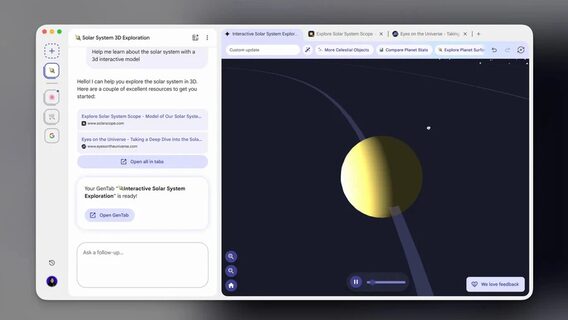
A key feature of Disco is GenTabs technology, which transforms ordinary information search into the creation of personalized interactive tools using artificial intelligence.
A key feature of Disco is GenTabs technology, which transforms ordinary information search into the creation of personalized interactive tools using artificial intelligence.
The Chrome development team has introduced a new experimental browser called Disco to Google Labs. As Google writes in its blog, the concept of the browser is a combination of traditional Googling and vibecoding.
When a user enters a query, Disco opens a set of regular tabs with relevant information and generates a GenTab — a custom web application created specifically to solve the current task.
The technology is based on the Gemini 3 model, which is capable of creating disposable interfaces “on the fly”.
During the demonstration, Google representatives showed several scenarios:
Trip planning: When asked about a trip to Japan, the browser created an interactive map with landmarks and a route. It is important that the system works dynamically: if the user opens new tabs with interesting places, GenTab automatically adds them to the route.
Training: An interactive 3D model with explanations was generated for a query about foot anatomy.
Everyday life: To organize a move, AI created a table comparing prices of moving companies and a calculator for the weight of items.
Unlike many AI browsers that try to replace websites with chatbot responses, Disco encourages users to follow links. The developers call this a “virtual loop”: the pages the user opens serve as a source of truthful information for the AI, which improves the performance of the generated application.
Chrome team leader Parisa Tabriz emphasizes that Disco is not a replacement for Chrome, but a hackathon project that has grown into a serious experiment.
The company is currently exploring whether GenTabs will become a standalone product, a project management tool, or part of the Chrome and Docs ecosystem.
The main task now is to understand whether users are ready to move from simply consuming content to creating their own micro-tools right in the browser.
Earlier, OpenAI released its artificial intelligence-based web browser called Atlas, immediately after which shares of parent company Google reacted by falling on the stock market.