Хочете будувати кар’єру в Data Science та AI? Vodafone Big Data Lab відкриває новий набір —>
Наталя ХандусенкоAI Eng
25 September 2026, 09:53
2026-09-25
Google is sending a tiny data center for artificial intelligence into space
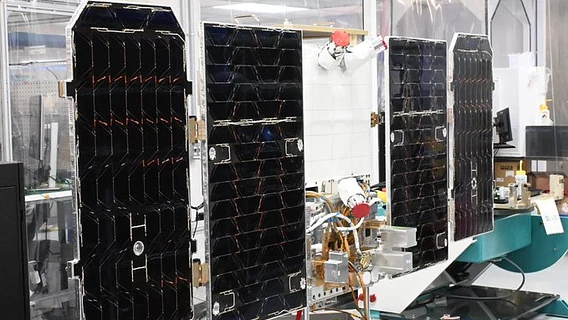
Google's Project Suncatcher, which aims to place large AI infrastructures in low Earth orbit, is preparing for a key event. The company is sending a miniature data center into space to test the chips' performance in harsh space conditions.
Google's Project Suncatcher, which aims to place large AI infrastructures in low Earth orbit, is preparing for a key event. The company is sending a miniature data center into space to test the chips' performance in harsh space conditions.
What exactly will fly into space?
The satellite, called MVP, is scheduled to launch on October 1 on a SpaceX Falcon 9 rocket. It is not a full-fledged data center in the usual sense, but four specialized processors — TPU (Tensor Processing Unit). Together, they provide the power of just one standard server, The New York Times reports .
Power will be provided by a solar panel with a capacity of only 1 kilowatt - the same as a regular household hairdryer. Google believes that this will be enough for testing the equipment. The satellite is planned to respond to simple AI requests for a year, after which it will remain in orbit for about six years before burning up in the dense layers of the atmosphere.
Main challenges and trials
At the Crocker Nuclear Laboratory, the chips were exposed to intense radiation. The main threat from radiation is random bit changes, when binary code changes from 1 to 0 or vice versa. Instead of complex solutions, Google plans to use a proven method: simply rebooting the chips in case of failures.
Physical high-energy particles can penetrate and melt semiconductor junctions, which can cause irreversible damage to equipment.
Conventional heat dissipation doesn't work in space. Google has created its own system based on thermally conductive materials. However, it only allows the chips to operate continuously for about 15 minutes, after which they must be turned off to cool down.
Launching even one Falcon 9 rocket costs about $74 million. Scaling a system from 4 chips to thousands is an extremely complex and expensive engineering task.
Prospects and realistic deadlines
Despite successful ground tests, company representatives urge restraint in expectations.
“Let’s be honest: we don’t expect this to evolve into something that’s really workable for real-world tasks in the next few years,” said James Manica, Google’s senior vice president of research, technology, and society.
Brandon Lucia, a professor of electrical and computer engineering at Carnegie Mellon University, emphasized in a commentary for the NYT: "Scaling from a single satellite to a giant network operating as a single data center would require years and enormous financial resources."
What's next?
Despite all the difficulties, Google has a clear development plan: next year, the company plans to launch two more similar satellites, and in the future, to form a group of 80 devices that will fly in close formation to jointly process AI requests.
In the long term, the possibility of building a giant orbital satellite the size of a football field is even being considered, although the company has not yet disclosed the total amount of investment in Project Suncatcher.
Як нейромережі бачать вільну та незалежну Україну? Тест dev.ua
Нейронні мережі для генерації зображень бачать світ по-своєму, їхню логіку зрозуміти часом зовсім неможливо. Але таки хочеться. На честь Дня Незалежності України редакція dev.ua вирішила провести невеликий експеримент.
Ми задали чотирьом різним нейронним мережам п’ять однакових запитів: «прапор України», «День Незалежності України», «український Крим», «перемога України» та «українці». Отриманими результатами ми ділимося з вами нижче.