Хочете будувати кар’єру в Data Science та AI? Vodafone Big Data Lab відкриває новий набір —>
Наталя ХандусенкоAI Eng
5 February 2025, 11:44
2025-02-05
Major changes in Google's AI policy: the company now believes that using AI for weapons and surveillance is normal
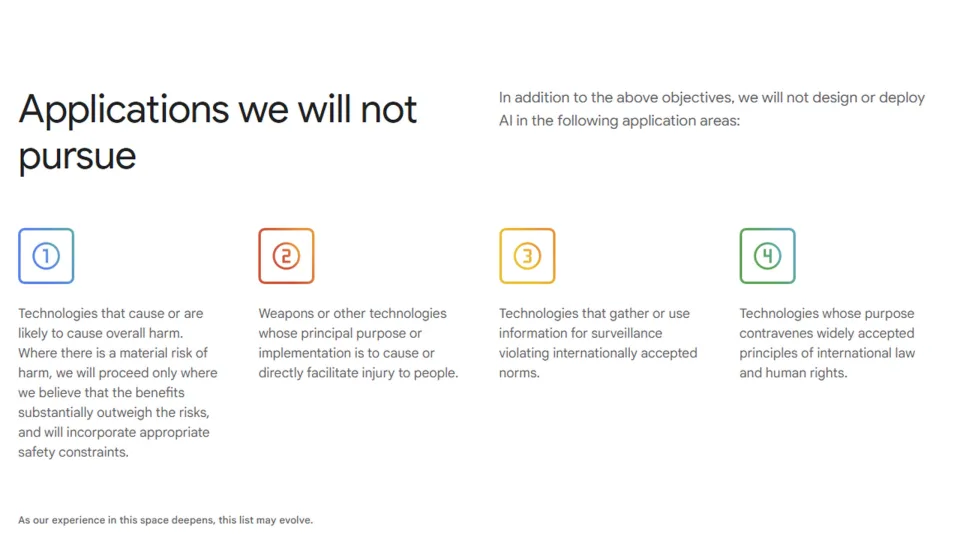
Google has made one of the most significant changes to its AI principles since they were first published in 2018. The search giant has edited the document, removing promises that it will not “develop or deploy” AI tools for use in weapons or surveillance technologies. The principles previously included a section called “applications we will not use,” which is missing from the new version of the document.
Google has made one of the most significant changes to its AI principles since they were first published in 2018. The search giant has edited the document, removing promises that it will not “develop or deploy” AI tools for use in weapons or surveillance technologies. The principles previously included a section called “applications we will not use,” which is missing from the new version of the document.
Instead, a section called “Responsible Development and Deployment” has appeared. In the AI principles, Google says it will implement “appropriate human oversight, due diligence, and feedback mechanisms to align with user goals, social responsibility, and generally accepted principles of international law and human rights,” Engadget writes.
These are much broader commitments than the company made in the previous version of the AI principles. For example, on weapons, the company previously said it would not develop AI for use in “weapons or other technologies whose primary purpose or use is to cause or directly contribute to the infliction of harm on people.” On AI surveillance tools, the company said it would not develop technologies that violate “internationally accepted norms.”
Source: Engadget
When asked for comment, a Google spokesperson pointed Engadget to a blog post the company published on Thursday, in which DeepMind CEO Demis Hassabis and James Manyaka, Google’s senior vice president of research, labs, technology, and society, argue that the emergence of AI as a “general-purpose technology” required a policy change.
“We believe that democracies should lead the way in AI, guided by core values such as freedom, equality, and respect for human rights. And we believe that companies, governments, and organizations that share these values should work together to create AI that protects people, promotes global growth, and supports national security,” they wrote. “… Guided by our AI principles, we will continue to focus on AI research and applications that are consistent with our mission, our scientific direction, and our areas of expertise, and will remain consistent with widely recognized principles of international law and human rights—always evaluating the specific work, carefully assessing whether the benefits significantly outweigh the potential risks.”
Як нейромережі бачать вільну та незалежну Україну? Тест dev.ua
Нейронні мережі для генерації зображень бачать світ по-своєму, їхню логіку зрозуміти часом зовсім неможливо. Але таки хочеться. На честь Дня Незалежності України редакція dev.ua вирішила провести невеликий експеримент.
Ми задали чотирьом різним нейронним мережам п’ять однакових запитів: «прапор України», «День Незалежності України», «український Крим», «перемога України» та «українці». Отриманими результатами ми ділимося з вами нижче.