Хочете будувати кар’єру в Data Science та AI? Vodafone Big Data Lab відкриває новий набір —>
Наталя ХандусенкоAI Eng
17 April 2026, 16:24
2026-04-17
OpenAI launches GPT-Rosalind, a specialized AI model for drug development and life sciences research
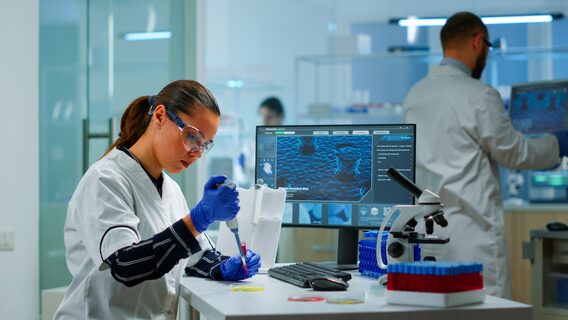
OpenAI has unveiled GPT-Rosalind, its first dedicated AI model aimed at the scientific sector. The new model is capable of complex logical reasoning in the field of biomedical research.
OpenAI has unveiled GPT-Rosalind, its first dedicated AI model aimed at the scientific sector. The new model is capable of complex logical reasoning in the field of biomedical research.
The model is designed for evidence synthesis, hypothesis generation, experiment design, and multi-step scientific processes in biochemistry, genomics, and protein engineering. GPT-Rosalind is the first in a series of highly specialized models from OpenAI, The Next Web reports .
The model is available in research preview format on ChatGPT, Codex, and via the OpenAI API, but access is limited by a "trusted access" program to qualified enterprise customers in the United States only.
The model is named after Rosalind Franklin, a British chemist and X-ray crystallographer whose diffraction images of DNA played a crucial role in the discovery of the double helix structure, although her contribution was unfairly overlooked when Watson, Crick, and Wilkins were awarded the 1962 Nobel Prize.
OpenAI is positioning GPT-Rosalind as a tool to shorten the time between a scientific idea and clinical evidence. The company estimates that it currently takes about 10 to 15 years for a drug to go from target discovery to U.S. regulatory approval.
GPT-Rosalind is designed to help at the early stages: it is able to query specialized databases, analyze scientific literature, interact with computational tools, and suggest new paths for experiments — all within a single interface.
Along with the model itself, OpenAI is introducing the Life Sciences Research Plugin for Codex. It connects the models to over 50 scientific tools and data sources, giving scientists programmatic access to biological databases and computational pipelines.
Launch partners include Amgen, Moderna, Thermo Fisher Scientific, and the Allen Institute. OpenAI is also collaborating with Los Alamos National Laboratory on projects to create proteins and catalysts using artificial intelligence.
According to an OpenAI report, benchmark results show that GPT-Rosalind achieved a success rate of 0.751 on BixBench, a bioinformatics test from Edison Scientific that evaluates models based on real-world computational biology tasks.
On LABBench2, a broader benchmark for research tasks, the model outperformed GPT-5.4 in six out of eleven categories, with the biggest advantage in CloningQA, a test that requires end-to-end reagent design for molecular cloning protocols.
The most impressive performance indicator was obtained during an independent evaluation conducted in conjunction with Dyno Therapeutics, a gene therapy company specializing in the design of AAV (adeno-associated virus) capsid proteins.
Як нейромережі бачать вільну та незалежну Україну? Тест dev.ua
Нейронні мережі для генерації зображень бачать світ по-своєму, їхню логіку зрозуміти часом зовсім неможливо. Але таки хочеться. На честь Дня Незалежності України редакція dev.ua вирішила провести невеликий експеримент.
Ми задали чотирьом різним нейронним мережам п’ять однакових запитів: «прапор України», «День Незалежності України», «український Крим», «перемога України» та «українці». Отриманими результатами ми ділимося з вами нижче.
У TikTok тепер можна генерувати фон за допомогою нейромережі. Ми протестували її та ділимося результатами
У TikTok з’явилася нова функція «Розумний фон». З її допомогою як фон для тіктоків можна підставляти згенеровані нейромережею зображення. Редакція dev.ua протестувала цю технологію і ділиться своїми враженнями.