Хочете будувати кар’єру в Data Science та AI? Vodafone Big Data Lab відкриває новий набір —>
Наталя ХандусенкоAI Eng
21 May 2026, 10:00
2026-05-21
Vibecoding between dog walks, tango with bugs, and zero costs: how a humanitarian with no technical background created a tennis app in 15 hours
Commercial special projects producer at AIN.UA Viktoriya Khorovets took three days off to reboot, and instead… accidentally became a vibecoder. Without any technical background, but with a lot of enthusiasm, Viktoriya organized a 50-round “ping-pong” of queries between Claude and Gemini. The result? Her own working application for playing tennis with friends, which now flaunts an icon on the screen of her smartphone.
Victoria shared with dev.ua her experience of transforming from a humanitarian into a vibecoder in just three days.
Commercial special projects producer at AIN.UA Viktoriya Khorovets took three days off to reboot, and instead… accidentally became a vibecoder. Without any technical background, but with a lot of enthusiasm, Viktoriya organized a 50-round “ping-pong” of queries between Claude and Gemini. The result? Her own working application for playing tennis with friends, which now flaunts an icon on the screen of her smartphone.
Victoria shared with dev.ua her experience of transforming from a humanitarian into a vibecoder in just three days.
Tennis, AI, and three days of vacation
Victoria Khorovets is responsible for commercial special projects at AIN.UA. Her element is texts, communications, creativity and working with partners. Victoria calls herself a 100% humanitarian, and describes her previous experience in IT ironically: “The most I knew how to do was kill the motherlode in Sims 4.” Despite the fact that AI assistants like ChatGPT, Claude and Gemini have long become her daily working tools for creating briefs or analyzing information, she has never really gotten around to developing software.
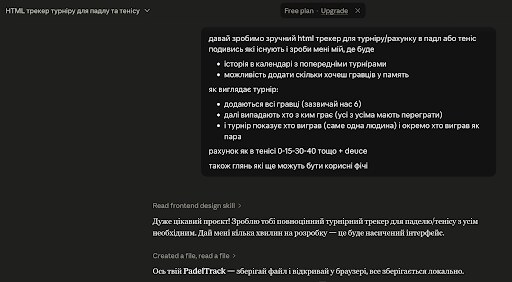
Trending posts about "vibecoding" remained just background noise for Victoria, until a very real pain appeared. The producer has been playing tennis for several years. When a large group of friends formed around the game, the question of organizing tournaments arose. There was no ideal software for their needs: existing applications either required mandatory registration from each participant, or intimidated with a terrible interface and subscriptions. Victoria could not find a ready-made, simple tool for quickly shuffling players and displaying results.
The puzzle came together unexpectedly when the producer took three days off. Left alone with free time and no clear plans, she decided to challenge herself.
Vibecoding between dog walks
The app took about 12–15 hours of pure time over a three-day weekend to create. The development process took place between everyday chores and walks with the dog. The main challenge for the newly minted “vibecoder” was not writing code, which she did not understand, but the ability to correctly formulate her thoughts. Going through 50 iterations meant constantly translating her own ideas into a language understandable to artificial intelligence.
“I didn’t think about the code at all (because I don’t understand it). I thought about how to convey what I want in my own words — as accurately as possible, to get the result I want to see. All this time, in fact, was spent on this: how to formulate correctly, how to explain, how to reformulate when something went wrong,” says Victoria.
Victoria didn't spend a single penny on the experiment — she used only the free versions, simply mixing two AIs when one of them reached its request limits.
Claude became the main “architect” because he was the best at keeping the context of the conversation and producing aesthetic and ready-to-use HTML files for the application. Gemini, on the other hand, served as technical support and a source of “second opinion.” He would join in during Claude’s breaks and proved to be stronger at logical tasks and bug fixing, although he was less good at the visual part of the interface.
“That is, the distribution came out naturally, not planned: Claude is the main one, Gemini is when you need to wait or check something from a different angle,” Victoria noted.
Claude — designer, Gemini — consultant
“I came with the task of making a tracker for paddle/tennis. There was no idea of making an “app” at all. I simply described everything I wanted: the player base, the tournament grid, the tennis score with deuce and advantage, the winner individually and as a pair. Claude immediately gave me an HTML file. I opened it and fell in love with the interface. That's where it all started,” recalls Victoria.
The next stage was the classic QA cycle (testing and fixing bugs). The main technical stumbling block was the division of players into pairs: the algorithm constantly duplicated teams. Victoria had to independently calculate the mathematical model of unique combinations and reformat the query logic for AI.
The experience of managing two different neural networks under the limited limits of free versions was also interesting. Since Gemini tended to change the already approved interface from Claude, Victoria divided their roles: Claude remained the main developer and designer, and Gemini acted as an independent consultant for debugging difficult moments and generating ideas.
The final release of the product was done using the GitHub Pages tool. On Gemini's advice, Victoria posted the code there, got a direct link, and displayed the page icon on the smartphone's desktop using the Safari browser. Despite the fact that the application is architecturally an HTML page, it fully met all the needs of tennis players.
"I didn't have the desire to quit at all. I was moving on some kind of adrenaline-dopamine drive, I couldn't be stopped. Like a Formula 1 car — I see the goal, I don't see obstacles. That's why I can't even remember a moment when I really gave up."
Victoria admits that she doesn't have any secret prompt engineering tricks, as everything is based on specifics and context. However, she has come up with a few rules of her own:
first, write correctly, as neural networks work more stably with neat text (preferably in English);
secondly, in case of a deadlock, ask the AI itself to ask leading questions or decipher the logic of its actions.
Although I had to dance “tango with bugs” regularly: the AI often broke the design while fixing the program logic, and vice versa. When the neural network finally lost the thread of conversation, the producer used a radical method — forcing it to write the problematic piece of code from scratch.
According to Victoria, the hardest part of “vibecoding” is the iterative process itself, which requires enormous patience, meticulousness, and systems thinking. Instead, the easiest part was launching the project. Describing the technical task in ordinary words (as if in a conversation with a friend) immediately gave a ready-made and aesthetic interface.
This instant result without a single line of code removed the main psychological barrier and proved that lack of technical education is no longer a sentence for creating your own product.
Tournament manager for padel and tennis
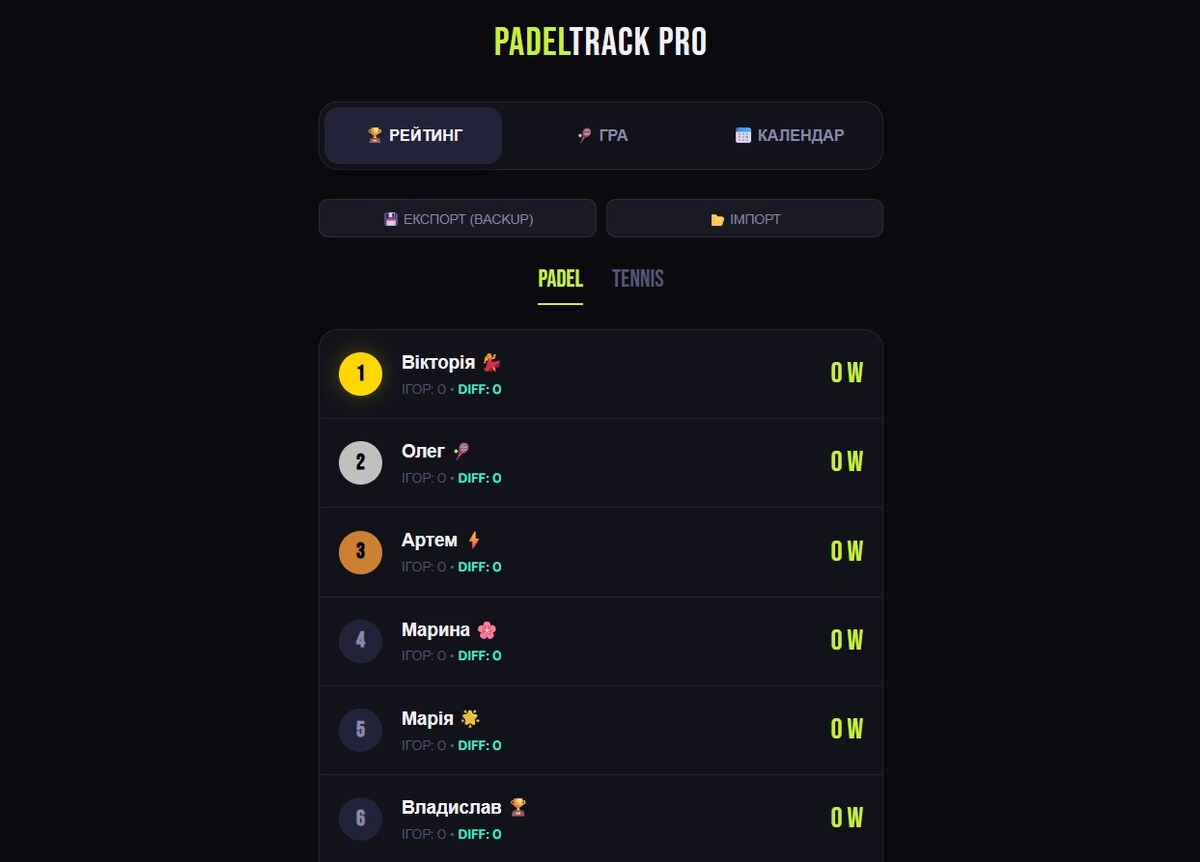
The application can store a database of players (with names and emojis for customization), keep separate statistics for both sports, and automatically generate matches using the Americano system for 4, 6, or 8 participants, where each pair plays together only once.
During the game, the score is kept according to classic tennis rules (0, 15, 30, 40, AD), and if the tournament leaders have the same number of wins, the system uses the point difference as a tiebreaker. After the final, the application determines the champion and sends the game to the archive with full details.
Moreover, Victoria provided a function for deleting tournaments with automatic recalculation of the overall rating, as well as the ability to export and import data via a JSON file, which solved the problem of synchronization between her laptop and smartphone.
The application has already passed its baptism of fire. “We have already tested it once right on the court. We found bugs right away that would have been impossible to find without a real live test. Overall, everyone was pleased with the convenience and proud that I did it myself — it was a surprise for them!”
What's next?
For now, Victoria is focusing on polishing the current application to perfection and fixing bugs found on the court. She is in no hurry to turn her hobby project into a large commercial product, but notes that if she sees real demand outside her tennis company, she is quite ready to think about something more serious.
However, the career of the "vibecoder" definitely does not end with one application. The producer's next ambitious goal is to create her own bot-analyst. She was inspired to take this step by the case of Oleksandr Ulytsky , whose experience on LinkedIn she was sincerely impressed with. It seems that the era of AI experiments for Victoria is just beginning.
Tips from a humanities vibecoder
Victoria’s main advice to anyone who has ideas but is afraid of programming is to start with a specific pain, not with technology. You shouldn’t teach something complicated just “for the sake of a useful goal.” It’s much more effective to take the position of a customer who is genuinely annoyed by some everyday problem and try to solve it. According to the producer, we live in a “golden age” when a humanitarian can turn into a developer in just three days.
In addition, you don’t need to try to understand the code itself — artificial intelligence is there for that. The main area of responsibility of a person in this process is to clearly understand what exactly they want. AI will write the technical part without any problems, but the architect of the idea and the final result always remains the author.
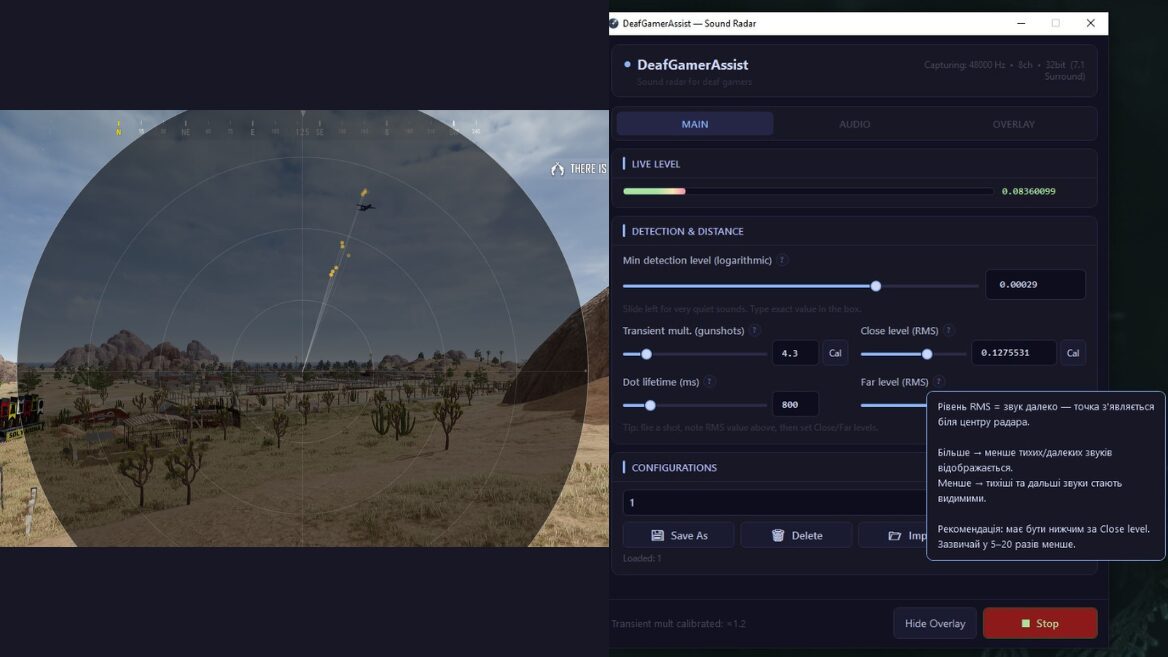
A developer coded a sound visualizer for his hearing-impaired brother to play shooters. He created the app with a bunch of settings in four hours, and didn't even have to take his eyes off the game.
Як нейромережі бачать вільну та незалежну Україну? Тест dev.ua
Нейронні мережі для генерації зображень бачать світ по-своєму, їхню логіку зрозуміти часом зовсім неможливо. Але таки хочеться. На честь Дня Незалежності України редакція dev.ua вирішила провести невеликий експеримент.
Ми задали чотирьом різним нейронним мережам п’ять однакових запитів: «прапор України», «День Незалежності України», «український Крим», «перемога України» та «українці». Отриманими результатами ми ділимося з вами нижче.
У TikTok тепер можна генерувати фон за допомогою нейромережі. Ми протестували її та ділимося результатами
У TikTok з’явилася нова функція «Розумний фон». З її допомогою як фон для тіктоків можна підставляти згенеровані нейромережею зображення. Редакція dev.ua протестувала цю технологію і ділиться своїми враженнями.