Редакція dev.uaІсторії
26 September 2025, 16:10
2025-09-26
Blending Business and Science: How Infinity Technologies Builds R&D Hubs
In 2019, something remarkable happened: a Swiss pension fund chose Ukrainian entrepreneur Oleksandr Yatsentyuk and his IT company, Infinity Technologies, to lead a large-scale digital transformation. Under his leadership, the team built one of Switzerland’s first interactive portals for hundreds of thousands of members. Previously, fund clients relied on paper correspondence and waited weeks for appointments. With the new portal, all communication moved online.
In 2019, something remarkable happened: a Swiss pension fund chose Ukrainian entrepreneur Oleksandr Yatsentyuk and his IT company, Infinity Technologies, to lead a large-scale digital transformation. Under his leadership, the team built one of Switzerland’s first interactive portals for hundreds of thousands of members. Previously, fund clients relied on paper correspondence and waited weeks for appointments. With the new portal, all communication moved online.
The major project with the Swiss pension fund was preceded by more than two decades of Infinity Technologies’ growth: from printing services and website development to advanced 3D visualizations and projects for IBM, Nestlé, Siemens, KPMG, and Vodafone. The company hasn’t rested on its laurels. In 2025, the team shifted its focus to deep science and the creation of R&D centers, bringing together not only developers but also scientists from Ukraine, the EU, the UK, and Latin America.
In this feature, we explore how the company bridges business and science, how enterprises are adopting AI, and what it really costs to build an MVP for a startup.
How R&D Benefits Business
This winter, Infinity Technologies was approached by one of the world’s leading printer manufacturers. The client had been accumulating hundreds of terabytes of telemetry data on device usage — including cartridge levels and consumption, failure reports, and real-time machine statuses. Despite the vast amount of information, the company struggled to generate business value from it, while spending around $40,000 a month just to maintain the storage infrastructure. The client had previously sought help from a Big Three consulting firm, but the recommendations they received were too generic and delivered little real benefit.
For Infinity Technologies, requests like this are nothing new. While most IT firms join a project at the idea stage, Infinity typically steps in when the client already faces a pressing problem but hasn’t yet found a solution.
«We don’t wait for a customer to spell out what they’re missing — we conduct in-depth research into their business and propose solutions that can strengthen their market position,» explains Roman Reznikov, CEO and Managing Partner of Infinity Technologies. «Not every company has its own R&D department, and building one just to address a single challenge isn’t always practical.»
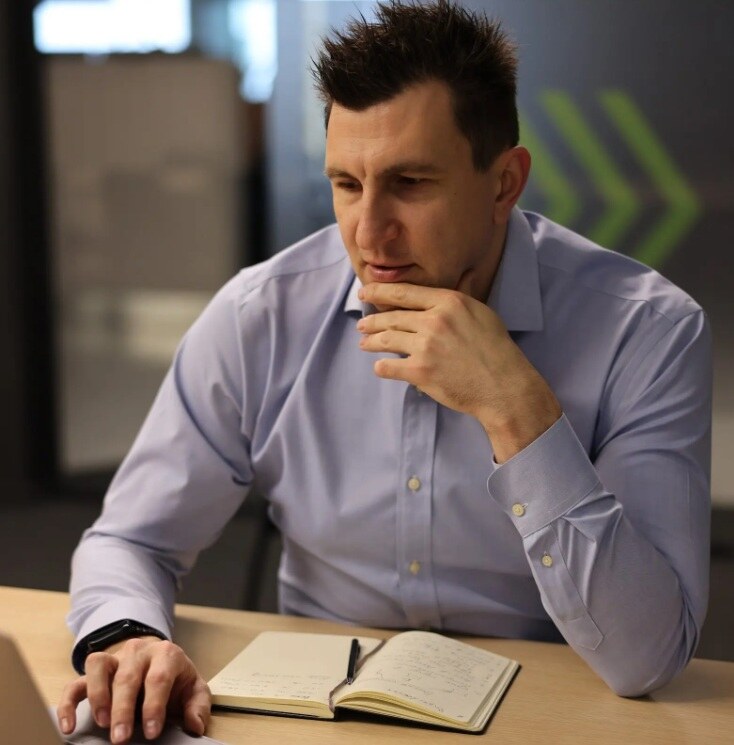
Roman Reznikov, CEO and Managing Partner of Infinity Technologies
For the printer manufacturer, Infinity built an ML model based on ink levels and print history that could predict when cartridges would run out — with an accuracy of up to three days. This enabled the company to offer automatic cartridge refills and boost sales.
After the pilot, however, it turned out that the sales growth was marginal.
«We dug deeper and used the data to identify customers who, despite their service agreements, were using unauthorized Chinese cartridges,» says Reznikov. «The manufacturer then launched a targeted communication campaign, which significantly increased sales of original cartridges.»
Another successful project was the launch of a B2B service providing dashboards with analytics on printer fleet efficiency. This service evolved into an additional paid product that corporate clients quickly adopted.
Unlike consulting giants such as McKinsey, who primarily offer best-practice recommendations, Infinity Technologies looks beyond what is already being done in a client’s industry. They apply scientific methods — analysis, synthesis, systems thinking, modeling, empirical research, Proof of Concept development, and hypothesis testing.
This approach allows Infinity to deliver truly innovative solutions that help clients get ahead of the competition. For pharmaceutical companies, they design AI-powered tools that can significantly shorten the drug development cycle. For e-commerce players, they leverage neuro- and biobehavioral research using EEG, eye-tracking, and heart rate sensors. The insights help reveal what attracts or repels users, refine product interfaces, and ultimately increase conversion rates. Such projects are carried out in collaboration with the Behavioral Lab at Sumy State University.
How R&D Works
At Infinity Technologies, clients are provided with autonomous R&D hubs that operate as an external team of researchers and developers. Here’s how the R&D process unfolds, illustrated with a data-driven project:
Analysis of global and adjacent experience: Studying how other companies within and outside the industry work with data. Dozens of examples are collected to gain a broad overview of possible solutions.
Review of scientific research: Examining academic papers and publications to identify concepts that have not yet been practically implemented but could become breakthrough innovations.
Prioritization and selection: Evaluating scenarios based on potential business impact and implementation complexity, then selecting the most promising examples.
Modeling and hypothesis testing: Building mathematical and simulation models to predict effects and validate hypotheses at early stages.
Experiments and prototyping: Developing Proofs of Concept and prototypes, testing them in real conditions, and adjusting based on results.
Preparation for scaling: Refining the chosen solution to a stage where the client’s team can implement and further develop it independently.
This year, R&D solutions were launched as a standalone service. However, Infinity Technologies has been running similar projects for years, including collaborations with Sumy State University.
«Over the past 20 years, we have completed more than 50 R&D projects for clients in Europe, the US, and the Middle East,» says Oleksandr Yatsentyuk. «Now we’ve decided to sharpen our focus and involve scientists more actively, as clients increasingly seek genuine innovation.»
Oleksandr Yatsentyuk, Founder and Managing Partner of Infinity Technologies
The search for the right experts is supported by Roman Reznikov’s network — under his leadership, the company has brought in 20 Ph.D. holders. Reznikov is closely connected to the field of scientific research: in 2021, he earned a Ph.D. from the National Academy of Sciences of Ukraine and is currently pursuing a doctoral degree. His research focuses on the impact of digital technologies on the economy.
Roman joined Infinity Technologies earlier this year. Prior to that, he spent over a decade in executive roles at SoftServe and Intellias, including leading a business unit with more than 800 employees.
Bridging Business and ScienceInfinity
Technologies gathers use cases and datasets from a wide range of sources — from academic publications and industry reports to paid, proprietary data sets. Some information is also obtained directly from companies like Amazon, Google, Microsoft, IBM, Oracle, and Talend.
Research can take up to two months for smaller tasks and up to six months for larger cases. Another approach is an ongoing process, where one team continuously conducts research while another tests the hypotheses in practice. Some projects require highly specialized scientific expertise.
«We’ve received requests for developing encryption and data compression algorithms. We needed mathematicians capable of solving extremely complex equations far beyond the standard skills of typical developers,» explains Roman Reznikov. «Finding such experts is a challenge, but it’s precisely what allows us to compete with major companies.»
One example is the collaboration with Professor Andriy Matviychuk from KNEU, whose research is applied in commercial projects. One such project is the IntelScoring platform, which automates scoring systems and enables the creation of highly efficient and robust models in just minutes — or hours for large datasets — whereas this process typically takes months.
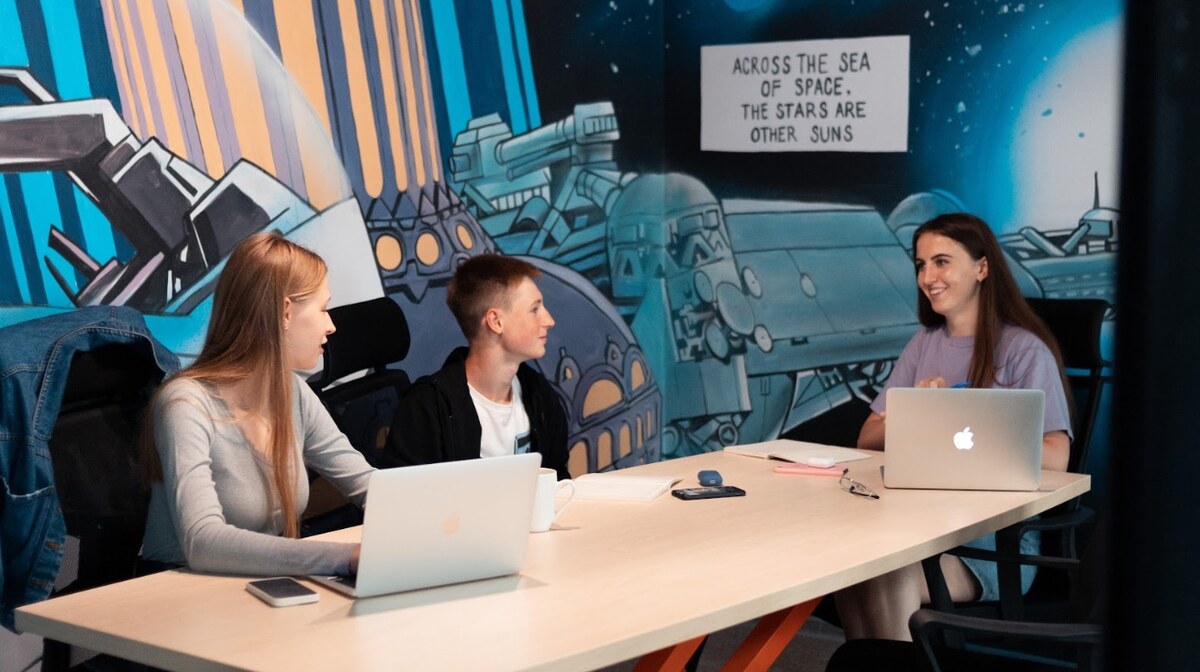
Lecture at Infinity Technologies Office
Another area Infinity Technologies is developing is quantum technologies. The company collaborates with the Kharkiv Quantum Cluster, is developing a master’s program with V. N. Karazin Kharkiv University, sponsors the Quantum Machine Learning School 2025 at UCU, and, together with Haiqu and SoftServe, provides scholarships for young talent. For his efforts in advancing quantum technologies in Ukraine, Roman Reznikov was recognized with the KSE 150 award in the «Talents for Ukraine» program.
And what about development?
In addition to research projects, Infinity Technologies also works on product development that delivers fast results for businesses. Most clients seek AI integration into operational processes, with two main types of requests:
Connecting AI to internal databases: This is particularly relevant for companies still using legacy accounting software. Once integrated with an LLM, employees can ask questions as they would with ChatGPT — for example, «How many sales did we make in January?» — and get instant answers without writing complex SQL queries.
Intelligent search in corporate archives: Many companies accumulate terabytes of files over the years in various formats. When an LLM model is connected to the storage, search becomes a simple dialogue: the user asks a question, and the system finds the answer within the documents and provides links to the relevant files.
When it comes to building a product prototype or MVP, Infinity Technologies relies on no-code platforms like n8n and Make.com. These tools enable API integration, data processing, and the creation of complex automation workflows by combining ready-made modules.
«Startups especially appreciate the modular approach — we help them quickly test hypotheses without investing in extensive design work or months of analytics,» says Oleksandr Yatsentyuk. «Whereas the first version of a product used to cost $50–80K, now it can be tested for just $10–15K».
The company develops projects for clients worldwide, but its roots are in Sumy, where part of the team still works in the local office.
«We respect people’s desire to stay in their hometown and want to support them,» adds Yatsentyuk.
At Infinity Technologies, developers are encouraged to be more than just executors — they can become potential business partners.
«Their high-quality work builds trust in the company,» explains Roman Reznikov. «It works better than any sales department: clients not only continue collaborating but also recommend us to their partners.»
The company follows a partnership model: if a team member brings in a new client, they receive a share of the project’s profit — typically a 5–10% commission. The individual keeps this share even if they leave the company.
«Our company is built on people who are passionate about technology,» says Oleksandr Yatsentyuk. «For me, IT isn’t just a business; it’s a chance to create things that change people’s lives. It gives a sense of purpose and drives me more than any amount of money.»