Хочете будувати кар’єру в Data Science та AI? Vodafone Big Data Lab відкриває новий набір —>
Марія БровінськаWeapon
28 July 2026, 09:00
2026-07-28
“Sometimes we compete only with the Russians.” Ukrainian DefTech manufacturers on global component shortages, seven-fold increase in fiber prices, and the war economy during downtime
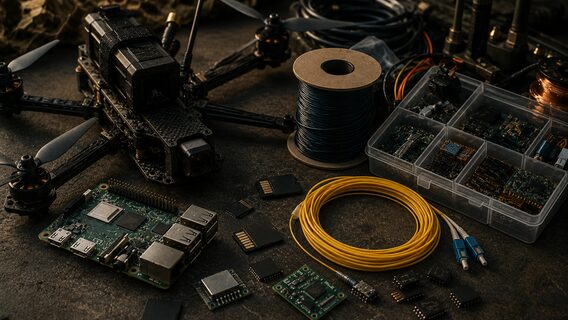
Ukrainian defense manufacturers have long been accustomed to working in conditions of shortages — but this shortage rarely concerns weapons themselves. Most often, everything rests on ordinary microelectronics: Raspberry Pi, memory cards, fiber optics, specific microcircuits.
dev.ua asked engineers from Dwarf Engineering, SKIFTECH, and the CEO of BlueBird Tech what the production processes really rely on when it comes to components.
Ukrainian defense manufacturers have long been accustomed to working in conditions of shortages — but this shortage rarely concerns weapons themselves. Most often, everything rests on ordinary microelectronics: Raspberry Pi, memory cards, fiber optics, specific microcircuits.
dev.ua asked engineers from Dwarf Engineering, SKIFTECH, and the CEO of BlueBird Tech what the production processes really rely on when it comes to components.
A day of downtime costs millions—even if it never happens
Downtime is the biggest pain for manufacturers. «Even one day of downtime costs at least millions of hryvnias. After all, expenses continue to accrue regardless of whether production is running or not: these are rental of premises, employee salaries, equipment maintenance, and other operating expenses,» Valeriy Zarubin from BlueBird Tech tells dev.ua. For large manufacturers with several sites and hundreds of employees, this is already tens of millions of hryvnias in losses per day.
But that is why none of the surveyed manufacturers is actually ready to count downtime as a separate financial indicator — all three build processes so that it simply does not happen. «Production is organized in such a way as to avoid a complete stop: if individual components are missing, we reschedule work and switch to other modules,» SKIFTECH explains, specifying that delays that do occur are compensated for by overtime — this raises the cost, but does not stop the line.
Dwarf Engineering admits that in theory, production could stop due to one small part, but in practice this does not happen for two reasons. «Manufacturing creates stocks of components, and the primary task of engineers who design devices is to ensure the possibility of replacing individual components,» the company says, adding that they strive to use alternatives that are easy to find in Ukraine.
Fiber optic prices have increased sevenfold
If downtime can be avoided, then no one can save you from the increase in the price of components — the only question is what exactly is increasing in price the most. «One of the most illustrative examples is fiber optics. Due to the rapid growth in demand and active competition for production capacity, its cost has increased several times in some cases, in some places the increase in price has reached 7 times,» says the CEO of BlueBird Tech.
Dwarf Engineering records the biggest price increase in another segment: «The parts that have computing components, permanent and operational memory have risen the most. In our case, these are Raspberry Pi of all models and microSD memory,» the company says. And SKIFTECH refuses to single out individual parts at all: «We analyze not individual components, but entire groups, because one product contains from several hundred to several thousand parts.» The company calls microelectronics and materials related to petrochemicals the biggest influencing factor.
Who is actually the competitor for components?
So who are manufacturers actually competing with for these components on the global market? And here the answers diverge interestingly. «Probably, we compete the most with all the manufacturers of military solutions, who use all these modules and memory drives,» says Dwarf Engineering. The manufacturer explains this by the fact that most military devices are disposable or quickly destroyed in battle, so the demand for replacement is constant.
SKIFTECH takes a broader view: «We compete not only with defense companies, but with the entire global electronics industry. The same components are used in different industries, so today the advantage is given to companies that have a strong system of international procurement and inventory management,» the company notes.
The most illustrative example, however, was given by BlueBird Tech: «Most often, we are talking about specific or already outdated components that have not been mass-produced for the civilian market for a long time, but remain effective for certain defense solutions… Sometimes we actually compete only with Russian manufacturers, since civilian demand for such components has long been absent,» says Zarubin.
SKIFTECH also confirms the purchase «around the world»: «First of all, these are individual microelectronic components that are produced in limited batches. We also purchase civilian platforms that are integrated into our solutions, in particular the DJI Mavic,» the company says, adding that due to the high demand for such platforms, it is necessary to maintain an entire network of suppliers.
The most underestimated expense item
So what cost item has increased the most for defense manufacturers, even though almost no one talks about it publicly? And here SKIFTECH and BlueBird Tech actually gave the same answer in different words. «The most underestimated cost item is ensuring supply chain sustainability. Reserve stocks, alternative suppliers, re-contracting and constant re-planning of purchases have become as important a part of production today as the technological process itself,» SKIFTECH says.
BlueBird Tech specifies the same thing through a financial instrument: «This is working capital in purchases. In order to produce more products, it is necessary to pay for larger volumes of components much earlier, wait for their manufacture, transportation, customs clearance, and storage in warehouses. As a result, large amounts of funds can be frozen for several months before the components enter production,» explains Zarubin.
Overall, over the past two years, according to BlueBird Tech, the largest increase in costs was for scaling production — and these include not only new sites, but also hiring and training personnel, launching new processes, and maintaining quality.
SKIFTECH adds another factor — salaries: to remain competitive in the labor market, you have to maintain a level of pay, which also pushes up the cost of living.
«Either Europe will learn from Ukraine, or Europe will be taught by Russia.» Will Ukraine become the EU’s defense laboratory: Ukrainian deftech manufacturers respond