"The Jugular Vein of the Internet": How Iran and Russia Turned Undersea Cables into a New Weapon in Hybrid Warfare
The physical infrastructure of the global internet is under unprecedented threat. While Russia «accidentally» cuts undersea cables with anchors in the Baltic Sea, Iran’s Islamic Revolutionary Guard Corps (IRGC) is preparing a plan for legal blackmail. Tehran wants to recognize the fiber optic cable in the Strait of Hormuz as an «occupation of Iranian subsoil» and force Google, Amazon, and Microsoft to pay tribute.
The physical infrastructure of the global internet is under unprecedented threat. While Russia «accidentally» cuts undersea cables with anchors in the Baltic Sea, Iran’s Islamic Revolutionary Guard Corps (IRGC) is preparing a plan for legal blackmail. Tehran wants to recognize the fiber optic cable in the Strait of Hormuz as an «occupation of Iranian subsoil» and force Google, Amazon, and Microsoft to pay tribute.
dev.ua examines how underwater highways have become the main target of dictatorships and how many billions it costs the global economy.
Today, 94% of European businesses are critically dependent on uninterrupted internet connectivity. But most data, from financial transactions to artificial intelligence, is transmitted not via satellites but via thin fiber-optic cables laid along the ocean floor. And it is these that have become the West’s most vulnerable point.
Iran’s plan: Internet tax
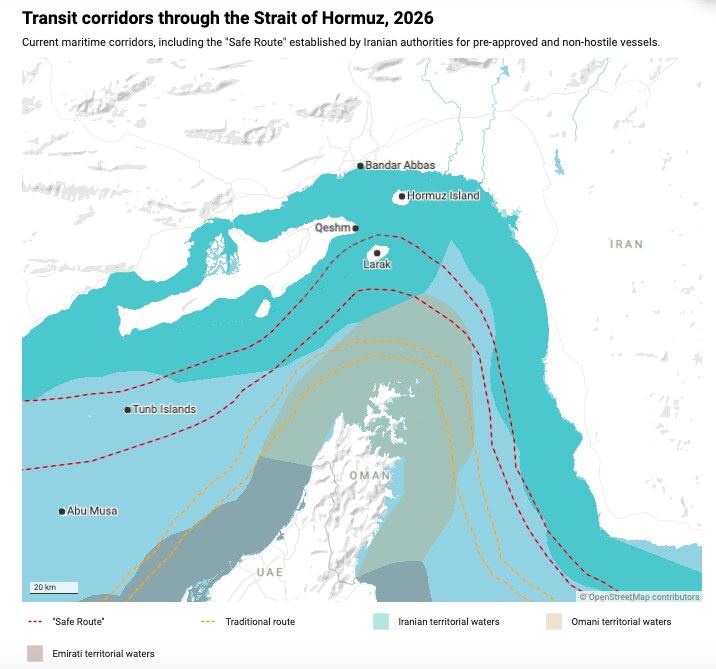
Recently, Iranian media outlets Fars and Tasnim, which are directly affiliated with the IRGC, simultaneously released materials demanding the monetization of transit through the Strait of Hormuz. Key networks (FALCON, GBI, Gulf-TGN) connecting Europe and Asia pass through it.
The Iranian legal logic is based on a specific interpretation of the UN Convention on the Law of the Sea. Since the strait is less than 39 km wide at its narrowest point, the territorial waters of Iran and Oman (22.2 km each) completely overlap.
The IRGC media claim that, yes, international law guarantees ships transit through the water, but this does not cancel Iran’s sovereignty over the seabed itself. Any cable there is an «occupation of Iranian soil,» for which foreign operators must pay a per-meter infrastructure fee. In addition, Tehran wants to monopolize all repair work in the strait.
The Iranians openly call the cables «the jugular vein of the global internet,» and the Strait of Hormuz their «digital lever of power,» which will allow them to dictate terms to Western technology companies.
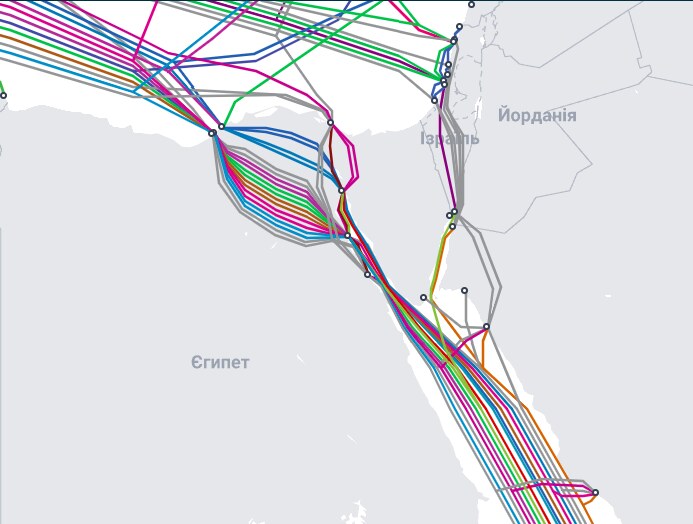
The idea of monetization is not taken from the ceiling. The Iranians are guided by the experience of Egypt, which, according to the same Tasnim, earns from $250 million to $400 million per year from cables passing through the Suez Canal.
Russian method: «random» anchor
While Iran is preparing the legal ground for blackmail, on the other side of the world, in Europe, cables are already being physically cut. The era of hybrid warfare has made undersea highways an ideal target.
Since 2022, 10 undersea cables have been cut or damaged in the Baltic Sea. In December 2025, a cargo ship traveling from St. Petersburg to Israel dragged its anchor along the bottom of the Gulf of Finland and severed a telecommunications cable between Helsinki and Estonia. Russia has categorically denied any involvement, citing an «accident.» And as early as early 2026, Russian submarines were spotted near critical cables in British waters.
«Areas like the Baltic are particularly at risk because the seabed is only about 100 meters deep. If you drop anchor or deploy a trawl and start moving, not only is the cable easy to cut, but it’s also very easy to back out of it,» explains Christophe Eugene, senior defense advisor at Sopra Steria and a former rear admiral in the French Navy. Back in 2023, NATO confirmed that the Russian Federation was actively mapping the underwater infrastructure of Ukraine’s allies.
The price of the question is billions of dollars and the «falling» of clouds
Damage to the main lines has catastrophic consequences for businesses. A striking example: in September 2025, a ship’s anchor severed two major cables in the Red Sea. As a result, companies in India lost 60% of their connectivity to Microsoft Azure services, and businesses in Pakistan were left without any connectivity at all. The economic losses from this incident were estimated at $3.5 billion.
What happens when a cable breaks in Europe? Traffic has to be rerouted over much longer routes, such as through the United States.
» This adds about 150 milliseconds of latency (ping). That’s enough to make video conferencing, high-frequency stock trading and online streaming unworkable,» says Tony O’Sullivan, CEO of internet service provider RETN. This becomes even more of a problem given that many of Europe’s new AI data centers are being built in Scandinavia, and mainland companies are connecting to them via the limited Baltic routes.
Why Big Tech is under the spotlight
Both Iranian blackmailers and Russian saboteurs understand perfectly well who they are targeting. The global Internet is now monopolized by a handful of American corporations — the so-called «hyperscalers.»
According to analysts at TeleGeography, while in 2012 the tech giants consumed only 13% of international bandwidth, today it is 74%. Amazon (AWS), Microsoft and Google control about 70% of the European cloud market. That is why the IRGC openly states that the purpose of its cable tax is to force hyperscalers to comply with Iranian laws.
This dependency is also frightening for Europe itself. The EU plans to triple spending on so-called «sovereign cloud infrastructure» by 2027 to reduce its dependence on the US. But even if it moves servers to its territory, data will still have to be sent over ocean cables.
What should IT businesses do?
On average , 150-200 cases of cable damage are recorded worldwide each year. In the context of hybrid warfare, experts put «cable risks» on a par with cyberattacks.
The international financial organization FS-ISAC has already urged companies to create disaster recovery plans that take into account fiber outages. The main rule is to have an alternative.
«Companies need contingency plans. As soon as one cable channel is lost, they need to be ready to switch to another. And that „other“ today is likely to be a satellite (e.g. Starlink),» Rear Admiral Eugene concludes.
The days when undersea cables were considered inviolable are over. Protecting infrastructure from saboteurs and political blackmailers is becoming a matter of survival for the digital economy in the coming years.