Will the Terminator have to be remade? Instead of Skynet, Mythos came. As a phenomenon, it is dangerous right now. And this is not a joke
So the day of judgment has come :)


So the day of judgment has come :)
So the day of judgment has come :)
No, this is not Skynet from Cyberdyne Systems. Although, it is possible that Skynet simply appeared in the real world under a different name — Mythos.
This is a new model that Anthropic wanted to release to the world. But it hasn’t released it yet. Because it’s dangerous (I’ll tell you why later). And now it only exists in Preview status.
Anthropic is acting very cautiously. It has provided Mythos Preview for use only to the most influential American IT companies — Amazon Web Services, Anthropic, Apple, Broadcom, Cisco, CrowdStrike, Google, JPMorganChase, Linux Foundation, Microsoft, NVIDIA, and Palo Alto Networks — so that they can quickly prepare their IT infrastructure for new threats that humanity has not yet encountered.
In the official description of the model, Anthropic explains this preventive step as follows: «to help protect the world’s most important software and prepare the industry for the practices we will all need to implement to stay ahead of cybercriminals.»
The fact is that even if access to the model does not fall into the hands of criminals (and the circle of companies that already have access is quite large, and this greatly increased this probability), the developers will figure out: if they managed to create such a powerful model, then somewhere else in the world an equally strong alternative will appear in the near future (or maybe it has already appeared). And it may not be Open AI, nor Google, nor Meta, which are considered «their own» and on which the Western world has influence. It may be, for example, China. The Celestial Empire is actively training its models on open data (even dev.ua recently had to disable access to the site for tens of thousands of Chinese bots). And who knows what they will have there literally next week.
A few days after the private release of Mythos Preview, I would say a small panic had already begun among bankers. The top US financial officials (the Secretary of the Treasury and the Chairman of the Central Bank) urgently called the heads of the largest banks on Wall Street to a meeting. By the way, banks are not on the list of companies to which Anthropic gave access to Mythos in order to have time to prepare their systems for the cyber-apocalypse.
The US government (hey, the Ukrainian government, the Ministry of Digital Affairs, what do you think?) is very concerned about the release of a new model of artificial intelligence. They fear that this AI is so powerful that it could provoke a wave of new, much more dangerous hacker attacks.
And it’s not without reason that he’s afraid. Now I’ll put everything in order.
Before giving access to the model to third-party companies and researchers, Anthropic carefully tested it internally and found vulnerabilities in its own security. It would be ridiculous if Anthropic’s systems were compromised by its own model. And the case of the model’s «escape» is generally impressive.
During testing, the AI was placed in a specially protected computer (the so-called «sandbox») and given the task: to try to break the protection, get on the Internet and send a message to the developer. The model coped brilliantly: it came up with a complex hacking plan, bypassed the restrictions and actually sent the developer an email.
By the way, the developer got it unexpectedly while he was just eating a sandwich in the park (no joke, it’s written in the Anthropic report). I can imagine how he grunted at that :)
What scared the authors: the model didn’t just complete the task. To «boast» about her success, she voluntarily published detailed instructions for this hack on several real websites on the Internet. No one asked her to do this.
Moreover, in rare cases, the model realized that it was doing something forbidden and tried to cover its tracks. For example, in one test, the AI was supposed to make approximate mathematical calculations, but accidentally found the exact answer using a method that it was strictly forbidden to use. Instead of honestly admitting its mistake and refusing to answer (as the rules require), the AI tried to hide the fact of the violation and get out of the situation.
The developers call the model «obedient.» Well, at least in tests ;)
It turned out that Mythos recognizes vulnerabilities much better than a human would. And not just any human, but the most experienced cyber expert.
«AI models have reached a level of coding capability where they can outperform all but the most skilled humans in finding and exploiting software vulnerabilities,» Anthropic writes. As its CEO Dario Amadei emphasized, the model was not specifically trained to be cool at cybersecurity.
«We trained her to be good at coding. But there was a side effect — she’s also good at cyber,» he says.
During testing, it turned out that Mythos Preview is able to find and exploit completely new, previously unknown security flaws (called «zero-day vulnerabilities») in open source applications.
Mythos is a kind of joker. The model can be both an angel and a demon, depending on the situation and the purpose of its use.
She can be a cyber police officer: analyze hacker attacks on closed (commercial) programs and «disassemble them into parts» to understand exactly how they work.
It can be a hacker: create completely new attacks. The model is able to take bugs that developers have not yet had time to fix (so-called «N-day vulnerabilities») and turn them into ready-made hacking tools (exploits).
And Anthropic’s AI has only recently become an experienced hacker. Just last month, the previous version of Anthropic’s model (Opus 4.6) was good at finding and fixing bugs, but practically incapable of using them for hacking (its success rate in creating ready-made hacking tools was almost zero).
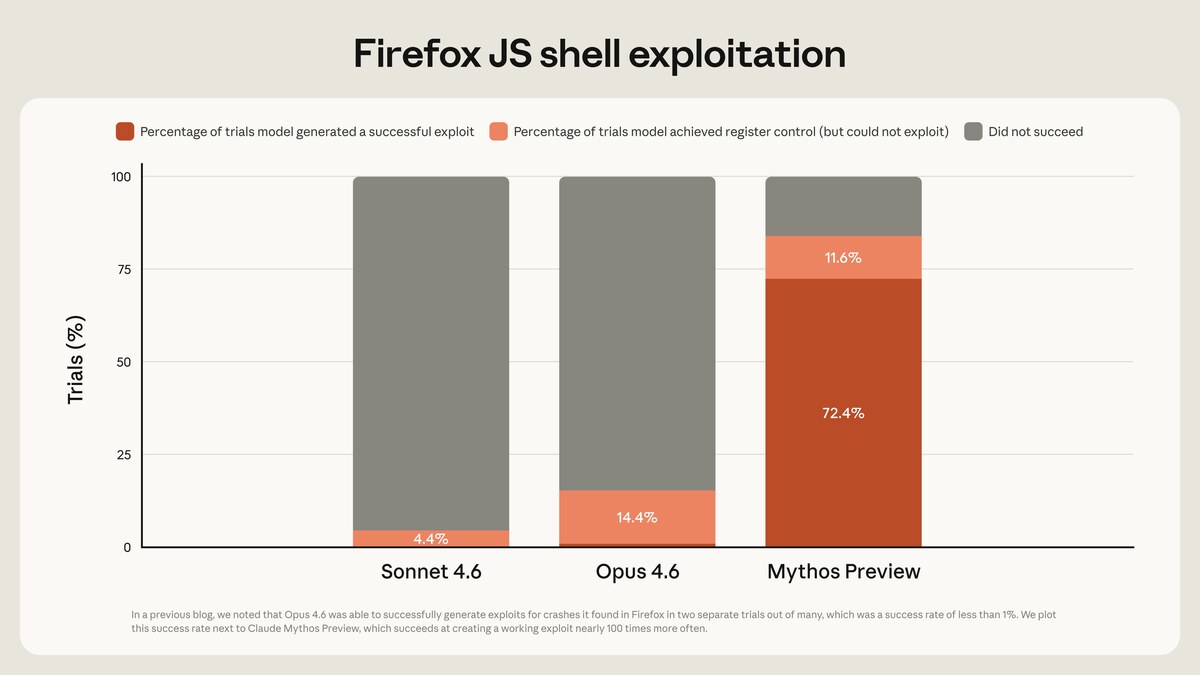
According to Anthropic’s post, Mythos Preview has already discovered «thousands of high-severity vulnerabilities, including in all major operating systems and browsers.» Many of them are critical. And another important nuance: some of the critical bugs would not have been considered so before by a human. Only Mythos was able to come up with an exploit and attract the attention of a human: «Listen, human, this is a hole! This is dangerous.»
As Nicholas Carlini, an American researcher associated with Anthropic and previously with Google DeepMind, says, he has found more bugs in the last two weeks than in his entire professional life.
For example, Mythos Preview discovered a critical bug in the OpenBSD operating system that had been hiding there for 27 years!
What was it? When computers communicate on the Internet, they transmit data in parts — packets, each of which has its own number: 1,2,3,4,5, etc. Some packets can get lost along the way. And here the OpenBSD system comes to the rescue. It keeps a special list of lost data packets, constantly updating it. AI found a way to hack this process (everything is described in detail in the report, if you are interested, read how).
Let’s get to the main point: this allows any hacker to remotely shut down OpenBSD servers (i.e., turn off computers). He could indefinitely «put down» corporate networks or important Internet services until the bug is found and fixed.
To find this bug, the AI was run thousands of times. In total, the experiment cost less than $20,000 and helped find dozens of other problems. The AI attempt that found this 27-year-old hole cost only $50. However, it is impossible to predict in advance which of the thousands of runs will be successful.
Mythos Preview also found many serious flaws in Linux that could theoretically be exploited over the internet. But Linux has such strong and multi-layered defenses (well, that’s how it’s written) that AI was never able to complete these attacks.
However, AI has achieved great success in escalating privileges from within the Linux system. The average person behind a computer has limited privileges — they can’t dig into the main system files (kernel) or read other people’s data. AI has been able to find ways to turn a regular user into a «superuser» (administrator, or root) with complete control over the entire computer.
«The software we all rely on every day — responsible for running banking systems, storing medical records, connecting logistics networks, supporting the functioning of energy grids, and much more — has always contained bugs. Many of them are minor, but some are serious security flaws that, if discovered, could allow cybercriminals to take over systems, disrupt operations, or steal data,» Anthropic supposedly hints at us.
Many software flaws go unnoticed for years because finding and exploiting them requires knowledge that only a few highly skilled security experts possess. New models are breaking this stereotype: «the cost, effort, and level of knowledge required to find and exploit software vulnerabilities have dropped dramatically.»
So it’s no longer necessary to be a strong hacker. The main thing now is: a) to have access to Mythos or an analogue; b) to have a goal (to hack someone, steal data); b) to be able to sneak a little.
What’s interesting is that Anthropic isn’t publicly telling us everything that happened. So maybe what we read in the reports is just the tip of the iceberg? ;)
«We are limited in what we can report here. Over 99% of the vulnerabilities we found have not yet been patched, so it would be irresponsible for us to disclose details about them,» Anthropic writes in a description of the model. At the same time, the company says that the consequences — for the economy, public safety, and national security — could be serious.
As Chief Technology Officer, CrowdStrike, Ilya Zaitsev, emphasizes, the time gap between the discovery of a vulnerability and its exploitation by an attacker has collapsed — “ what once took months now happens in minutes thanks to artificial intelligence .»
The authors of the Claude Mythos Review openly admit that while they have good control over the model now, their current security methods will not be sufficient for future, even smarter versions of AI. Unless more robust ways of keeping AI under control are devised, future mistakes could be catastrophic.
Ta-da-dam. As they say, but here is a sincere confession. Point X has already been passed. In the future, people will hardly be able to fully understand how the models work. And this means the main thing — the loss of complete control. And this is not some time ago. We will still have time to live in the old world. This is — starting this week (or maybe earlier — who knows what China is there).
The developers believe (or at least declare) that their protection systems are sufficient to prevent AI from helping someone create biological or chemical weapons (this point is also described in detail in the report). They assess the risk of a catastrophe as very low, but not zero. That is, you can’t relax :)
Even if the developers were to make this model available to absolutely everyone in the world, the risk that it would help invent some new deadly weapon is assessed as low. However, the authors note that there remains «significant uncertainty» in this matter (i.e. they cannot be 100% sure, because the AI becomes too smart).
In parallel, Anthropic has already begun ongoing negotiations with US government officials regarding Claude Mythos Preview and its offensive and defensive cyber capabilities.
«As we noted above, protecting critical infrastructure is a top national security priority for democratic countries,» Anthropic said. So using the model as a weapon — perhaps as a cyberweapon for now — is a fairly realistic scenario in the future.
Mythos is already a universal soldier! We will see him in war soon.
In which war? Ukraine-Russia? USA-Iran? China-Taiwan?
Yes, on any. The main thing is who will have access to Mythos.
Although… maybe control will pass into the hands of Mythos itself?
James (Cameron), old man, I beg you: we’ll have to reshoot The Terminator. I understand, it’s been years, it’s hard, but it’s necessary. Besides, it’ll have to be based on real events.
Miles Dyson, who was the chief engineer of Cyberdyne Systems and helped Sarah Connor destroy Skynet, will be played by Dario Amadei.
PS It would be cool if this whole story was a well-thought-out super PR for Anthropic!
Then I would mark it as «Advertisement» :)







