A potential lever of Trump's (USA) influence on Ukraine is the cloud. Why we need to think ahead
Last night it became known that the Russians attacked the Gigacenter data center. After this attack, we can say that the enemy tried to attack the sites of all the largest Ukrainian cloud providers. Some of them — Parkovy, Datagroup, Cosmonova, Mirohost — stopped their work. Others — withstood and are updating the infrastructure after the attacks.
Last night it became known that the Russians attacked the Gigacenter data center. After this attack, we can say that the enemy tried to attack the sites of all the largest Ukrainian cloud providers. Some of them — Parkovy, Datagroup, Cosmonova, Mirohost — stopped their work. Others — withstood and are updating the infrastructure after the attacks.
The first conclusions are that cloud services work. Almost without failures (or with short-term failures). This is, first of all, the merit of the operators of the sites themselves, who long before the arrivals spread their infrastructure to different places and managed to save customer data. This is also the merit of the data owners, who took care of backups in advance.
But there is a problem.
After this fall, unfortunately, it is the foreign cloud, not the Ukrainian one, that will become the home for most Ukrainian online projects. Even if national providers upgrade their capacities, the services will be much more careful about storing information in Ukraine. Of course, global hyperscalers (large clouds) are a reliable alternative. More expensive, but with a large set of additional AI services.
Although there are also big minuses that are more hypothetical, more hidden, but if everything suddenly goes according to the worst scenario for us, we will definitely feel it. The fact is that the largest international clouds, the same AWS or Azure, are American. Yes, they work all over the world, but incorporated in the USA, they work, first of all, under American law.
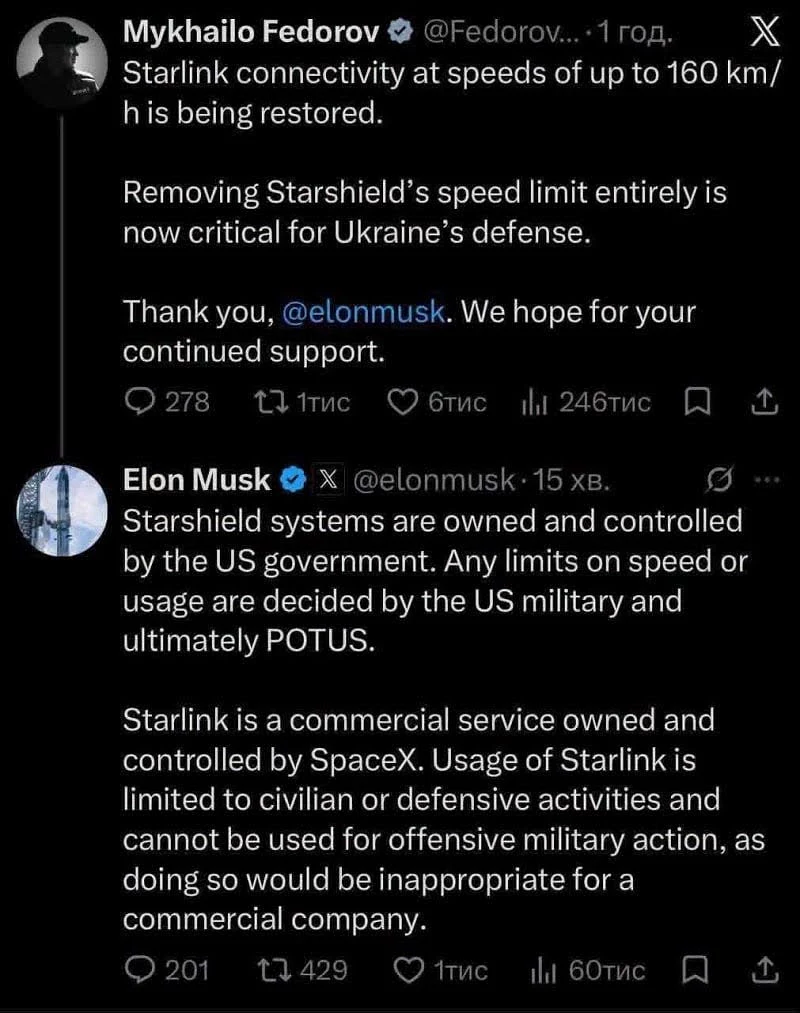
Of course, no AWS would voluntarily restrict access for its customers, wherever they are. That would contradict its principles. But let’s recall the latest case from another technological market — satellite communications. Elon Musk clearly made it clear, responding to Mikhail Fedorov’s gratitude for returning the data transfer speed to 160 km/h, that Starshield, a project implemented on the basis of the Starlink satellite fleet, is not controlled by the entrepreneur. It is under the control of the American government.
That is, the infrastructure is private. But some of its functions are controlled by the government. This is a rather revealing story.
Returning to clouds: there is no information that some of their functions (such as military data or financial data) are controlled exclusively by the US government.
But it cannot be ruled out that adventurers like Donald Trump will try to take advantage of this.
In fact, it is a powerful lever of influence that lies on the surface. Control of data processing. And it can be much more influential than even the same satellite communication. Our dependence on American clouds is enormous. In many industries.
All US cloud owners are subject to the so-called CLOUD Act. This is a US federal law passed in 2018. It allows US law enforcement agencies to require US cloud providers to provide customer data upon a court order, even if the servers or information themselves are physically located outside the United States.
After all, the risks are quite real.
What to do?
Most likely, there is no other way but to strengthen the protection of our own cloud infrastructure. And if in the summer there were only talks about underground data centers, now these intentions must be transformed into concrete actions. Data is part of our sovereignty, and we must have a secure alternative for its storage and processing.
We are closely monitoring how our drones are carrying out critical cloud infrastructure of Russian services — Yandex, Vkontakte. And so far we see that they are managing to balance their own infrastructure. Yes, traffic from the Vkontakte data center fell after arrivals in the Leningrad region over the weekend, but it was quickly picked up by the Moscow site.
It is obvious that the Russians will try to balance on their own infrastructure at the moment, and it will be increasingly difficult for them to do this, because internal infrastructure capabilities are limited.
It is obvious that it is easier for us to maneuver at the moment, because most of our critical infrastructure has long been backed up in the West.
But if we don’t think ahead, we could be held hostage by American providers as the enemy learns over time to defend its own data centers.
I believe that Ukraine should have a separate program in the form of a public-private partnership, with clear guidelines and clear goals, with funding for the protection and construction of data centers. And its main goal is to ensure the protection of sovereign data. Before it’s too late.