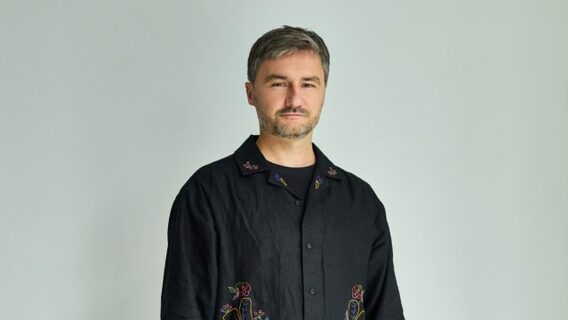
"Hardware prices have doubled due to the AI boom": GigaCloud co-founder Anton Khvastunov on cyber threats, abandoning Windows, and the future of Ukrainian clouds
The Ukrainian IT market in 2026 found itself at a unique point: on the one hand, there was a huge shortage of hardware and a GPU boom, and on the other, there was an urgent need for digital sovereignty against the backdrop of war.
The Ukrainian IT market in 2026 found itself at a unique point: on the one hand, there was a huge shortage of hardware and a GPU boom, and on the other, there was an urgent need for digital sovereignty against the backdrop of war.
Recently, the dev.ua editorial team published a video version of an interview with Anton Khvastunov, co-founder of GigaCloud (one of the largest local cloud providers) and development director of GigaGroup. He told why France is abandoning Windows, how Ukrainian MilTech is saving itself from new-generation cyberattacks, why hardware has doubled in price in a year, and when a full-fledged replacement for 1 °C will appear in Ukraine.
Today we are also publishing an abridged text version of the interview with Anton.
On the «cloud from a shoelace», data sovereignty and expansion into Europe
— Anton, let’s make a short introduction. Yesterday I talked to businessmen in a bathhouse — they seem to understand what «clouds» are, but they don’t always know the big players. What is GigaCloud, how did the company come about, and what are you doing in Ukraine now?
— The story is very organic. This year, our group of companies (GigaGroup) turns 20, and the cloud provider GigaCloud itself turns 10. We developed evolutionary: first we built the GigaTrans internet provider, then the GigaCenter data center, and later we built up our cybersecurity expertise.
We work exclusively in the B2B segment and currently serve over 1,700 legal entities of various forms of ownership. We have 5 large sites: in Kyiv, Lviv and in Europe (in particular, several data centers in Poland). Also, thanks to a global contract with the Equinix data center group, we can deploy infrastructure anywhere in Europe. We are not trying to be as loud as Amazon or Google, but we are a big local player. And we are very «stolen» for the idea of digital sovereignty. During war, it is an absolute necessity to understand where your data is physically located, how it is backed up and whether there is a risk of losing it due to dependence on third parties.
— What is your main advantage compared to your competitors? I understand it to be the synergy of the cloud and the network?
— Exactly. Our first asset GigaTrans is our superpower in Ukraine. We give the cloud to the client, as the saying goes, «right off the bat.» That is, the client receives the cloud, data transmission channels, data center and our management service in one package (for example, we close the issue with DevOps). This is a classic one-stop-shop. We actually cover with our own infrastructure what others are forced to rent.
At the same time, in Europe we operate as data-center agnostic. We do not own data center buildings there, but we own the core infrastructure: servers, storage systems (data storage systems), telecom networks in racks. This reduces the investment burden, but gives complete freedom to choose the best locations.
— Does it make sense to build your own data center in Poland?
— Right now, it seems to me that it’s much more efficient to just buy a ready-made company there. Are we going to do that? Time will tell (smiles).
The state data center in the mountains and the war in the dungeons
— There are rumors in Ukraine that state structures want to build a secret state data center somewhere in the mountains, almost in a rock. What do you know about this and how do the realities of war change the construction of such facilities?
— There are many rumors, we ourselves are involved in certain communications, because the issue of resilience is now a top priority. The narrative of the war is this: the facility must be in a rock or deep underground. As far as I know, a large centralized project of this kind has not yet been implemented, but small underground shelters are already being built — we are doing them too.
But there is an important point here. True resilience is not just about burying everything in one big bunker. The main thing is geographical diversity and multi-domain. In large international hyperscalers (such as AWS or Azure), the architecture is often single-domain. If something happens to this domain due to a massive cyberattack or physical destruction of nodes, everything falls down immediately, as has already happened in the Arab world, when systems «lay» for days.
Our vision is different: we build infrastructure in a multi-distributed way. Different data centers, different providers are different domains. They are interconnected by interoperable services. If one segment «goes down», the data instantly migrates to another. We recently became members of the Digital Sovereignty Ukrainian Alliance, which also includes other cloud players and telecom companies. We are already advising the state on creating such a sovereign hybrid infrastructure: a mixture of ground sites, underground locations and Data Embassy (digital embassies) of Ukraine abroad.
The market is growing by 30%, and business is returning from the American clouds
— How much is the Ukrainian cloud market growing now? Have you already gathered all possible clients, or is there still potential?
— The market is growing every year, despite the war. The situation is changing. For example, there is currently a huge demand from MilTech companies, for which the issue of data sovereignty is in the first place — they are massively buying infrastructure for CPUs and GPUs for artificial intelligence. A big driver is the scaling of state services.
In foreign exchange, the market is steadily adding 20%+, and in hryvnia, we are seeing 20–30% growth year over year. If the war were over, growth would be even faster due to the return of a large commercial sector.
— At the beginning of the full-scale invasion, state bodies and big business were allowed to transfer data to foreign clouds, and Western giants gave a lot of free credits. What is the situation now, when real money is being asked for these clouds? Is there a reverse trend?
— Yes, the trend has changed a lot, because everyone started counting money. First, the free cheese is running out. Second, the world is currently experiencing a severe chip crisis, which has raised the cost of owning IT assets in the US.
But the main thing is that Europe and Ukraine have realized the critical dependence on American hyperscalers. No one is saying to completely run away from them, but the paradigm has changed towards balance and hybrid solutions. Look at the world cases: last year, the French aviation giant Airbus made the final decision to completely migrate all its information systems from the States back to Europe. France is even discussing at the state level the abandonment of Windows. They have their own powerful LLM model Mistral and are investing billions in their own software ecosystems.
Our Ministry of Digital and the Office of the President say the same thing: on the battlefield, it is Ukrainian information systems that play a key role, not American ones. Creating our own Ukrainian LLM is also an element of digital sovereignty. Business sees this and begins to build hybrids: backups abroad, but the working core is on local sovereign clouds.
When will 1 °C be killed in Ukraine and why has the price of iron doubled in a year?
— I am frankly confused by the situation with software. For example, Russian 1 °C. Or car alarms — you buy an old car, you want a Ukrainian security system, and they tell you: «There are no alternatives, lack of resources.» Why do our products seem undercapitalized and underhumanized? How to break through this ceiling?
— In fact, everything is already changing, it’s just impossible to «saw through» software of this scale in a month. Regarding 1 °C: as a company, we have been holding a large Svoe.IT event for the third year in a row, where we gather Ukrainian software developers. And there are already very decent domestic ERP and CRM systems there, which are ready to completely replace Russian software. The process of migration and retraining of accountants has already been launched, it will definitely happen.
Regarding the lack of scale — yes, the war is holding back investment inflows. But look at our MilTech — this is the strongest technological production that Ukraine has developed since independence from scratch. We have world civilian leaders in security, like Ajax. Step by step, business will push this market, especially with the support of the state.
— About hardware. It becomes gold. Why doesn’t GigaCloud start producing its own Ukrainian hardware, boards, or servers?
— This is a question of global resources. During the war, I read Chris Miller’s book «Chip Wars» and it was like a slap on the head. Silicon is the oil of the 21st century. These are geopolitical wars where everyone is chasing control of microchips, because without them artificial intelligence is impossible.
Producing our own analogues of Nvidia-level chips in Ukraine is a good, but currently utopian dream, because we are critically dependent on global vendors. Due to the AI boom and GPU hysteria, hardware prices on the global market doubled in 2026 alone. And this trend continues.
Of course, this also puts pressure on cloud providers, because we buy this hardware. But the big players have leverage: leasing programs, large equipment fleets, special relationships with vendors. In addition, we at GigaCloud are fundamentally not vendor-locked (tied to one supplier). We balance: we have both Lenovo and Dell as partners. Even in the GPU market, where Nvidia currently has a total monopoly, we keep our finger on the pulse and test AMD solutions. For us, this is a basic element of the BCP (business continuity plan).
Next-generation cyber threats: how AI writes exploits
— About artificial intelligence. Recently, Anthropic developed a new Mythos model and refused to release it to the public because it turned out to be dangerous — it is capable of retiming itself and writing exploits to hack systems. If such AI models fall into the hands of hackers, conditionally in China or Russia, how protected will Ukrainian business be in the cloud?
— The problem is super critical. We see it clearly: AI is now the number one threat to the viability of IT infrastructure. I don’t want to sow paranoia among the audience, but artificial intelligence must be controlled.
Throughout the war, we kept most of our top cybersecurity team in-house to protect the cloud perimeter, rather than just selling it as a service «outside.» Now, our CISO (Chief Information Security Officer) has a very strict policy on digital hygiene. We audit clients and often prohibit the deployment of fancy AI agents that supposedly automate work but actually leak data or expose code holes.
You can’t install everything from the market right now — you have to be very selective about what information you feed the models. The best way out for business and the state is to drive AI models into the closed perimeter of a sovereign or private cloud (Private Cloud) so that the data does not physically go online.
— Does it make sense for GigaCloud to sign a direct partnership agreement with OpenAI or Anthropic?
— I think this is a matter of the near future. We have already integrated services from NVIDIA, and expanding cloud platforms with services from leaders in generative AI is a task for this year. Soon, customers will see this in our portfolio.
— And finally: when can we expect the next major exhibition of Ukrainian software Svoe.IT?
— The team is currently preparing a large-scale info-show, so I will keep the exact date a secret for now. I will only say one thing: the next Svoe.IT will be incredibly large. We have found new niches and powerful partners who want to invest and support Ukrainian in Ukraine. This will not be just a boring conference, but a space with live demo stands, where everyone — from the chief accountant to the CEO — will be able to «touch» the software with their hands and immediately implement it in their business. So wait for announcements soon, dev.ua will be among the first invited!