Промо на dev.uaIT education
16 July 2026, 15:42
2026-07-16
Beyond the IDE: How KSE ProfTech's FIX IT Course Helps Developers Understand the World of Electronics
Many developers have at least once caught themselves thinking: «It would be interesting to understand what is happening on the other side of the code.»
How does a power supply work? Why does a charging station fail? How do you find faults on a printed circuit board? What stands between the program code and the device we hold in our hands?
It is with such questions that IT professionals increasingly begin their acquaintance with the world of electronics.
Many developers have at least once caught themselves thinking: «It would be interesting to understand what is happening on the other side of the code.»
How does a power supply work? Why does a charging station fail? How do you find faults on a printed circuit board? What stands between the program code and the device we hold in our hands?
It is with such questions that IT professionals increasingly begin their acquaintance with the world of electronics.
KSE ProfTech noticed this trend during open technical workshops. Among the participants were not only people who wanted to change their profession, but also programmers, testers and other IT specialists who wanted to better understand hardware. That is why the FIX IT course appeared — a five-day practical intensive that introduces electronics assembly, soldering and equipment repair.
Not about changing professions, but about expanding engineering horizons
FiX IT is a course from KSE ProfTech that in one week provides a basic understanding of how electronic components work, teaches you how to read simple diagrams, use measuring instruments, troubleshoot, and perform basic repairs.
For many developers, this is an opportunity to bridge the gap between software and hardware.
Why this format turned out to be close to IT professionals
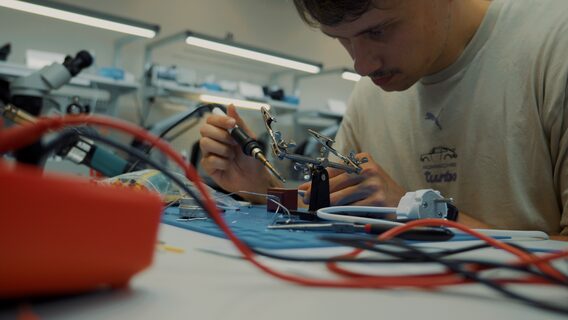
The training is structured in the way most IT teams are used to working. A minimum of theory — a maximum of practice. Each new topic is immediately reinforced with exercises. First, participants get acquainted with the basics of electronics, learn to use a multimeter, work with individual components, and perform soldering. After just a few classes, they move on to drawing up circuits, and then to troubleshooting and repairing real devices.
In fact, it’s a continuous cycle: I gained new knowledge — tested it in practice — saw the result.
Debugging doesn’t just exist in code
One of the most interesting parts of the course is troubleshooting.
Participants learn to determine why an electronic device is not working, check individual components, look for damage, and restore the board to working order.
Logically, the process is very similar to debugging, which is familiar to developers: first, you form a hypothesis, test it, reject false options, and gradually find the real cause of the problem.
Only instead of logs, there’s a multimeter.
Embedded, IoT and own projects
For some participants, the course becomes the first step towards embedded development or IoT.
After getting acquainted with electronics, it is much easier to work with Arduino, ESP32, Raspberry Pi, create your own devices, home automation, or experimental pet projects.
When hardware ceases to be a black box
A modern developer increasingly works at the intersection of disciplines. IoT, robotics, automation, smart devices — all of these areas require not only knowledge of programming languages, but also a basic understanding of electronics.
That’s why short practical intensives like FIX IT can be useful to better understand how the world works outside the IDE and discover another tool for engineering thinking.
If you have long wanted to try your hand at this field, you can learn more about the program and upcoming enrollments for the FiX IT course on the KSE ProfTech website.
What does the course look like in practice?
If you want to see how the training goes from the inside, we recommend watching the video of Ukrainian YouTube blogger Kyryl (Ki Reel channel).
For five days, he took the FiX IT course at KSE ProfTech and showed his journey — from his first attempts to work with a soldering iron to assembling electronic circuits, diagnosing faults and repairing devices. In the video, he also shares his impressions of the training and tells what surprised him most as a developer.
Професії у геймдеві. Хто такий левел-дизайнер і як ним стати?
Ми продовжуємо нашу рубрику, присвячену професіям у геймдеві. Тема нового матеріалу в ній — левел-дизайн. Його вважають підвидом геймдизайну, але все-таки практично кожна студія хоче окрему людину на позицію левел-дизайнера. Адже у цій спеціальності вистачає своїх нюансів та особливостей.
Розібратися з ними всіма нам допоміг досвідчений левел-дизайнер зі студії Fractured Byte Дмитро Нестеренко. Також він веде свій блог Game Designer Notes про геймдизайн в цілому, в якому розбирає багато цікавих нюансів розробки ігор.