Хочете будувати кар’єру в Data Science та AI? Vodafone Big Data Lab відкриває новий набір —>
Валентин ШнайдерScience Pop
29 August 2025, 13:05
2025-08-29
Quantum Internet is closer: American engineers transmitted quantum signals through conventional fiber optics with 97% accuracy
American engineers have demonstrated that a quantum internet can work on existing fiber-optic networks. They managed to transmit quantum particles over commercial Verizon lines using the same IP protocols used in the modern internet.
American engineers have demonstrated that a quantum internet can work on existing fiber-optic networks. They managed to transmit quantum particles over commercial Verizon lines using the same IP protocols used in the modern internet.
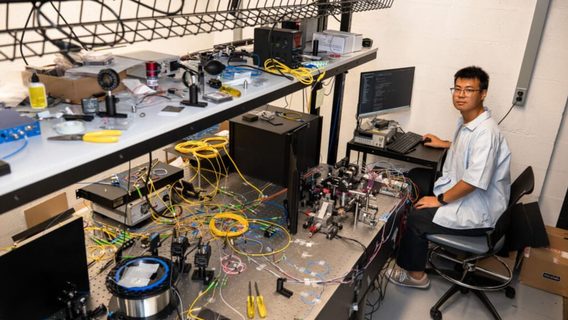
This is reported by Interesting Engineering. In the study, a team from Verizon's Philadelphia campus, together with engineers from the University of Pennsylvania, presented a Q-chip (Quantum-Classical Hybrid Internet by Photonics), which is capable of simultaneously coordinating classical and quantum signals while preserving vulnerable quantum states. During the experiment, data packets with quantum information were transmitted over a distance of one kilometer via Verizon fiber-optic lines, and the signal accuracy reached 97%.
The key innovation is that a classical light “header” is transmitted along with the quantum particle. It can be measured for routing, while the quantum signal itself remains intact. In this way, quantum data is “embedded” in the familiar IP protocol, allowing it to be processed in the same way as regular internet traffic.
The developers emphasize that this is an important step towards creating a full-fledged quantum internet, where the computing power of different quantum processors can be combined. “We have shown that a quantum network can literally speak the same language as a classical one,” explains one of the authors of the project, Yizhi Zhang.
Among the challenges is the inability to “amplify” quantum signals without losing entanglement, which currently limits transmission range. However, scientists have already created an error correction system that uses the classical signal to correct noise without touching the quantum particles themselves.
The researchers say the prospect of such solutions is reminiscent of the early days of the internet in the 1990s, when university networks were just beginning to connect. If the technology takes off beyond the lab, it would be enough to simply add new chips to existing fiber optic lines to scale the network.
In the context of the future, quantum networks are seen as the key to creating ultra-secure communication channels and the basis for a global quantum economy. Such experiments bring closer the moment when they can move from the level of scientific tests to real commercial services.
Previously, dev.ua wrote about an international team of scientists from France, Italy, and Germany working on a photonic quantum computer that uses glass chips and particles of light instead of electrons. The success of the project could open up new horizons in energy, medicine, and the study of the universe.