Редакція dev.uaІсторії
23 December 2025, 13:29
2025-12-23
Kyiv in the 1970s: How the Soviet “Silicon Valley” Grown Ukrainian IT
Perhaps every professional programmer's story begins long before a person sits down at a computer for the first time or writes the first line of code. The story of IT-Enterprise co-founder Volodymyr Mikhailov began in Kyiv in the 1970s, in a city that would have had every chance of becoming the Soviet Silicon Valley if not for the imperial realities of that era. It was an environment where children's games were intertwined with adult engineering conversations, and the words "computer", "ASUV" and "Institute of Cybernetics" sounded not like science fiction, but as part of everyday life...
Perhaps every professional programmer's story begins long before a person sits down at a computer for the first time or writes the first line of code. The story of IT-Enterprise co-founder Volodymyr Mikhailov began in Kyiv in the 1970s, in a city that would have had every chance of becoming the Soviet Silicon Valley if not for the imperial realities of that era. It was an environment where children's games were intertwined with adult engineering conversations, and the words "computer", "ASUV" and "Institute of Cybernetics" sounded not like science fiction, but as part of everyday life...
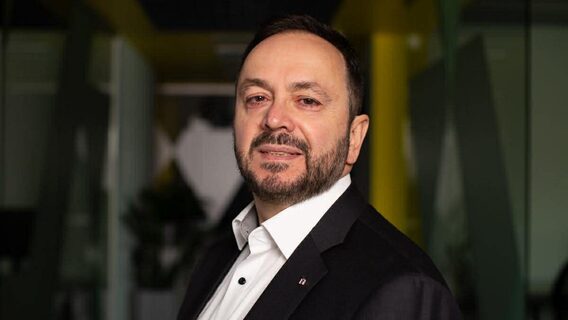
Volodymyr Mykhaylov, co-founder of IT-Enterprise, tells how a generation of Ukrainian IT engineers was formed in Kyiv in the 1970s and 1980s, a city that became a center of defense, cybernetics, and mechanical engineering. What follows is his direct speech.
I grew up in a Kyiv industrial and engineering environment. My father worked at a factory and at the age of 33 went from the head of the blacksmith shop to the chief economist (today it would be called the financial director). In 1969, he created the ASUV (automated production control system) department at the Darnytskyi Car Repair Plant. And already in 1970, on the basis of this department, he organized the PKB ASU of the USSR Ministry of Railways — in fact, a full-fledged research and development institution that automated factories from Stryi and Lviv to Ussuriysk and Chimkent. If this had happened today, it would have been called a product R&D company with its head office in Kyiv and a network of projects throughout the country.
How the dream came about and what are punch cards for?
At home, since preschool age, I had heard about "Minsk-32" (the first serial Soviet computer for economic problems), COBOL (a programming language that none of my peers knew about), ES-1022 (a Soviet mainframe, a clone of the IBM 360), ASUV (what today we would call ERP), the Institute of Cybernetics, Academician Glushkov... For me, all these words were mysterious, but very attractive. And at home, there was a thick book for children "A Little Encyclopedia of Great Cybernetics", which I reread from time to time.
My father would periodically bring home long rolls of perforated paper. On them, in “jumping letters” printed on an ACP, you could read stories by the Strugatsky brothers, songs by Vysotsky, Galich, Okudzhava, and something else that our parents read and didn’t give us, and which was called the mysterious word “samizdat.” And behind all this was the almost magical “it was done by a computer — a mysterious electronic computing machine.”
The best walk for me was when my father would take me and my brother on weekends and take us around the factory through all the workshops, conveyors, and huge production halls. We would definitely go to the IOC (Information and Computing Center), where the same Minsk-32 and ES-1022 were located. They were serviced by people in white coats who were called "mathematicians" - the term for programmers at the time.
The trophies of such walks were spools of punched tape and punched cards - at school they could easily be exchanged for chewing gum wrappers. Today it sounds like archaeology, but for us it was the magic of the beginning of the computer age.
Perhaps today's youth will think that I am talking about the times of the Egyptian pharaohs or at least the times of the discovery of America. No, it was our 70s and it was the dawn of domestic cybernetics (now we would say IT). It's like taking a modern guy to CERN or to Apple headquarters and showing him something like that. That is, from the age of 7-8 I definitely dreamed of EOM, incomprehensible programming and huge production plants.
It was believed that for this you need to know mathematics well. There were no problems with this. Everything came easily at school. When new textbooks were given to us at the end of August, I read them “from cover to cover” in the first week. After that, homework took 15 minutes, the rest of the time was spent on yard culture of the 70s: football, “war” (Soviet children, there was nothing you could do), tennis and chess. Yes, yes, in our yard chess had the same prestige as football.
Forerunners of the Ukrainian IT cluster
What is Kyiv like in the 70s and 80s? It is a strange mix of high-tech, which openly copied Western technologies, and industrial giants of instrument and mechanical engineering. Something between Silicon Valley, Texas, and Taiwan.
Hi-tech was then personified by:
The Academician Glushkov Institute of Cybernetics in Teremki, together with two "subsidiaries": SKB MMS (Special Design Bureau for Mathematical Machines and Systems) and SKTB (Special Design Technological Bureau), which worked exclusively for the defense and space industries
Kyiv Institute of Automation,
Central Research Institute of Technical Management, dozens of industry research institutes,
The Academic City as a separate microcosm,
KPI, where every department was developing something.
Industry is "Artem", "Antonov", "Arsenal", "Kvant", "Kvazar", "Electronmash", "Bolshevik", "Octava", "Burevisnik", "Radar"... Each of these factories had its own IOC - information and computing center, its own programmers, its own engineering laboratories.
When young Kyiv IT professionals ask today where such a powerful IT cluster came from, the answer is simple: here are its forerunners. People who worked in these research institutes and factories created companies in the 1990s that became the architects of the Ukrainian IT market.
Samydav vs. Komsomol: seeing other worlds
The underground reading of "samizdat" and all those "Grads of the Doomed", "Ugly Swans" and "It's Hard to Be a God" did not pass without a trace. I joined the Komsomol last in the class after all the school "hooligans". The headmistress could not understand why the excellent student did not show the proper enthusiasm for the development of communism. And I simply saw other worlds - on punched paper, printed in computer letters.
This is how my childhood and youth passed - in a city where computers were kept in sterile, huge halls, like space engines, where programmers were called mathematicians, and the future was literally in the air.
In the next part, I will tell you how this world led me to KPI, to Professor Pavlov, and to the understanding that production planning and combinatorial problems are not an abstraction, but the basis of what will later turn into Ukrainian industrial ERP and APS systems.
Професії у геймдеві. Хто такий левел-дизайнер і як ним стати?
Ми продовжуємо нашу рубрику, присвячену професіям у геймдеві. Тема нового матеріалу в ній — левел-дизайн. Його вважають підвидом геймдизайну, але все-таки практично кожна студія хоче окрему людину на позицію левел-дизайнера. Адже у цій спеціальності вистачає своїх нюансів та особливостей.
Розібратися з ними всіма нам допоміг досвідчений левел-дизайнер зі студії Fractured Byte Дмитро Нестеренко. Також він веде свій блог Game Designer Notes про геймдизайн в цілому, в якому розбирає багато цікавих нюансів розробки ігор.