Хочете будувати кар’єру в Data Science та AI? Vodafone Big Data Lab відкриває новий набір —>
Олег ОнопрієнкоІсторії
22 May 2025, 09:00
2025-05-22
Kyiv Polytechnic University launches the Center of the Future. How a modern center for prosthetics and additive technologies works: report dev.ua
The Kyiv Polytechnic Institute hosted the grand opening of a new innovation space designed to become a point of intersection of science, rehabilitation, and high technologies. The space, born from the initiative and efforts of the Sikorsky Challenge innovation ecosystem team, Igor Sikorsky Kyiv Polytechnic Institute, and the KOLO Foundation, became the embodiment of a true partnership between the university, the foundation, technology companies, and philanthropists, appflame, OBRIO, and Genesis for Ukraine. dev.ua tells how the Additive Technologies Science Park functions.
The Kyiv Polytechnic Institute hosted the grand opening of a new innovation space designed to become a point of intersection of science, rehabilitation, and high technologies. The space, born from the initiative and efforts of the Sikorsky Challenge innovation ecosystem team, Igor Sikorsky Kyiv Polytechnic Institute, and the KOLO Foundation, became the embodiment of a true partnership between the university, the foundation, technology companies, and philanthropists, appflame, OBRIO, and Genesis for Ukraine. dev.ua tells how the Additive Technologies Science Park functions.
125 years ago, engineering thought in Ukraine was born at KPI. During its, without exaggeration, great scientific history, the institute has become a driver of innovations that are used all over the world. It was here that a complex of mechanical workshops was built. It was an innovative complex of the early 20th century. Now the former premises of the KPI boiler house have found a new modern incarnation in the Science Park of Additive Technologies and the Center for Prosthetics and Rehabilitation. This ecosystem will become a platform not only for modern technologies, but also for the integration of veterans of the Russian-Ukrainian war.
Natalia Seminska — Director of the Center
Traditional technologies that exist now cannot solve the global problem of prosthetics. We cannot rely only on foreign investments and foreign technologies. And therefore, the decision was made to move into our own production, the creation of our own technologies and, most importantly, not only their creation, but the possibility of their implementation.
One of the key driving forces of the project was the coordinator and co-founder of the startup school Sikorsky Challenge, Inna Gennadiyevna Malyukova. According to Malyukova, the process from the idea to the launch of the Center took about 2.5 years. Initially, the Prosthetics Center was created on the basis of the Institute of Postgraduate Education of KPI. They began to train the first specialists, and then they began to attract the first patrons to create a science park.
“Equipment, repairs and everything you see here, including the training of prosthetists, cost about 40 million hryvnias,” Ms. Inna told dev.ua exclusively.
What does the prosthetics process look like?
The complex has several large rooms where various stages of prosthetics take place: from design to the production of parts.
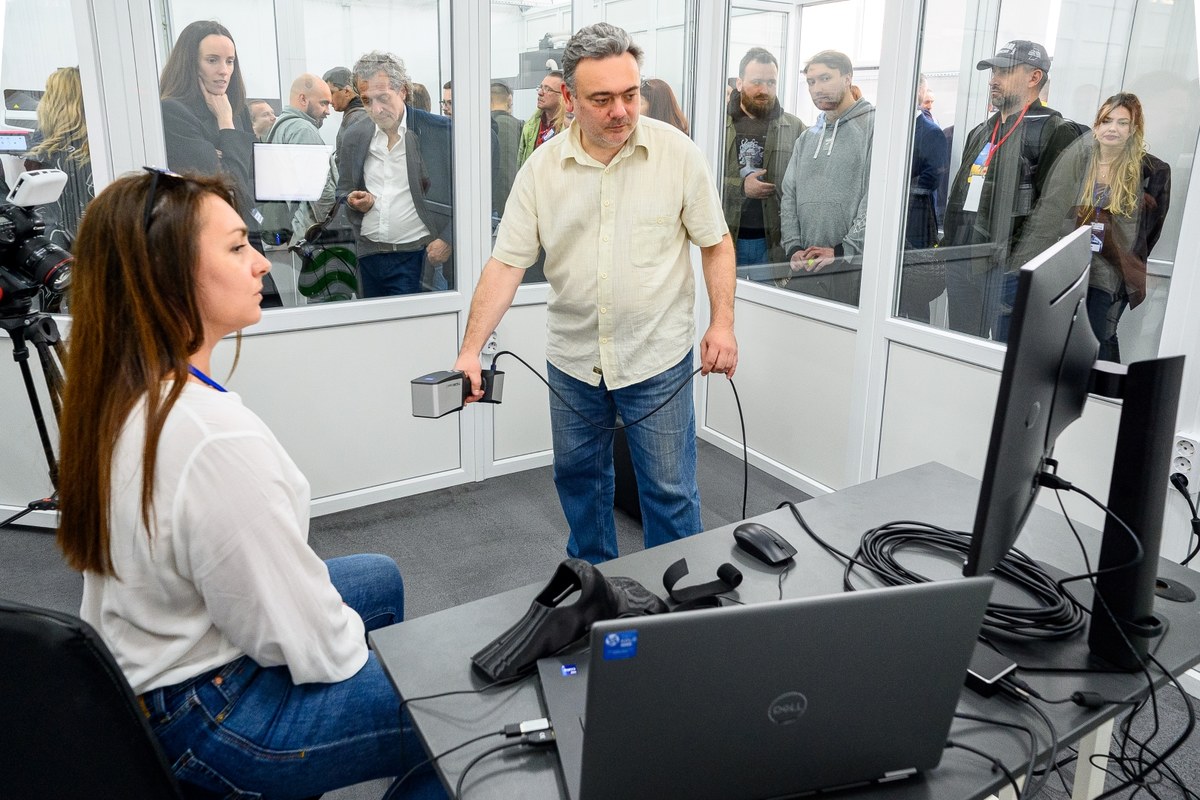
Before the production process, there is a design process and direct acquisition of primary data through limb scans for further modeling. Several veterans who have already been trained to work at the center showed what this process looks like. Almost nothing is required of an amputee, except to sit for five minutes while an engineer scans the limb using a modern laser scanner.
During the demonstration, a leg was scanned, for which special beacons are installed at floor level, which in real time allow the scanner to read the necessary data for 3D visualization of the leg from the foot to the knee. The engineer noted that even such a quick scan is enough to obtain the necessary model for further production.
The process of scanning a foot with a laser scanner
When the model is agreed upon by the designer, taking into account the entire anatomy of the limb, its direct production of parts in the technical area of the space begins. For this purpose, the Center has several industrial 3D printers based on HP's Multi Jet Fusion (MJF) technology, which allows printing products from thermopolymers, rubbers and nitron. A unique feature is the ability to mass print complex parts with high accuracy. One printing unit can work continuously for up to 12 hours, printing both large and small parts simultaneously. Engineers choose the optimal materials for printing - these can be biocompatible polymers, reinforced plastics, flexible or hard alloys, depending on the type and load on the prosthesis.
All this must comply with safety, sterility, and comfort standards. In their work, the center's specialists rely on Generative design — an approach to engineering modeling in which the design of an object is created not manually, but using algorithms that generate dozens or hundreds of design options based on given parameters.
See
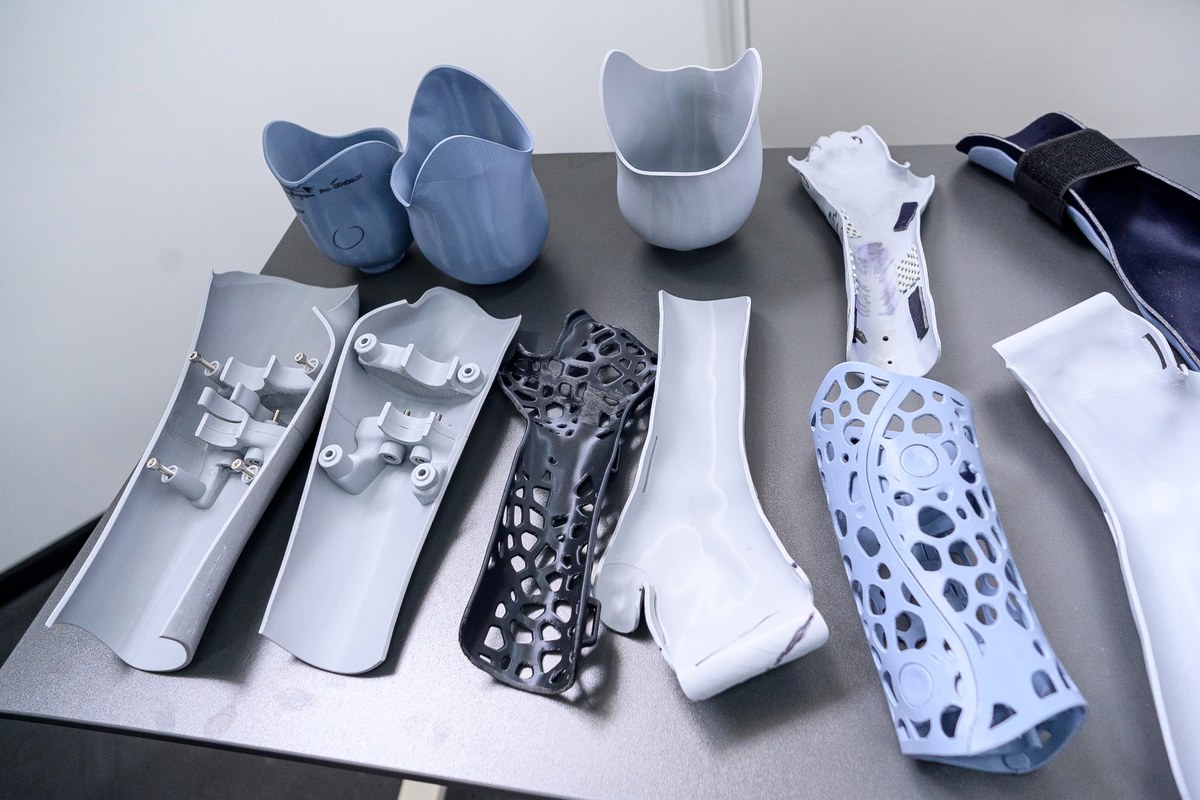
Samples of finished products
The prosthesis is made on a 3D printer using the additive manufacturing method - when the product is created layer by layer. This allows you to achieve high accuracy and detail, reduce waste and production time. Printing can last from several hours to several days, depending on the complexity of the prosthesis. The finished product undergoes final processing: grinding, sterilization, painting, and if necessary, insertion of mechanisms or sensors. Then, a fitting and testing with the patient is carried out, correction and training in using the product are carried out.
According to engineers, full-scale production of prostheses will begin in two to three weeks.
New life for veterans
Due to the full-scale Russian war against Ukraine, our country has many military personnel who lost limbs during combat missions. During the opening of the Science Park and Center, great attention was paid to involving veterans in the work, since they not only know exactly what amputees need in terms of prosthetics, but also because this is a social function of the project, so that people can benefit after serious injuries and better adapt to social life after the war.
“The bottleneck now is not the equipment, but the lack of specialists who know how to design products for printing. Therefore, the emphasis is on training personnel,” said the project engineers. According to the director Natalia Seminska, 37 people have already joined the Center’s program. The next stage of training new veterans to work with the equipment will start on May 26.
It is important to note that the non-technical premises of the complex are equipped with inclusive areas specially designed for people with special needs. In general, the veterans present are very interested in the opportunities that the Center will provide. Despite the fact that several of them have already undergone initial training, they still ask the engineers about the details of each prosthetics process with undisguised enthusiasm and curiosity.
The opening of the innovation complex at Kyiv Polytechnic University became a symbol of the unification of science, education and business for the sake of an important social goal - helping people in need of prosthetics and rehabilitation. The participants of the event expressed confidence that this space will become a powerful center for the development of advanced technologies and the training of qualified specialists, contributing to qualitative changes in this important area.
"Ukraine now has the largest cyber army in the world. The democratic world needs this experience." Interview with a top Romanian cybersecurity official