Хочете будувати кар’єру в Data Science та AI? Vodafone Big Data Lab відкриває новий набір —>
Стас ЮрасовThat's Life
12 August 2025, 16:10
2025-08-12
Kyivstar conducted the first public test of satellite communication from a smartphone using Starlink. Soon they will launch a messaging service from anywhere in the country. For now, the service will be free
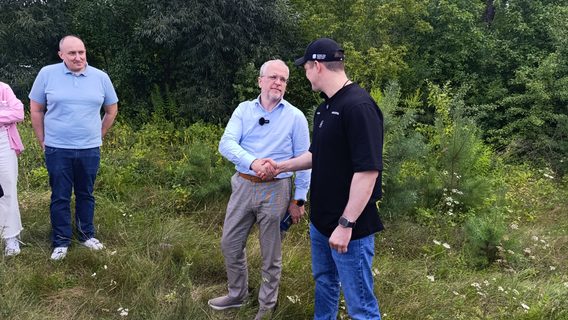
The telecommunications company Kyivstar conducted a test of satellite technology from Starlink — Direct to Cell — in the Zhytomyr region. During the test, the CEO of Kyivstar and the First Deputy Prime Minister of Ukraine — Minister of Digital Transformation Mykhailo Fedorov first connected two smartphones to the Starlink network, and then exchanged their first messages. On the second attempt, they even managed to make a video call.
The telecommunications company Kyivstar conducted a test of satellite technology from Starlink — Direct to Cell — in the Zhytomyr region. During the test, the CEO of Kyivstar and the First Deputy Prime Minister of Ukraine — Minister of Digital Transformation Mykhailo Fedorov first connected two smartphones to the Starlink network, and then exchanged their first messages. On the second attempt, they even managed to make a video call.
A dev.ua journalist visited the test. We tell you the details
«Today, we have deployed a test segment with SpaceX. The test segment is a patch of approximately 200 km across the territory of Ukraine, where we are testing Direct-to-Сell technology from SpaceX,» said Oleksandr Komarov.
What is testing?
The operator is testing several different means of use. «First of all, it is the transmission of messages through messengers. Any messengers, WhatsApp, Signal, Viber, through any messengers from anywhere in Ukraine, if you are on the street, you will be able to stay in touch,» emphasizes the company’s CEO.
This service should launch after testing at the end of 2025.
«We believe that, given the current conditions of a full-scale war, there are millions of people who need any kind of communication in critical conditions. These are our military on the front lines, these are people who find themselves without communication because the infrastructure has been destroyed,» Komarov said.
He added that even in Zhytomyr region (one of the best regions in terms of coverage in Ukraine), Kyivstar’s coverage by population is 98%, and by territory — 69%. He emphasized that we live in a large country and it is simply impossible to cover it 100%.
«The combination of Kyivstar’s terrestrial network and SpaceX’s satellite network gives us the opportunity to very quickly build 100% coverage of the entire territory of Ukraine,» said Komarov.
After launching the messaging service, the next step will be voice communication. And the third step will be the provision of broadband mobile Internet services via the satellite network.
«We can’t promise a timeframe yet. It depends on SpaceX, it depends on the launch of the second generation of satellites,» said Alexander.
He noted that the number of D2C satellites is growing rapidly. «When we started negotiations with them — it was the first half of 2024 — they had 60 satellites of this group in orbit. Now — 600,» the manager said.
Kyivstar’s D2C service will operate on a separate radio frequency band (5 MHz), which the company has previously exempted from the use of terrestrial technologies.
During tests (Speedtest), it turned out that the download speed is 3 Mbit/s, and the upload (uplink) is approximately 0.5-0.6 Mbit/s.
Komarov emphasized that this can be compared to the 3G technology that Ukrainians previously used.
What about money?
As the CEO of Kyivstar said, next year the service will be free for all Ukrainians. He also added that most likely the service will be free until the end of the war. He emphasized that the deal with Starlink is not cheap for Kyivstar — it is millions of dollars that will have to be paid for the service.
On smartphones
Any LTE smartphone supports the new technology. But Komarov emphasizes that there is a division. There are smartphones that are adapted to the technology. That is, they understand that this is satellite communication and adjust the smartphone’s operating parameters. Of the 16 million LTE smartphones in the Kyivstar network, this is about half.
Unadapted smartphones will also see the technology and will cooperate with it, but perhaps not as optimally as adapted ones. «We also don’t want to have a negative experience, but we understand that our main task is to give people connection in crisis situations,» said Oleksandr Komarov.