Хочете будувати кар’єру в Data Science та AI? Vodafone Big Data Lab відкриває новий набір —>
Наталя ХандусенкоSpaceTech
26 May 2026, 09:52
2026-05-26
Will humans be able to give birth in space? The Chinese decided to investigate this question by sending artificial embryos into orbit
Humanity's grand ambitions to colonize the Moon and Mars face one major obstacle: humanity's ability to reproduce beyond Earth. While we're still a long way from having children in space, it's time to start investigating the exact risks of such attempts. An experiment aboard the Chinese space station could help provide some answers.
Humanity's grand ambitions to colonize the Moon and Mars face one major obstacle: humanity's ability to reproduce beyond Earth. While we're still a long way from having children in space, it's time to start investigating the exact risks of such attempts. An experiment aboard China's space station could help provide some answers.
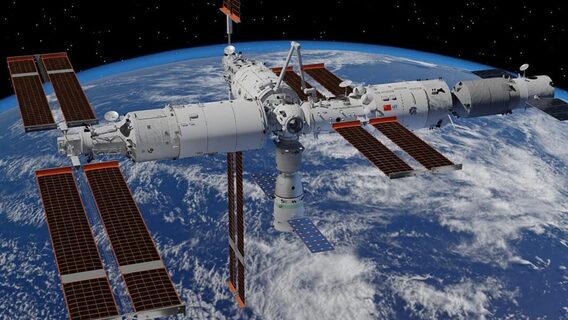
In a unique experiment, China sent artificial embryos grown from living human stem cells to the Tiangong space station. They flew into space on May 10 aboard the Tianzhou-10 cargo ship. The embryo-like structures spent about five days in low Earth orbit so that scientists could recreate the initial stage of development that occurs in the first days after fertilization, Gizmodo reports .
Making children in orbit
The experiment, led by researchers from the Chinese Academy of Sciences, aims to test the effects of microgravity on the early development of the human embryo.
The artificial embryos consist of two types of models that recreate different phases of embryonic development. The first group of samples was grown on uterine cells to recreate the critical stage of embryo implantation into the uterine wall. The other samples were placed in a microfluidic chip that simulates the moment when a single-layer structure of cells rearranges into the different layers that will later form tissues and organs.
“The artificial human embryo is created using human stem cells as the starting material,” project leader Yu Leqian said in a statement. “It is not a real human embryo, and it is not capable of developing into a separate organism. However, it can serve as a model for studying early human development.”
Each embryo was kept in a separate chamber inside a special culture container. The embryos were allowed to develop for five days, after which they were frozen. These samples will later be returned to Earth for analysis. Meanwhile, on Earth, completely identical samples were studied in the laboratory - this is necessary in order to compare how the space embryos coped with the conditions of microgravity.
"We hope that by comparing the development of space and terrestrial samples, we can identify factors that affect the early growth of a human embryo in a space environment. This will help assess the risks and challenges that humans may face during long-term space travel," said Yu Leqian.
Human colonies
The embryonic development period that took place aboard the Chinese space station corresponds to approximately 14–21 days after fertilization. This is a critically important window—that is when human organs begin to form, and any abnormality that occurs during this time period significantly affects the fetus's subsequent development.
Although no one has ever attempted to conceive or raise children in space, previous research suggests that the harsh environment of space can have a negative impact on human reproductive function. Space radiation and microgravity can damage reproductive cells and prevent normal embryo development.
To minimize these negative impacts, scientists need to learn more about the risks of breeding outside of Earth. Hopefully, a recent experiment will help fill some of these knowledge gaps so that humanity is better prepared for the "birds and the bees" conversation on other planets.