Хочете будувати кар’єру в Data Science та AI? Vodafone Big Data Lab відкриває новий набір —>
Валентин ШнайдерRobots
21 August 2025, 17:04
2025-08-21
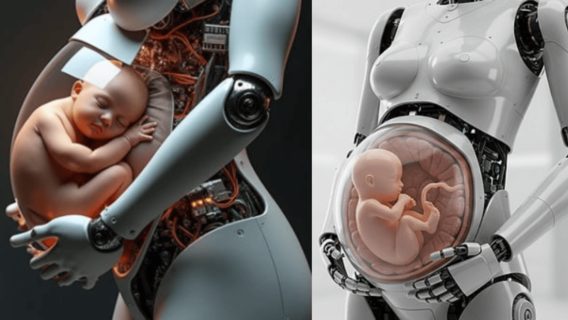
Chinese company Kaiwa Technology creates the world's first humanoid with an artificial womb
A concept robot capable of carrying a baby using an artificial womb has been unveiled in Guangzhou. The development is planned to be completed by 2026, and the cost of the device could be less than $14,000.
A concept robot capable of carrying a baby using an artificial womb has been unveiled in Guangzhou. The development is planned to be completed by 2026, and the cost of the device could be less than $14,000.
According to Interesting Engineering, Kaiwa Technology, led by researcher Zhang Qifeng, presented the project at the World Robot Conference 2025 in Beijing. It is not just an incubator, but a full-sized humanoid with an artificial womb built into it. The technology involves the use of artificial amniotic fluid and feeding tubes that simulate natural gestation.
According to the project’s author, the first prototype could be ready within a year. He emphasizes that artificial wombs have already demonstrated effectiveness in laboratory conditions, including in animal experiments. The team’s task now is to integrate this technology into a humanoid form to provide «human-robot interaction» throughout pregnancy.
The idea has already sparked heated debate in China. Some see the project as a chance for infertile couples, while others raise ethical and legal issues. Zhang himself said he had discussed the possible legal implications with the Guangdong provincial government, and legislative proposals are under consideration.
Scientists remind that experiments with artificial wombs have a long history. Back in 2017, researchers from the Children’s Hospital of Philadelphia successfully brought a prematurely born lamb out of a special «biopack.» However, modern developments mostly allow for life support only in the late stages. For the full cycle, from fertilization to birth, a significant breakthrough in science is needed.
Interestingly, other biotech innovations were also presented at the same conference. In particular, Chinese scientists showed GEAIR, the world’s first plant breeding robot with elements of artificial intelligence. It is capable of autonomously pollinating and creating hybrid seeds, which could transform the country’s agricultural sector.
Thus, China demonstrates its desire to combine robotics, AI and biotechnology in large-scale projects — from agriculture to medicine. At the same time, experts warn: artificial womb technology, especially integrated into humanoids, requires a thorough discussion on the level of ethics, law and social consequences.
Recall that dev.ua also published an article about how the Chinese four-legged robot White Rhino from Zhejiang University became the fastest robot dog in the world, covering 100 meters in 16.33 seconds and getting into the Guinness Book of Records.