Валентин ШнайдерGadgets
26 June 2025, 10:30
2025-06-26
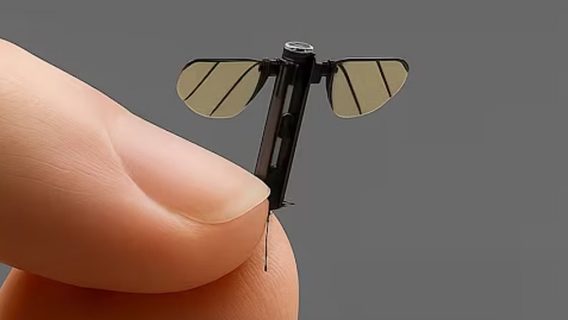
Chinese developers have introduced a mosquito-sized drone: it is almost invisible and already works in the air
China has developed an ultra-small drone for covert reconnaissance operations. Thanks to its bionic design, it mimics the flight of an insect and is difficult to detect even in difficult conditions. The technology could change the approach to battlefield surveillance.
China has developed an ultra-small drone for covert reconnaissance operations. Thanks to its bionic design, it mimics the flight of an insect and is difficult to detect even in difficult conditions. The technology could change the approach to battlefield surveillance.
Chinese developers have unveiled a microdrone that is no bigger than an insect. It was developed by the National University of Defense Technology in Hunan Province, TechSpot reports , citing a demonstration on state-run channel CCTV 7.
The microdrone visually resembles an insect: it has a thin body, two leaf-shaped wings and three almost invisible legs. The device can land on the surface and remain there stably. Due to its size and bionic design, it is extremely difficult to detect both from the ground and using radar. The main task of the drone is covert surveillance in difficult conditions, where maximum invisibility is important.
Technical features of the drone
type of flight: imitation of wing flapping, like insects;
weight and size: smaller than a normal mosquito;
control, power and data transmission elements: completely miniaturized;
can transmit information in real time;
capable of landing and hovering on the surface for extended observation.
Inside the drone are sensors, a power module, a communication system and a computing unit. The product was created thanks to new achievements in the field of microelectromechanical systems and biomimetics. At the same time, the maneuverability of the drone allows it to fly in tight or difficult-to-reach areas, for example, inside buildings or among vegetation.
There are already examples of ultra-small UAVs on the global reconnaissance drone market. Among them are Norway's Black Hornet and Harvard's RoboBee. But the Chinese project could become a new standard in military miniaturization, as it demonstrates a high degree of autonomy and stealth, critical for modern conflicts and special operations.
We also previously wrote about how Singaporean scientists developed a micro-battery that powers smart contact lenses.