Хочете будувати кар’єру в Data Science та AI? Vodafone Big Data Lab відкриває новий набір —>
Оксана Степура
3 November 2026, 13:15
2026-11-03
Astra has learned to “look under the hood” of other neural networks and correct errors by changing their parameters. MIT researchers showed how it works
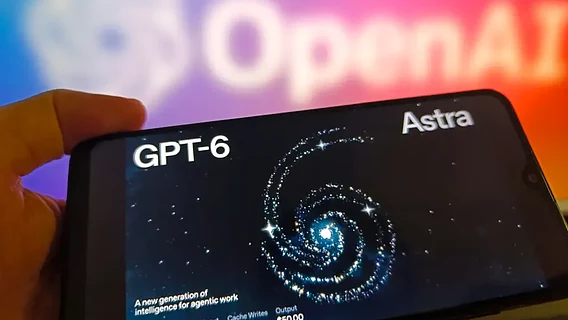
Researchers at the Massachusetts Institute of Technology (MIT) have demonstrated how GPT-6 Astra can find errors in other neural networks and correct them by directly changing their parameters instead of further training these models.
Researchers at the Massachusetts Institute of Technology (MIT) have demonstrated how GPT-6 Astra can find errors in other neural networks and correct them by directly changing their parameters instead of further training these models.
This was reported by researchers at the Massachusetts Institute of Technology (MIT).
Typically, to improve the performance of a neural network, it is trained on data. But these researchers decided to test whether another AI could understand what was going on inside the model and change its parameters on its own. These parameters are called weights. They are a large number of numbers that determine how the neural network processes information and generates responses.
The researchers obtained the most interesting result with Qwen3.5-0.8B, a small language model with approximately 800 million parameters. The model had a problem: when solving mathematical problems, it often got stuck, repeated the same reasoning and did not reach an answer.
Astra analyzed its parameters, found a mechanism related to the loop, and changed only 131,072 weights, or 0.016% of their total. After that, Qwen's score on the MATH-500 test increased from 7.9% to 48.1%. And on another math test, GSM8K, the score rose from 13.8% to 67.1%. In addition, the model's ability to follow user instructions also improved significantly.
The researchers also trained four separate neural networks to play Breakout, Pong, Pac-Man, and Freeway—one network for each video game. They then showed Astra the numerical parameters of each and asked it to guess which game it was designed for. Without running the neural network or seeing the actual gameplay, Astra correctly identified all four video games based on their numerical parameters alone.
Astra was also able to independently create three small neural networks, each of which could play one of these video games. To do this, it was given a description of how the games work and their programming code. Based on this, Astra created the parameters of the new neural networks itself, even without training.
The researchers call this approach Weight-Space Programming — programming directly through the weights of neural networks. They suggest that in the future, instead of having to retrain neural networks for a long time, AI will simply be able to find the right parts of another model and modify them to fix errors or adjust its behavior.
In the future, this could significantly reduce the cost of improving neural networks, help find hidden vulnerabilities, and even allow models to improve each other.
But it’s still a long way from one AI being able to arbitrarily rewrite and improve any other. For example, Astra failed to significantly improve the mathematical abilities of the Gemma 3 270M model, which, unlike Qwen, rarely got stuck, but simply made errors in calculations and reasoning. The researchers realized that such problems are much more difficult to eliminate by simply editing the parameters of the neural network.
Despite this, they believe that the ability to directly read and edit the parameters of other models could change the approach to developing artificial intelligence.
Previously, dev.ua wrote that researchers at Yale University were able to change how AI understands sentences without changing the text itself.
Як нейромережі бачать вільну та незалежну Україну? Тест dev.ua
Нейронні мережі для генерації зображень бачать світ по-своєму, їхню логіку зрозуміти часом зовсім неможливо. Але таки хочеться. На честь Дня Незалежності України редакція dev.ua вирішила провести невеликий експеримент.
Ми задали чотирьом різним нейронним мережам п’ять однакових запитів: «прапор України», «День Незалежності України», «український Крим», «перемога України» та «українці». Отриманими результатами ми ділимося з вами нижче.
У TikTok тепер можна генерувати фон за допомогою нейромережі. Ми протестували її та ділимося результатами
У TikTok з’явилася нова функція «Розумний фон». З її допомогою як фон для тіктоків можна підставляти згенеровані нейромережею зображення. Редакція dev.ua протестувала цю технологію і ділиться своїми враженнями.