Марія БровінськаWar
17 April 2026, 10:00
2026-04-17
AI finds mines but can't get them: We talk about the main bottleneck of demining and the chance for developers to change it
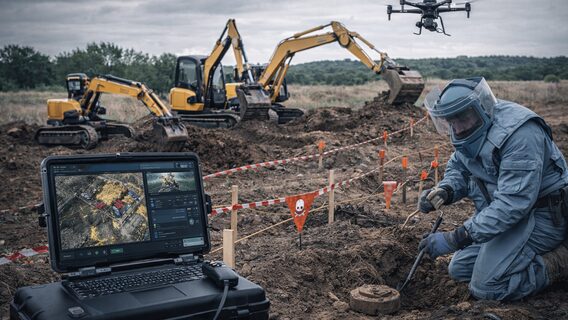
Despite the rapid development of AI, drones and robotic systems, humanitarian demining still faces an unexpectedly «analog» problem. The slowest and riskiest stage — signal excavation — is still in many cases performed manually. And this is where the greatest technological demand is concentrated today.
We understand why this happened, where exactly modern solutions «break» and how engineering teams can influence this.
Despite the rapid development of AI, drones and robotic systems, humanitarian demining still faces an unexpectedly «analog» problem. The slowest and riskiest stage — signal excavation — is still in many cases performed manually. And this is where the greatest technological demand is concentrated today.
We understand why this happened, where exactly modern solutions «break» and how engineering teams can influence this.
Why excavation is the main bottleneck
Signal excavation is the point at which, after a suspicious object has been discovered, it must be physically removed from the ground. And this is where the difficulties begin.
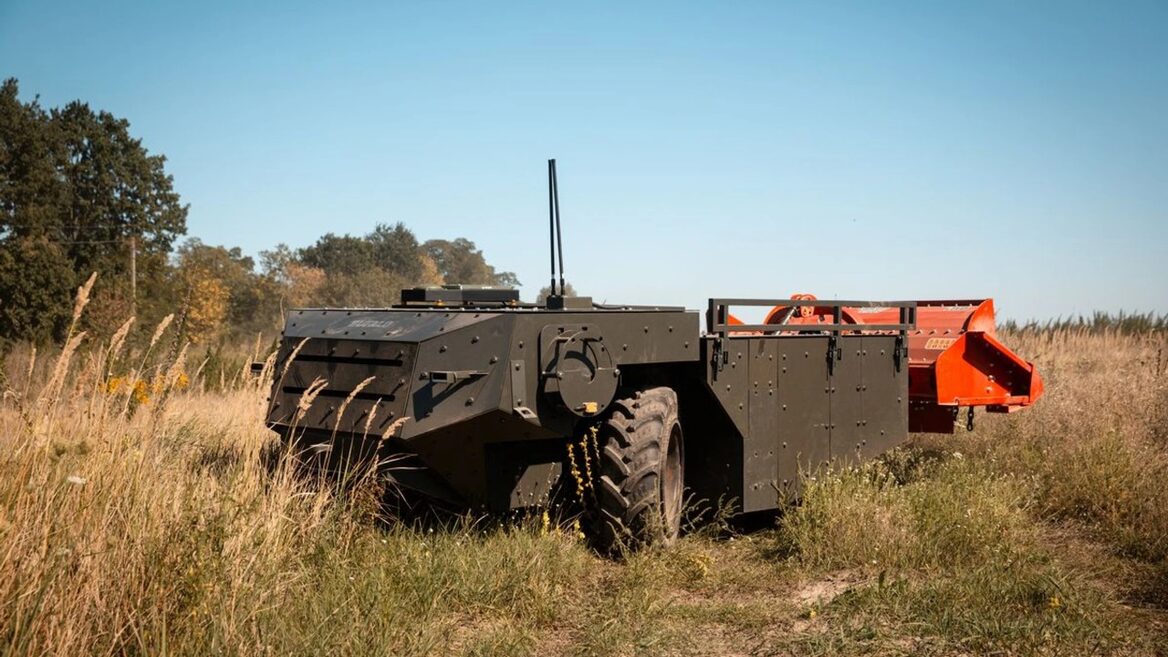
On the one hand, mechanization has been around for a long time: remotely controlled machines, mini-excavators, robotic platforms. In favorable conditions — flat terrain, low pollution density — they really speed up work and reduce risks. But the reality is much more complicated.
Ukrainian territories are a mixture of forest belts, slopes, overgrown areas, swampy areas, and fields with different soil structures. In such conditions, large machinery often simply cannot work or works inefficiently.
Another factor is added: the density of signals. In some areas, there are so many of them that the use of even light equipment becomes economically and logistically unprofitable. And then the sappers return to manual work.
And most critically, it’s accuracy. Modern mines can be extremely sensitive to pressure, vibration, or displacement. Any mistake and the risk of detonation increases dramatically. That’s why even where technology is available, the final stage is often still left to humans.
As a result, excavation can take up to 60–80% of the time of the entire demining operation.
What AI can already do, and where are its limits?
Today, technology is actively used in demining. AI and computer vision analyze data from drones, help find suspicious objects and build maps of contamination. Autonomous and semi-autonomous systems work at the stage of initial clearing of territories. But all these solutions stop before the last step. The problem is not that the technologies are «weak».
The problem is that the real user — the sapper in the field — works in conditions that are very far from laboratory conditions. Uneven ground, roots, moisture, dust, limited space, and constant risk.
In such conditions, even the most advanced systems often lose accuracy, become unstable, or simply inconvenient to use. Therefore, today’s technology limit looks like this: AI can find a mine, but cannot reliably and safely extract it.
Why lab solutions don’t work in the field
One of the key problems is the gap between prototype and real-world application. In the lab, everything is predictable: flat ground, one type of signal, no external factors. In the field, it’s chaos.
Solutions that look perfect on paper, in real conditions:
lose control over depth and effort,
work too aggressively or, conversely, slowly,
require complex logistics,
require additional resources for operator training,
or simply fail due to field conditions, including dust, moisture, and uneven terrain.
Another systemic problem is the lack of effective interaction with the end user. Without regular involvement of engineers at the development stage, solutions are created that do not work in the field.
Where is the greatest demand for innovation now?
If we generalize the global experience — from the Balkans to the Middle East — the «blank spot» is almost the same everywhere: accurate, safe and fast excavation of signals. Different countries have their own challenges — ruins in urban areas, mountainous terrain, old mines displaced in the soil. But the final stage almost everywhere remains manual.
In Ukraine, this problem is magnified by a combination of factors: large territories, diverse soils, high signal density, and a large number of types of ammunition. That is why the focus is shifting from «big machines» to compact, accurate, relatively inexpensive solutions that can work alongside humans, not instead of them.
How solutions are tested in real-world conditions
A key principle in overcoming the challenges of humanitarian demining is field testing from the very beginning. Testing takes place at special sites using inert mine models. All processes are under the control of specialists, with safety as a priority.
Efficiency is not measured «in theory,» but by specific parameters: speed of operation, positioning accuracy, control of soil removal, and stability in different types of environments. And this is where it often becomes clear that the solution needs to be radically redesigned.
How to solve the problem of demining: an opportunity for engineers
Ukrainian IT professionals can help accelerate and improve the efficiency of humanitarian demining. To select useful solutions, the Demine Ukraine platform launched the Minesight Innovation Challenge — an attempt to systematically solve the problem of excavation. This is an international engineering challenge that seeks applied solutions for excavation in humanitarian demining — not ideas «on paper», but those that can actually work in the field.
companies in the field of robotics, mechanical engineering, agricultural and construction technologies,
as well as teams from related fields who are ready to adapt their solutions for demining.
What participants receive:
funding for the creation of prototypes (two tranches of $50,000 each),
access to testing in real conditions in Ukraine,
mentoring from practitioners in the demining sector or field;
feedback from sappers and international experts,
the possibility of scaling and reaching real implementation.
The winner receives an additional $100,000 to bring the solution to a level suitable for field use. The key is not a hackathon or a «showcase of ideas.» It’s a pipeline from prototype to real-world application.
The main expected effect of the project is to speed up the slowest stage. Even if the processing time of one signal is reduced by half or three times, this scales to thousands of signals and significantly speeds up the entire demining process.
At the same time, the burden on sappers is decreasing and security is increasing. But only those solutions that do not create new problems — in logistics, training, or maintenance — will work. That is, the future lies not in the «magic button,» but in precise, reliable tools that can withstand Ukrainian realities.